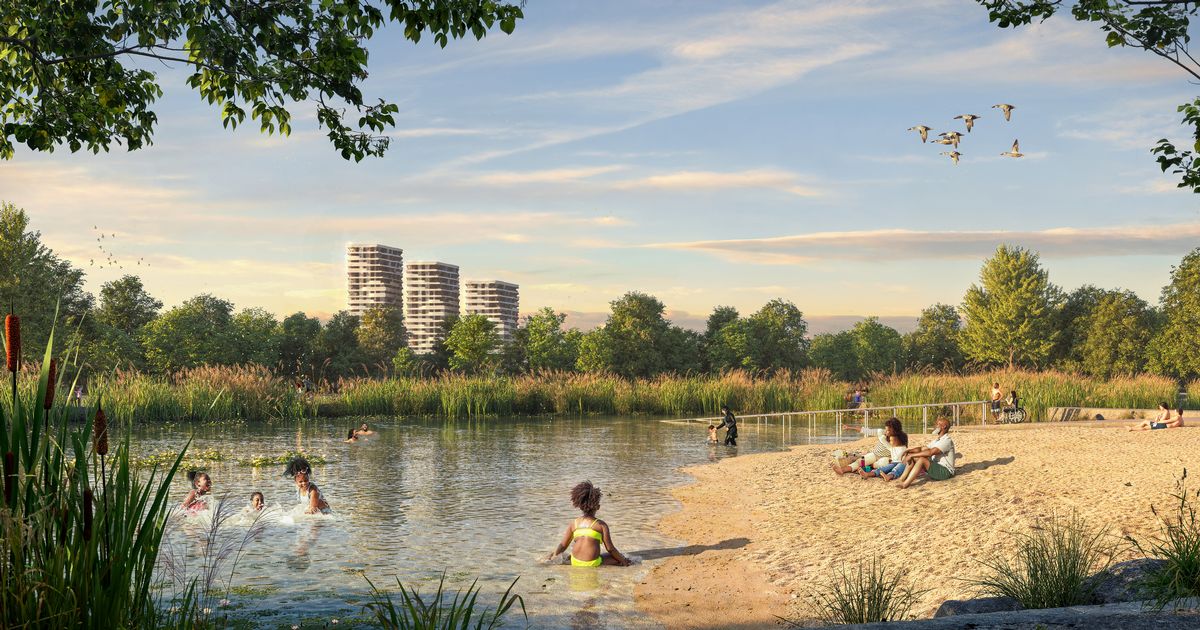
The wild swimming spot would facilitate up to 1,200 swimmers per day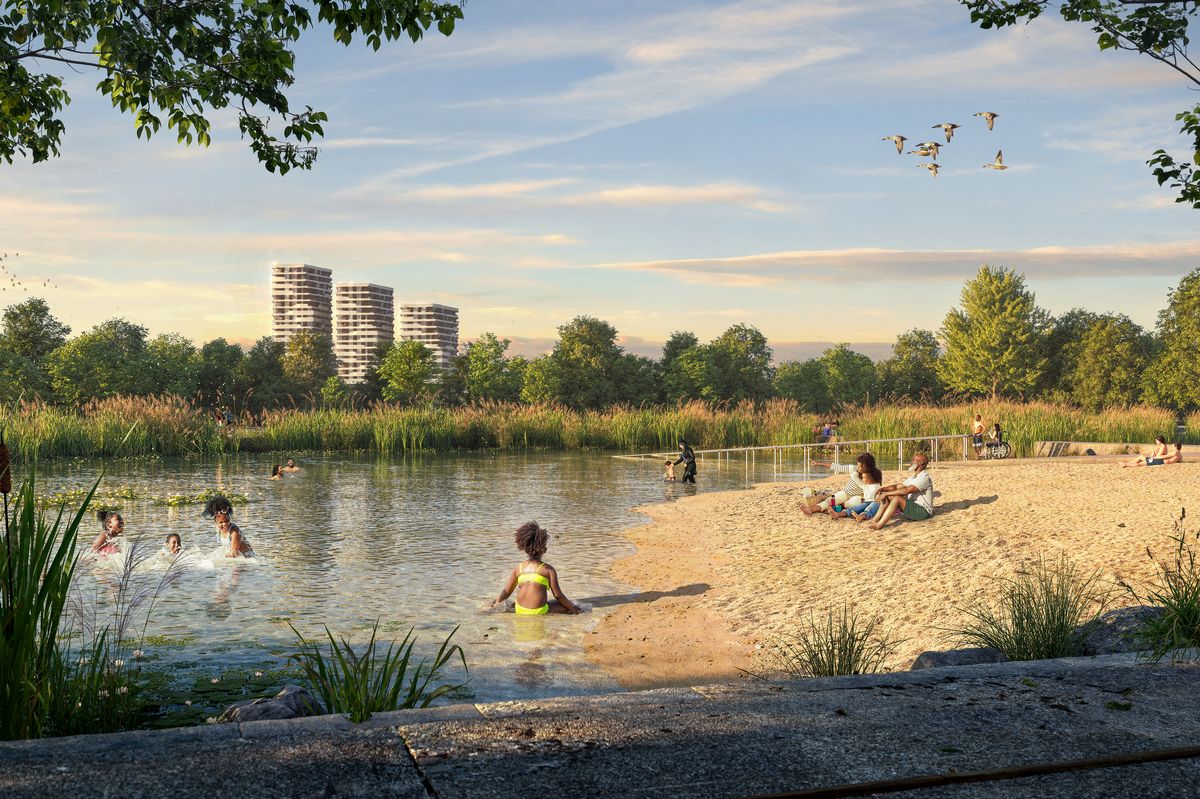 The plans involve creating a beach with enough space for nearly 100 people (Image: Chloe Mann)
A free wild swimming spot with a sandy beach could soon be arriving in Hackney. East London Water Works Park hopes to redevelop the old 14-acre Thames Water depot on Lea Bridge Road.
Illustrations show what these new wild swimming spot could look like if approved by Hackney Council. The plans show potential for 3,000 metres-squared of naturally filtered swimming space, as well as beach space for nearly 100 people. The area could facilitate up to 1,200 swimmers per day, say East London Water Works.
Current plans aim to make swimming sessions at the park totally free, says Nathan Miller, who is a director of East London Water Works. This would be funded by generating more electricity on the site than needed which could then be sold back to the grid. The pools would be filled with rainwater filtered clean by 5,300 square metres of reed beds.
 East London Water Works would also be home to a community garden and hub(Image: Shona Nectoux)
One of the pools would be more “family-oriented” with a wider beach and closer to the surrounding buildings. The second pool would be set further back and closer to nature for a more authentic wild swimming experience.
“My first thought was that I’d love something like this to exist for my kids rowing up and to have that locally for them,” Mr Miller told MyLondon.
He added: “There’s nothing like it in London yet. There are no free accessible swimming spaces so providing that is what the community want to experience. These kinds of projects let communities take back agency.”
The swimming space would only form part of the wild ponds, which total 8,3000 square metres in size. In comparison, London Fields Lido is 1,250 square metres big.
The park would also be home a walled garden, community hub, forest school and café. There would also be plenty of space for wildlife in the ponds, wildlife garden and wildflower meadow.
Reed beds, which can removed up to 90 percent of nitrogen from water, would form part for the filtration system. They also oxygenate water and trap sediment from runoff which leaves open water clearer and more accessible to wildlife.
Got a story? Please get in touch at katherine.gray@reachplc.com
Looking for more from MyLondon? Subscribe to our daily newsletters here for the latest and greatest updates from across London.