It’s been said that, when you die, your life flashes before your eyes.
While it has never been scientifically proven, one doctor’s shock discovery suggests it might not be pure fiction – and it has made him rethink everything he knows about death.
Dr Ajmal Zemmar and his team captured the first recording of a dying human brain – and, he told the Daily Mail, it suggested the organ was reliving memorable events rather than descending into immediate darkness.
The discovery stemmed from an unplanned case in Vancouver, Canada, during Dr Zemmar’s neurosurgery residency there in 2022.
An 87-year-old patient had undergone successful surgery for a subdural hematoma, or bleeding inside the head, but experienced subtle seizures on his final day in the hospital.
As standard procedure, an electroencephalography (EEG) was applied to the patient’s scalp using electrodes while he remained conversational. The device detects and amplifies brain waves, and neurological activity appears as wavy lines on the EEG recording.
Approximately 20 minutes into the test, however, the patient unexpectedly went into cardiac arrest and died.
The ongoing EEG captured what Dr Zemmar later realized was the first recording of a naturally occurring human death.

Dr Ajmal Zemmar and his team captured the first recording of a dying human brain, which suggested the organ was reliving memorable events

The discovery was made after a patient had undergone successful surgery for a subdural hematoma, or bleeding inside the head, but experienced subtle seizures on his final day in the hospital
While it recorded 900 seconds of the event, from before and after the man died, the most striking finding occurred 30 to 60 seconds after his heart stopped beating, as the brain continued to produce gamma waves.
Gamma brainwaves are the fastest frequencies associated with peak mental performance, including intense focus, heightened awareness, learning, memory and integrating complex information.
Dr Zemmar, now based in Louisville, Kentucky, explained that gamma waves are the same high-frequency brain oscillations also observed when living people recall or view highly memorable life events, such as the birth of a child, a wedding or a graduation.
‘We need to rethink death,’ said Dr Zemmar, adding that we can find comfort in knowing that when a loved one dies, they are no longer in pain, but instead revisiting meaningful moments from their life.
He also stressed that producing gamma waves requires high-level brain activity, not something that occurs accidentally.
‘It suggests that there’s some coordinated activity going on,’ he noted, adding that the discovery was a ‘paradigm shift’ from the Hollywood depiction of instant brain silence when the heart stops.
The pattern, according to Dr Zemmar, also provided the first neurophysiological evidence supporting reports from approximately 14,000 near-death experience survivors who consistently describe a life flashback during clinical death.
Until this recording, no scientific mechanism had explained those accounts.
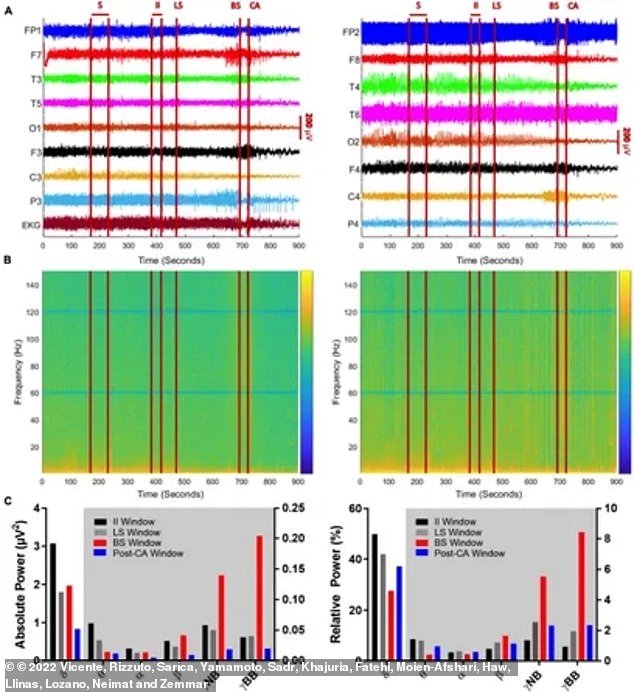
While it recorded 900 seconds of the event, from before and after the man died, the most striking finding occurred 30 to 60 seconds after his heart stopped beating, as the brain continued to produce gamma waves
Although initially cautious because the finding came from a single case, Dr Zemmar said two additional human cases identified by a separate research group at the University of Michigan have since confirmed the same gamma-wave surge.
In 2023 researchers found that two patients who were thought to be brain-dead experienced sudden bursts of activity after being taken off life support, the same gamma waves as Dr Zemmar had observed.
‘There are three cases in humans now,’ he said. ‘It’s not a lot, but it’s something, better than none.’
He also suggested that the brain could be biologically programmed to manage the transition into death, potentially orchestrating a series of physiological and neurological events rather than simply shutting off instantly.
Dr Zemmar, who once adhered strictly to provable science, now believes reducing uncertainty around death can comfort both the dying and the bereaved.
Drawing on teachings from Vietnamese Zen master Thich Nhat Hanh about the ‘seven bodies,’ he noted that only the physical body departs at death, while other dimensions – emotional influence, inspiration and guidance – remain.
‘The person who leaves us doesn’t stop interacting and influencing us,’ he said.
Ultimately, Dr Zemmar hopes the research helps humanity confront an inevitable experience with less fear.
‘Death affects every human,’ he concluded. ‘If we reimagine the way that death looks like and we try to find our comfort and our peace with that, I think those things may help humans to think about death in a different way.’