The Automatic Data Processing (ADP) Research Institute will release its monthly Employment Change Report for December on Wednesday. The ADP report is expected to show that the United States (US) economy created 47,000 jobs in the last month of 2025, to offset the 32.000 net employment loss seen in November.
The ADP report tends to attract interest because it precedes the key Nonfarm Payrolls report, released by the US Bureau of Labor Statistics (BLS), usually two days later. The correlation between these indicators is mostly poor, but deviations in the final reading of the ADP Employment Change normally have a significant impact on US Dollar crosses.
ADP Jobs Report: The US labour market and the Federal Reserve
December’s ADP report comes amid growing concerns about US labour market’s momentum and wide divergence among Federal Reserve (Fed) policymakers about the depth of the central bank’s monetary easing cycle.
The Fed cut its benchmark interest rate by a quarter point in December, but the minutes of the meeting revealed a deeply divided monetary policy committee. The weakening labour market revealed by the latest US employment releases, combined with a stubbornly high inflation, poses a serious challenge to the bank’s monetary policy-setting activity.
In this context, the bank’s interest rate projections, the so-called dot-plot, anticipate a unique rate cut in 2026. Futures markets, however, see at least two quarter-point cuts in the next 12 months, according to data released by the CME Group’s Fedwatch tool, and this week’s labour figures might be key to tipping the scales in one way or the other.
Minneapolis Fed President Neel Kashkari underscored this dilemma earlier this week. Kashkari assessed that monetary policy is close to neutral now, but warned that higher unemployment might force the Fed to lower borrowing costs deeper than forecast.
With most of the major central banks already at the end of their easing cycles, a weak US ADP in this scenario would deepen the monetary policy divergence with the Fed, and, highly likely, crush the US Dollar’s incipient recovery. A strong employment report, on the other hand, would ease concerns about the labour market and leave inflation as the Fed’s prevailing target. This outcome would have a positive impact on the US Dollar.
When will the ADP Report be released, and how could it affect the USD Index?
ADP will release the US Employment Change report on Wednesday at 13:15 GMT, and it is expected to show that the private sector added 47,000 new positions in December.
The US Dollar Index, which measures the value of the Greenback against a basket of majors, has opened the 2026 year on a strong note, but it remains near three-week lows after a 2.5% depreciation in December
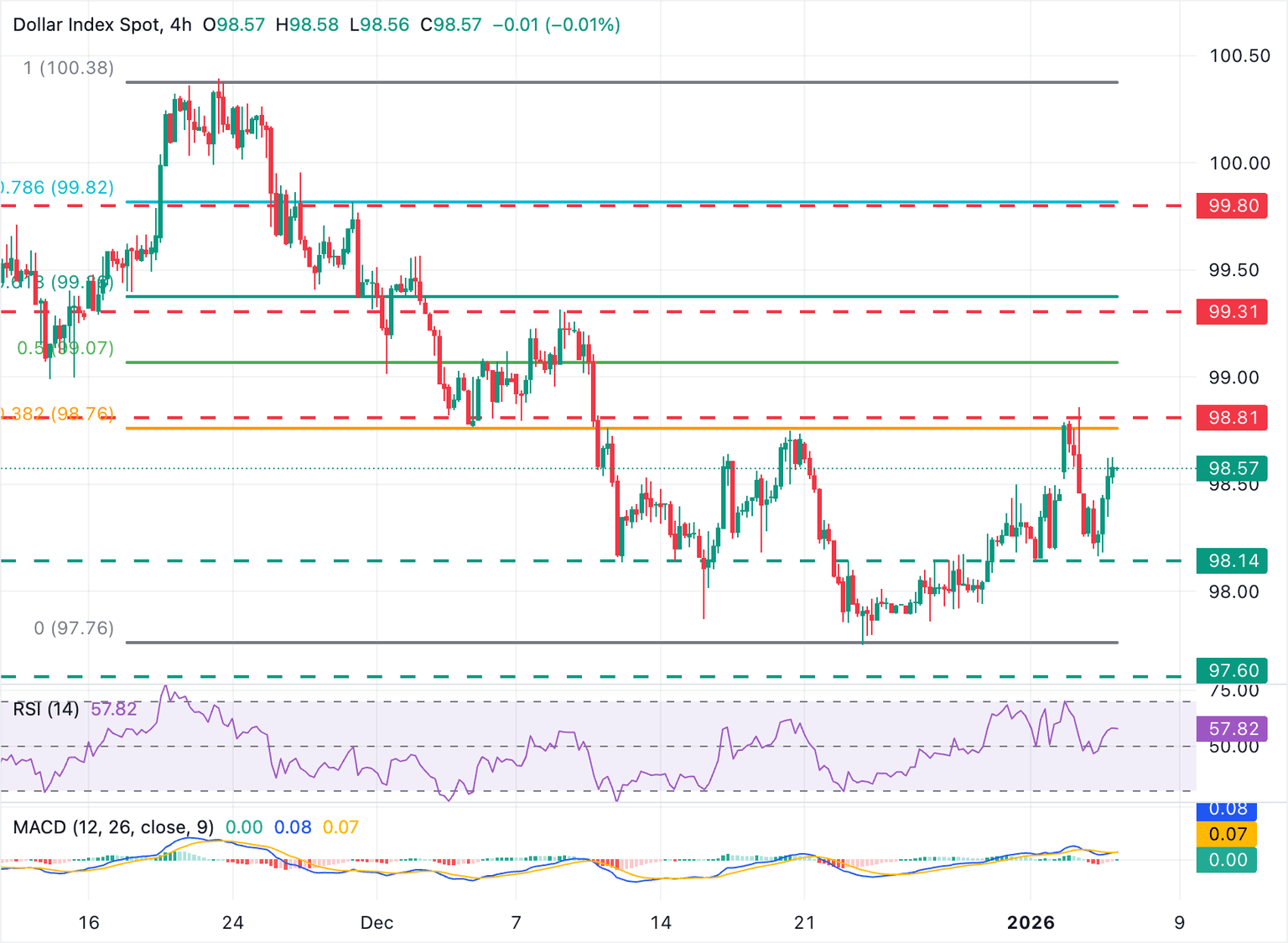 DXY 4-Hour Chart
From a technical perspective, Guillermo Alcala, Analyst at FXStreet, highlights the resistance area at 98.75 as a key level to confirm a trend shift: “The US Dollar Index is showing signs of a weakening bearish trend but the pair must break and hold above the December 19 low at 98.75 to aim to the early December and late November highs at the 99.30 and 99.80 areas respectively.”
“The US Dollar, however, is not out of the woods yet. Upside momentum remains frail, and weak US macroeconomic data might resurface investors’ concerns and push the pair below December’s bottom, at 97.75. In that case, the October 1 low, at 97.46, emerges as the next target”, says Alcala.
Fed FAQs
Monetary policy in the US is shaped by the Federal Reserve (Fed). The Fed has two mandates: to achieve price stability and foster full employment. Its primary tool to achieve these goals is by adjusting interest rates.
When prices are rising too quickly and inflation is above the Fed’s 2% target, it raises interest rates, increasing borrowing costs throughout the economy. This results in a stronger US Dollar (USD) as it makes the US a more attractive place for international investors to park their money.
When inflation falls below 2% or the Unemployment Rate is too high, the Fed may lower interest rates to encourage borrowing, which weighs on the Greenback.
The Federal Reserve (Fed) holds eight policy meetings a year, where the Federal Open Market Committee (FOMC) assesses economic conditions and makes monetary policy decisions.
The FOMC is attended by twelve Fed officials – the seven members of the Board of Governors, the president of the Federal Reserve Bank of New York, and four of the remaining eleven regional Reserve Bank presidents, who serve one-year terms on a rotating basis.
In extreme situations, the Federal Reserve may resort to a policy named Quantitative Easing (QE). QE is the process by which the Fed substantially increases the flow of credit in a stuck financial system.
It is a non-standard policy measure used during crises or when inflation is extremely low. It was the Fed’s weapon of choice during the Great Financial Crisis in 2008. It involves the Fed printing more Dollars and using them to buy high grade bonds from financial institutions. QE usually weakens the US Dollar.
Quantitative tightening (QT) is the reverse process of QE, whereby the Federal Reserve stops buying bonds from financial institutions and does not reinvest the principal from the bonds it holds maturing, to purchase new bonds. It is usually positive for the value of the US Dollar.
Economic Indicator
ADP Employment Change
The ADP Employment Change is a gauge of employment in the private sector released by the largest payroll processor in the US, Automatic Data Processing Inc. It measures the change in the number of people privately employed in the US. Generally speaking, a rise in the indicator has positive implications for consumer spending and is stimulative of economic growth. So a high reading is traditionally seen as bullish for the US Dollar (USD), while a low reading is seen as bearish.
Read more.
Next release:
Wed Jan 07, 2026 13:15
Frequency:
Monthly
Consensus:
47K
Previous:
-32K
Source:
ADP Research Institute