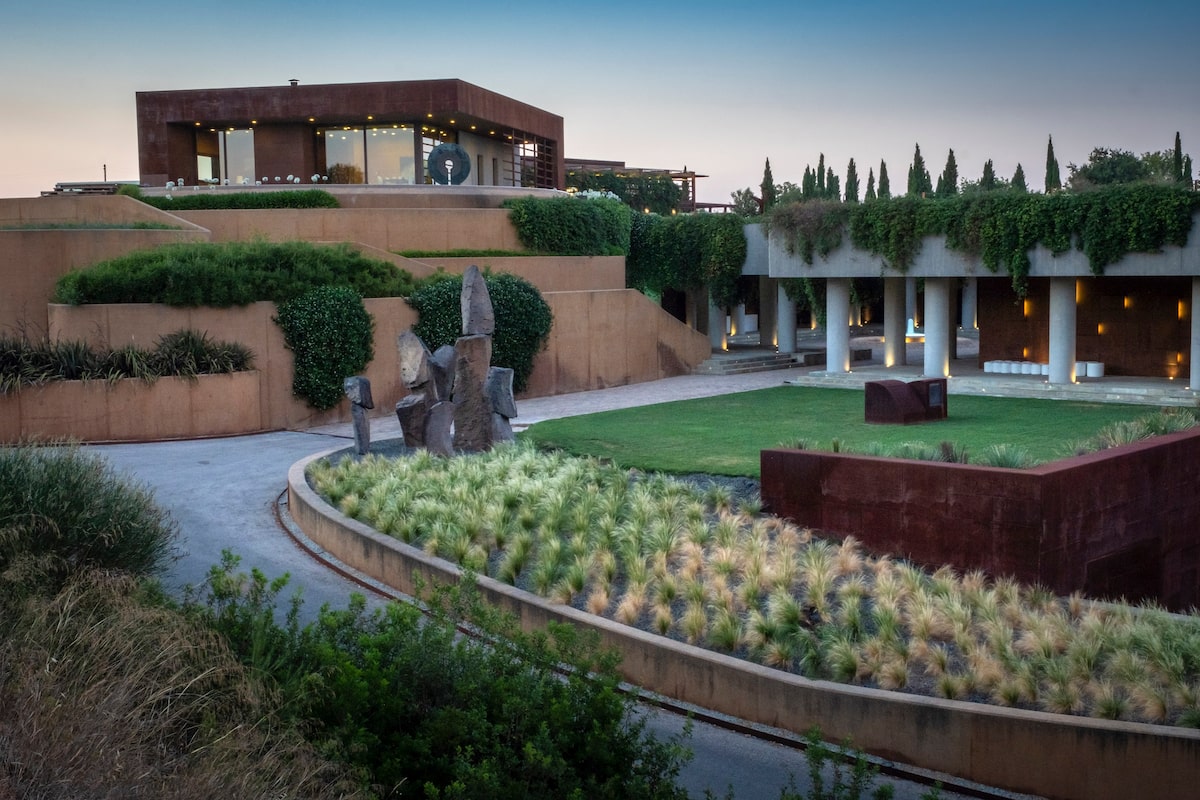
Designed in 2008, the Waltraud winery is an event and tasting space added to the larger Familia Torres facility in Penedes, about 45 minutes from Barcelona. It is named in honour of Waltraud Maczassek, the German artist and wife of Miguel A. Torres.Familia Torres/Supplied
Although wine is often seen as a traditional business, Spanish winemaker Miguel A. Torres turned his family’s company into a global leader by embracing new ideas and preparing for the future.
Fresh out of wine school in France, fourth-generation winemaker Torres introduced cabernet sauvignon and other French grape varieties into family vineyards in Penedes in 1966. A single-variety cabernet called Mas La Plana was introduced in 1970 to add a premium range to the company’s portfolio of blended wines, such as Sangre de Toro and Viña Sol.
Facing fears that the climate surrounding the company’s home base, near Barcelona, risk being too hot and dry to produce quality wine in 30 to 50 years, the Torres family has purchased land at higher elevations in the Pyrenees, including a parcel in Benabarre that’s considered too marginal to ripe many classic vinifera grape varieties at present.
Miguel A. Torres.Familia Torres/Supplied
“Appellation of origin, in my opinion, becomes secondary. The most important thing is to keep the quality of the wines,” Torres explained last month during a virtual interview.
In established vineyards near the company’s historic headquarters, workers are testing different canopy management systems, lower-density planting and shade nets to delay the ripening of the grapes. There isn’t one solution to the challenges of climate change, he says, but there are ways to adapt to the new situation.
The company owns more than 1,000 hectares of vineyards located in Catalonia, including sites in Penedes, Conca de Barbera, Priorat and Costers del Segre, and works with nearly 700 grape suppliers. The family’s wine operation has also extended beyond the region, with significant investments made in Rioja, Ribera del Duero, Rueda, Rias Baixas and Jumilla alongside international estates in Chile and California.
Torres, Familia Torres president since 1991, has embraced sustainability measures since watching Al Gore’s climate-change documentary, An Inconvenient Truth. Creating the Torres & Earth program in 2008, he challenged family and team to use renewable energy, optimize water resources, reduce bottle weight, recover ancient grape varieties that are resistant to high temperatures and drought, and find ways to capture, store and reuse CO2 to prevent emission into the atmosphere.
Regenerative viticulture practices at the Mas La Plana vineyard include agroforestry, cover crops, and grazing sheep to restore soil health, boost biodiversity, and combat climate change.Familia Torres/Supplied
The Torres family co-founded the International Wineries for Climate Action in 2019 with Jackson Family Wines, a California-based operation with estate-based wineries in California, Oregon, France, Italy and South Africa. (Members of the Jackson family own Unsworth and Blue Grouse wineries in the Cowichan Valley on the east coast of Vancouver Island.)
More than 170 international wineries, including Kelowna, B.C.-based CedarCreek, have joined the group working to mitigate climate impacts on vineyards and wineries and reduce greenhouse-gas emissions. Membership requires producers to share a third-party audited greenhouse-gas inventory as part of their pledge to reach zero emissions by 2050. Beyond offering winemakers a road map of effective climate-action changes, Torres believes participating family wineries and brands will promote their efforts, helping consumers understand how sustainable measures can have credible impact on the environment.
“Wine can be a symbol of resilience against climate change,” Torres says. “We like to have our vineyards and like to produce wine to make people happier.”
One of Torres’s long-standing white wine labels is recommended this week alongside three other notable Spanish labels that offer tremendous quality and value.
Campo Viejo Brut Cava (Spain), $17.95
Rating: 87
This pleasantly fruity and balanced sparkling wine is a brand extension from the popular Rioja-based Campo Viejo. It’s a classically made sparkling wine based on xarello, macabeo and parellada grapes that underwent secondary fermentation in the bottle. The mix of peach, pear and apple flavours with nutty notes make this more flavourful and refreshing than many similarly priced cavas. This has 11.5 per cent ABV and 12 g/litre r.s. Drink now. Available at the above price in Ontario, $16.99 in British Columbia, various prices in Alberta, $19.49 in Manitoba.
San Alejandro Las Rocas Garnacha 2022 (Spain), $19.95
Rating: 88
The grenache grape (a.k.a. garnacha) is responsible for many of Spain’s best value red wines. This ripe and concentrated expression comes from old bush vines cultivated in two vineyards in Calatayud in northeastern Spain. The juicy dark fruit, spice and cedar notes add to the appeal of this robust red that’s ready to drink. This has 15 per cent ABV and 3 g/litre r.s. Drink now to 2028. Available at the above price in Ontario, various prices in Alberta.
Valparaiso Roble 2023 (Spain), $17.95
Rating: 88
Made from 100-per-cent tempranillo grapes harvested from established (average vine age of 30 years) vineyards in Ribera de Duero, as suggested by the term “roble,” this was aged briefly in oak barrels (four months in a mix of French and American oak). The result is a vibrant and savoury red that makes the most of its core of plummy and cherry flavours. This has 14.5 per cent ABV and 2 g/litre r.s. Drink now to 2033. Available in Ontario.
Vina Esmeralda Mediterranean 2024 (Spain), $17.99
Rating: 88
This fragrant and crowd-pleasing blend of muscat and gewurztraminer has been produced by Torres since the 1970s. The style emphasizes the floral, white grape and citrus allure of the grape varieties as part of a light and fruity wine with a hint of sweetness. An enjoyable aperitif, this is a label whose allure increases with rising temperatures. This has 11.5 per cent and 9 g/litre r.s. Drink now. Available at the above price in British Columbia, various prices in Alberta, $16.50 in Manitoba, $15.55 in Quebec, $20.49 in Newfoundland.