(Credits: Far Out / Bent Rej)
Wed 7 January 2026 13:48, UK
The cohesion and chemistry seen onstage often create an illusion that shrouds many differences of opinion, tastes in music, political persuasion, and even friendship groups. Allegedly, the members of Led Zeppelin rarely mixed outside of band commitments, especially towards the end of their time together. Similarly, The Rolling Stones led very different lives to one another off-stage.
As a constantly reshuffling and evolving rock behemoth, The Rolling Stones maintained its longevity through the use of crucial hiatuses and a convergence of differing personalities. Although, at the core of the group, Mick Jagger and Keith Richards are the closest and oldest friends, even they have their differences. Richards was particularly upset with Jagger’s acceptance of a knighthood from the monarchy and kept his distance through most of the 1980s.
Additionally, the founding rhythm section, comprising Charlie Watts and Bill Wyman, seemed to operate at arm’s length from the central songwriting partnership. Capable as they were, Wyman and Watts were seven and two years older than Richards, the youngest member. Whether age was a factor or not, the drummer and bassist only dipped their toes into the riotous rock and roll lifestyle of drugs and debauchery.
Further to his social distance from Jagger and Richards’ hard-partying lifestyle throughout much of the Stones’ time together, Watts was curiously never much of a rock ‘n’ roll fan. As the longest-serving percussionist of the biggest rock band of all time, the irony was indeed not wasted on the late legend.
When asking someone to name their favourite drummer of all time, you will often receive a couple of responses: one from rock ‘n’ roll and another from jazz. This is because jazz percussionists are in a league of their own, often embracing unconventional time signatures that befuddle the humble rocker. Unless, of course, your name is Ginger Baker or Mitch Mitchell.
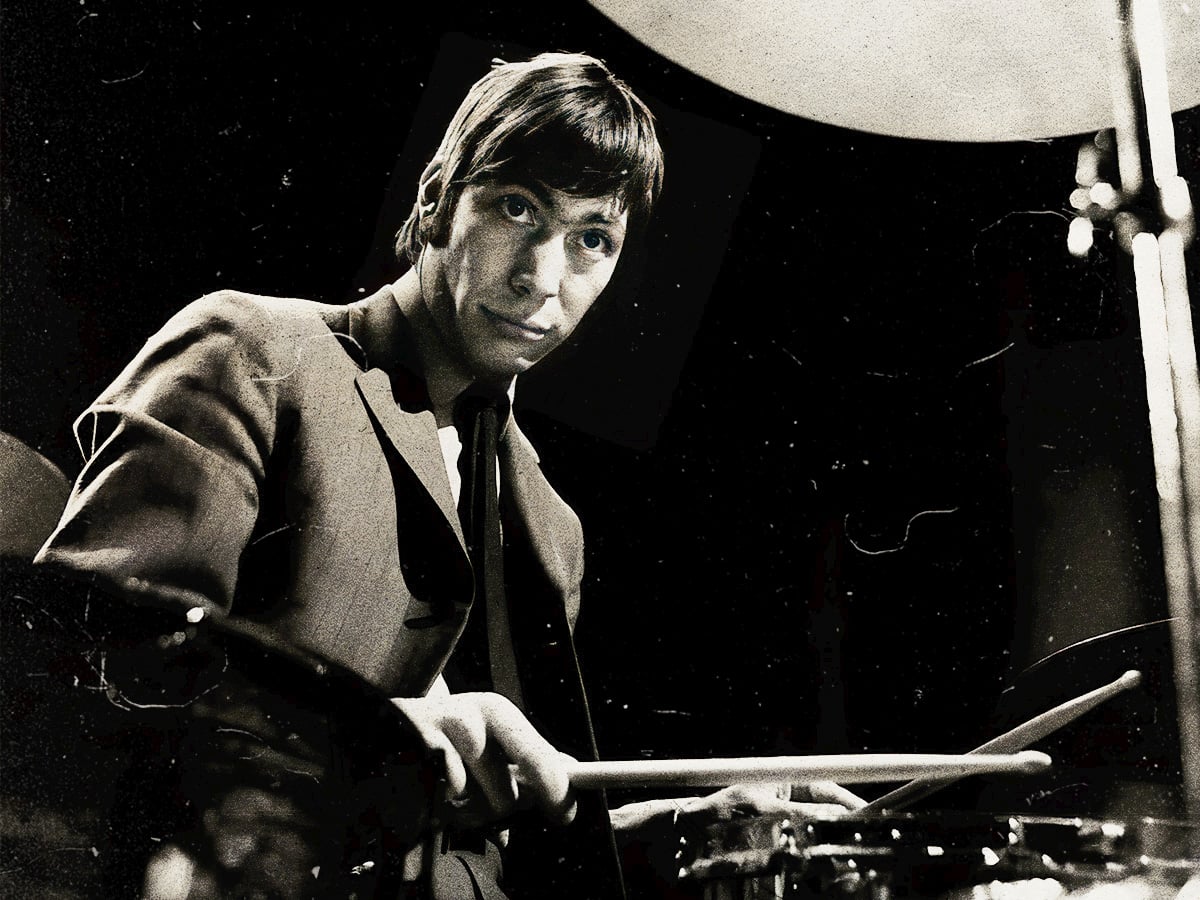
 Charlie Watts deep in thought. (Credits: Far Out / Bent Rej)
As a drumming savant, Watts was more interested in his role within the band than the band’s finished product. Even before he joined The Rolling Stones in 1963, he was a jazz aficionado. His heroes were players like Buddy Rich, Charlie Parker and Max Roach. “I never liked Elvis until I met Keith Richards,” Watts told Mojo in 1994. “The only rock’ n’ roll player I ever liked when I was young was Fats Domino.”
One of Watts’ formative musical experiences was going to see Miles Davis live in the 1950s. Undoubtedly, he was impressed by the legendary trumpeter, but as far as Watts was concerned, drummer Tony Williams stole the show. “He was so unlike anybody else,” Watts said in a 2013 interview with Rolling Stone. The interviewer suggested that Williams had shared he was opened up to the world by the work of Keith Moon, which shocked Watts.
For Watts, the two drummers were worlds away. Jazz drumming was something that required refinement and technique, whereas what Moon produced certainly needed talent, but was built on raw energy and magnetism; the two landscapes barely met across a sea.
Later in the interview, Watts seemed somewhat surprised that Williams once described Keith Moon’s drumming as “beautiful and totally free”. However, that wasn’t his only side. He explained, “But he could be a difficult guy, really. Actually, there wasn’t only one of him. He was more like three people in one. He used to live here in Los Angeles for a while, in some of his madder days. God, I remember being here once with him when he tried to turn me on to chocolate ants; he was walking about with tins of chocolate ants. That’s what I mean. He was not your regular guy, in that way, but he was, in his heart, a nice guy. I always got on well with him.”
Of course, Moon’s work with The Who was highly regarded in the rock ‘n’ roll sphere, and Watts respected him as a player and acquaintance. However, few jazz drummers, let alone rock percussionists, could compete with Williams. Tragically, Williams passed away in 1997, aged just 51. He is now remembered as one of the greatest and most unique drummers of the 20th century.
Related Topics