REFORMS to the council tax system in Scotland could see two thirds of households in Edinburgh move up at least one council tax bracket, compared to 24% Scotland-wide.
The Scottish Government last year launched a report and consultation into possible changes to the council tax system, which has been described as “outdated” and “regressive”.
This would likely mean that property valuations, which were set in 1991, before council tax regulations came into force, would be updated to modern valuations.
A council response to the Scottish Government’s consultation, citing analysis by the Institute for Fiscal Studies (IFS), said that almost two-thirds of properties in Edinburgh would jump up at least one council tax band.
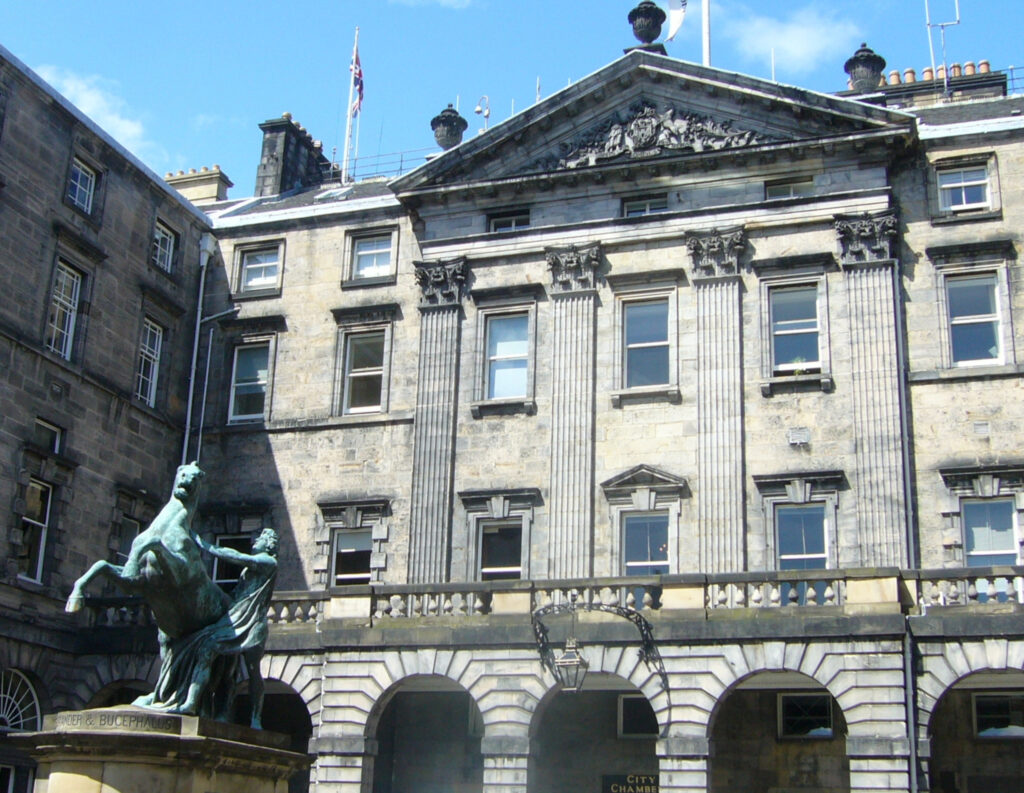
 Edinburgh Council’s tax decisions are made at Edinburgh’s City Chambers (pictured above) (C) Kim Traynor
The consultation, run jointly by the Scottish Government and COSLA, the umbrella organisation for Scottish councils, has seen local authorities and people in Scotland give their views on how changes should take shape.
This process is attempting to identify how best to structure changes, with options including the complete elimination of council tax on the table.
The government could, alternatively, choose to keep the existing band system for council tax but update it with modern property values.
Another option is to introduce new, progressive council tax bands and change the way they are applied.
The consultation also sought views on whether these bands should be set nationally or locally, making them reflective of local housing markets, with fewer band jumps in high-price areas.
Also being considered are “deferral schemes”, which would allow “asset-rich, income-poor” households to defer payment of increased council tax liabilities until property sale or transfer, with associated eligibility criteria.
Local authorities have now began publishing their responses to council tax changes.
The City of Edinburgh Council, in its response, prepared for next week’s Finance and Resources Committee, pointed out some of the issues with revaluation.
The report, prepared by council officers, states: “Independent analysis produced by the Institute for Fiscal Studies (IFS) indicates that, due to relative growth in house values since 1992 , even under a pure revaluation, almost two-thirds of properties in Edinburgh would be expected to go up at least one council tax band, compared to 24% for Scotland as a whole.
“In contrast, only around 5% of properties would go down one or more bands in Edinburgh, compared to 26% for Scotland as a whole.
“The percentage of properties seeing an increase in council tax liability would rise further if a more progressive national model were adopted.
“The additional income raised from these changes would, however, be offset by a corresponding reduction in general revenue funding, such that the overall level of funding available to the council would remain unchanged.”
 Shona Robison has been Cabinet Secretary for Finance and Local Government since 2023 and wants to “examine ways to make Council Tax fairer” together with partners (C) Scottish Government
Edinburgh’s property valuations, proportionally to the rest of Scotland, have skyrocketed since 1991.
A report prepared for the Scottish Government’s council tax inquiry into property valuations showed that Edinburgh now has the highest mean property value in the country.
Edinburgh’s property valuations have increased by 448% since the early 1990s, while property valuations in East Lothian, which topped the list, rose a staggering 500%.
A Scottish Government spokesperson today said: “The aim of this work is to examine whether consensus around a unified position on council tax could be achieved – rather than advocating for a specific reform.
“Ministers have been clear that any future changes to council tax must be informed by robust evidence and wide public debate.
“As part of our joint programme of engagement with COSLA, we are seeking views on these matters.”
Cabinet Secretary for Finance and Local Government has previously said: ““By working closely with local authorities and listening to the public, we will be seeking a consensus on a local taxation system that is fairer, financially sustainable and fits a modern Scotland.”
Council tax rates are ultimately decided upon by the local authority, but the bands and council tax rates are generally consistent across Scotland.
Increases to council tax were frozen in 2024/25 due to the pressures the tax hikes were putting on lower-income people in Scotland, and the government now views reform as essential.
Under the current rules, a home in band A valued at £24,000 (in 1991) would pay council tax equivalent to 3.96% of the property value, where as a band H house worth £240,000 would pay a rate of 1.45%.
Related