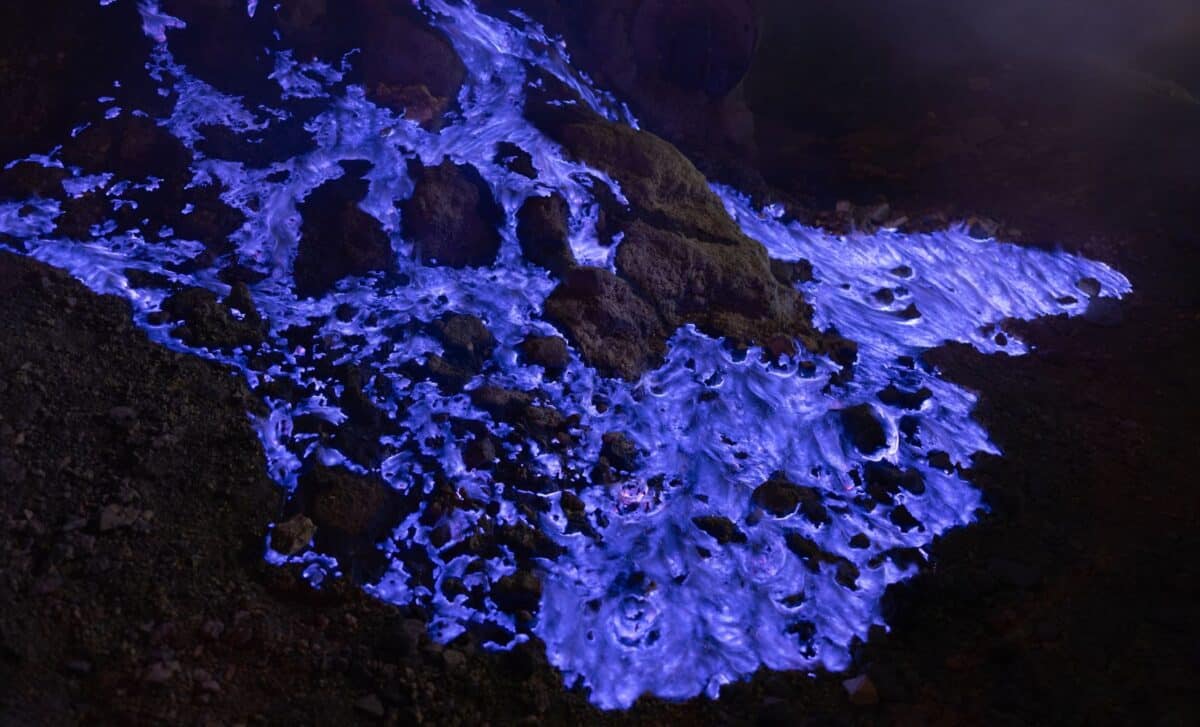
At Indonesia’s Kawah Ijen volcano, a breathtaking blue glow emerges at night, setting it apart from most volcanoes where lava burns in shades of red. At Kawah Ijen, however, the molten sulfur flows with an electric blue intensity, creating a stunning and otherworldly sight.
This captivating blue phenomenon has earned the volcano global fame, drawing the attention of both scientists and photographers alike. But there’s more to this glowing display than its striking appearance. Unlike typical lava, the blue flames at Kawah Ijen don’t behave like molten rock, adding to the mystery of this natural wonder.
Why Are Some Flames Blue?
When you think of lava, you likely envision glowing red molten rock, the result of intense heat. However, the blue flames at Kawah Ijen aren’t caused by lava at all. According to ZME Science, the blue glow results from the combustion of sulfuric gases. These gases emerge from cracks in the crater at temperatures exceeding 600 °C (1,112 °F). When the sulfur reacts with oxygen in the air, it burns with an intense blue flame.
The high temperature of these sulfuric gases is what causes the flames to glow, not the molten rock itself. This blue flame burns bright, creating the illusion of “blue lava.” However, it’s not the lava itself that’s blue; it’s the burning sulfur that causes this eerie, neon-colored phenomenon.
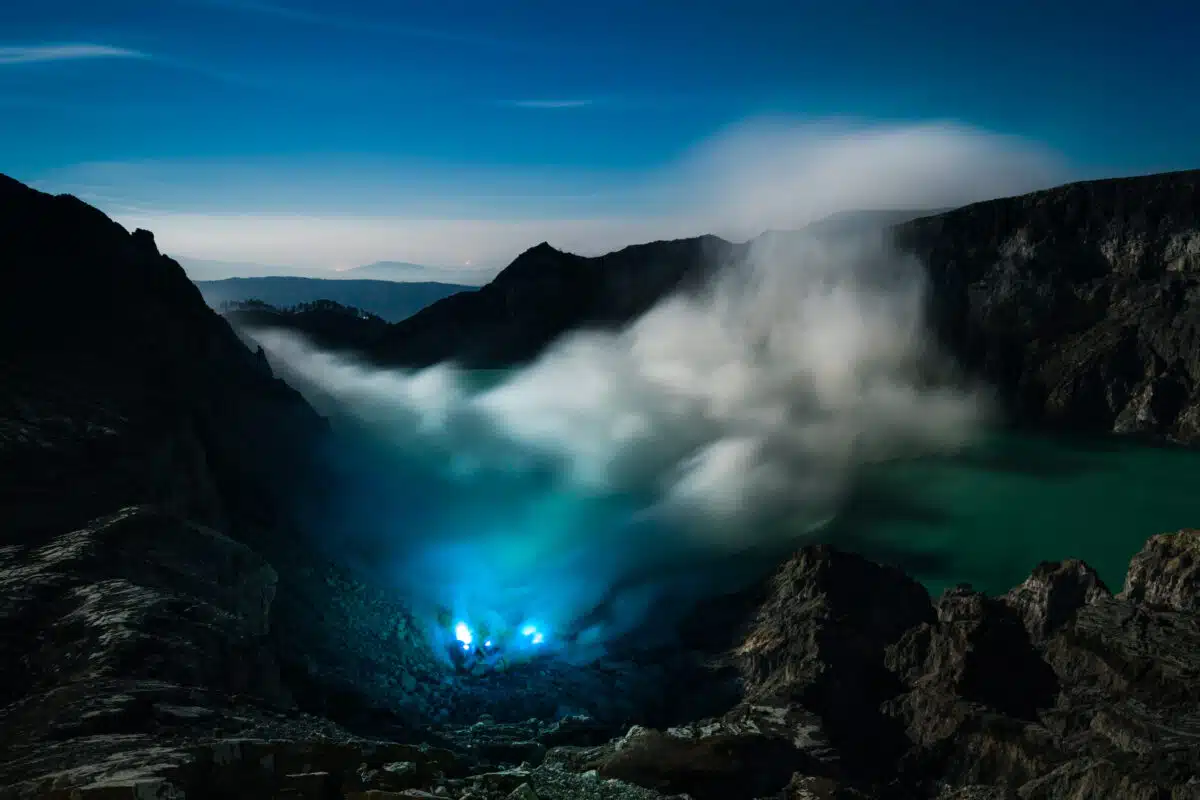 The blue glow of sulfur flames at Kawah Ijen volcano, set against the misty crater lake. Credit: Shutterstock
Liquid Sulfur and the “River of Fire”
The blue flames are not the only spectacle at Kawah Ijen. As the sulfur burns, it condenses into a liquid form, which then flows down the steep slopes of the volcano. This burning liquid sulfur resembles the flow of lava, further adding to the illusion of “blue lava.” The phenomenon is known as a Cerulean eruption, and it’s one of the rarest volcanic phenomena in the world. While other locations, such as Ethiopia’s Danakil Depression, experience similar eruptions, Kawah Ijen is one of the most well-known sites for this incredible display.
The flowing sulfur creates an incredible sight, as it moves down the volcanic terrain in streams of blue fire. This liquid sulfur, burning with a bright blue flame, mimics the movements of traditional lava rivers, adding an otherworldly quality to the entire scene. For photographers like Thomas Fuhrmann, who captured the phenomenon in 2018, the scene is a surreal experience that feels almost like science fiction come to life.
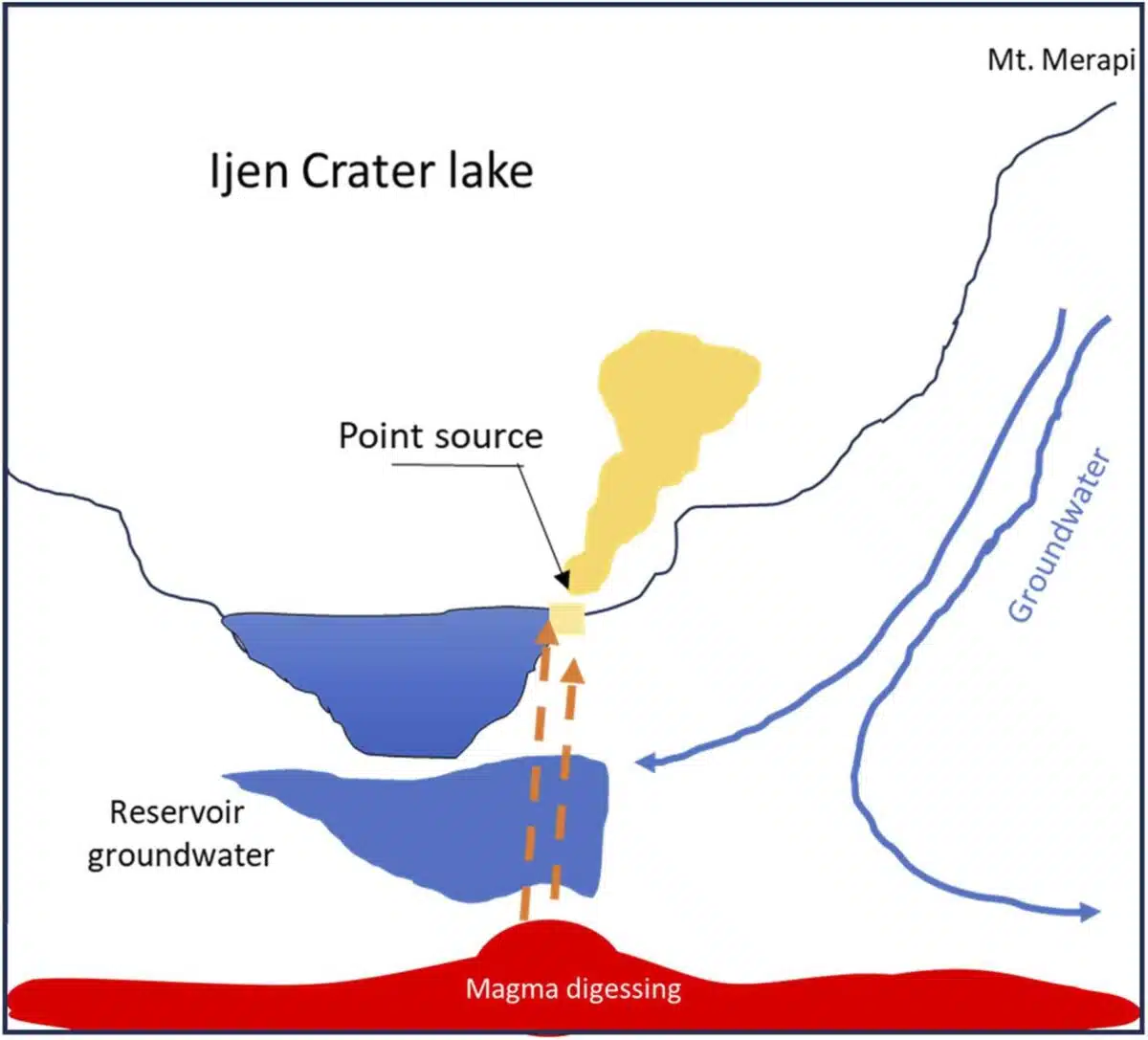 Diagram of Ijen Crater Lake, showing the interaction between magma, groundwater, and the source of the blue flames. Credit: Toxicology Reports
The Smelly, Risky Business of Mining Sulfur
The blue flames may be captivating, but they also highlight a dangerous reality. Local miners work in harsh, toxic conditions to extract sulfur from the crater. As stated in a study published in Toxicology Reports, miners often use little more than damp cloths to shield themselves from the thick smoke and sulfur fumes. They collect the solidified sulfur after the flames subside and carry baskets of the yellow mineral up the steep, hazardous slopes of the volcano, risking their health and safety every day.
The sulfur they collect, known as “Devil’s Gold,” is used in industrial processes like making fertilizers and other chemical products. Despite the risks, the miners continue working in these dangerous conditions, often without proper protective gear.