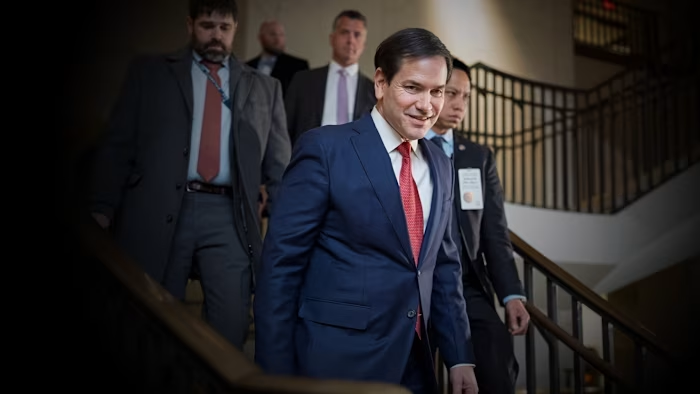
On a podcast hosted by Donald Trump Jr last year, Marco Rubio ridiculed the Biden administration for making “stupid” concessions to Venezuela’s brutal regime.
The Democratic president had offered dictator Nicolás Maduro sanctions relief and oil exports — including a “side deal” with Chevron to let it keep producing in Venezuela — in exchange for the promise of reforms that never came.
Biden’s team should have stopped “allowing them to get money”, the secretary of state said. “But they didn’t.”
Six months on, Rubio is the public face of the most aggressive action any US leader this century has taken on Venezuela, culminating last Saturday in a daring night-time military raid to remove Maduro from power.
With Rubio as his adviser, Trump abandoned the early negotiation tactics pushed by an envoy, Richard Grenell, and set aside — at least temporarily — the administration’s stated antipathy towards military interventionism and nation building.
But while Maduro’s ousting marked a win for Rubio — the son of Cuban immigrants who has spent his career warning of Latin America’s communist regimes — it has left him with a unique level of public responsibility for what comes next.
It is unclear how much Rubio, who harbours his own presidential ambitions, will be able to control.
“I think there’s a chance that he pulls this off,” said Juan Gonzalez, a former Biden and Obama administration official who worked on Latin America. “There’s a greater chance that this goes sideways and it blows up in Rubio’s face.”
In the initial hours after Maduro’s dramatic capture, it certainly seemed like Trump’s secretary of state was in the driver’s seat. The US president proclaimed that Rubio, together with defence secretary Pete Hegseth, would “run” the South American country, giving him the chance to reshape the region as he had dreamt of doing for decades.
“We’re going to run everything. We’re going to fix it,” Trump declared in the aftermath of the operation.
The administration quickly backed away from those claims. Rubio — formerly a champion for Latin American democracy and human rights in the Senate — has had to defend it.
“They’ve given Rubio more or less what he wants in the form of a scalp. They’ve given him Maduro,” said a person familiar with the administration’s thinking on Venezuela.
But Trump dismissed the Venezuelan opposition leader Maria Corina Machado — whom Rubio had called among “the bravest people in the world” — as a viable contender to govern Caracas. Instead, he left Maduro’s vice-president, Delcy Rodríguez, serving in his place. And within days the regime had cracked down on suspected pro-US traitors.
 Rubio, left, speaks to the press at Mar-a-Lago following the US’s actions in Venezuela © Jim Watson/AFP/Getty Images
“If you saw Rubio’s public embrace of Maria Corina, and if you saw the administration’s rhetoric surrounding Maduro’s repression and brutality, you’d be surprised to see that they landed in a place where they’re continuing that same oppression and brutality,” the person said.
Rubio has instead tried to manage expectations. In media interviews a day after Maduro’s capture, he declared that Washington would run “policy” in Venezuela rather than the country itself.
The administration’s main goals now in Venezuela are primarily to gain control over its natural resources, including oil; end official ties to drug traffickers; secure Venezuela’s co-operation in receiving deportees; and end Caracas’s partnerships with US adversaries such as Russia, China and Iran.
“There is a process now in place, where we have tremendous control and leverage over what those interim authorities are doing and are able to do. But obviously this will be a process of transition. In the end, it will be up to the Venezuelan people to transform their country,” Rubio said.
Trump on Wednesday said his administration had struck deals with the regime. Venezuela would now be “purchasing ONLY American Made Products”, he wrote on social media, and it would sell the US billions of barrels of its oil — for which the White House said it would loosen sanctions.
But the Trump administration has put democratic aims, including new elections, on the back burner. Rubio, while working to please Trump, is also aware that former constituents — including Cuban and Venezuelan Americans — have expectations of a man who recently charged that the Venezuelan regime could not be trusted.
“I don’t think Marco Rubio wants to return to Miami in three years saying that he tried his best,” said Carlos Curbelo, a fellow Cuban American and former Republican congressman from Miami. “It is very clear to me that Marco Rubio wants to be the change agent in the Americas.”
Rubio was not always so loyal. He ran against Trump in the Republican primary race in 2016, calling him a “con artist”. But as a cabinet secretary, Rubio has worked hard to ingratiate himself.
“Everyone loves working with him,” White House press secretary Karoline Leavitt said on Wednesday.
If Rubio makes another run for the White House, however, Venezuela could be decisive.
The administration’s Venezuela gamble will have failed if by the end of Trump’s presidency “the same heads of the military who have embraced and weaponised corruption and narco-trafficking” were still in control, said Andrés Martínez-Fernández of the rightwing Heritage Foundation.
Fernandez thinks highly of Rubio and the Trump administration. But Maduro’s “is a regime that has learned to wait out challenges”, he said.
Republicans on Capitol Hill say their former colleague is the right person for the job.
“The president knows that he’s got the right guy in the right place, and Marco knows this region better than anyone,” said James Risch, the Republican chair of the foreign relations committee, on which he worked closely with Rubio for years.
 Venezuelans in Miami rally after the US’s capture of Maduro © Cristobal Herrera-Ulkashkevich/EPA/Shutterstock
The secretary of state is not the only top Trump lieutenant working on Venezuela. Homeland security adviser Stephen Miller has focused on the country as a source of unwanted migration to the US. Vice-president JD Vance, a more sceptical voice about American interventionism, has also been involved.
It was Rubio who led a White House meeting of top officials in mid-December to “settle on, sequence and plan the operation, including the decision to implement an economic quarantine that employed US vessels to interdict sanctioned Venezuelan oil shipments”, said a person familiar with the operation.
In late December, Vance “back-channelled” talks with Qatar to see if Maduro would accept any “off-ramps” the US was offering, the person said. When that failed, Trump, Vance and Rubio became convinced that Maduro was not the “credible interlocutor” they needed in Venezuela, the person added.
“Rubio’s key contribution is in getting Trump to recognise that Maduro was never going to negotiate in good faith,” said Carrie Filipetti, former deputy assistant secretary for Cuba and Venezuela during Trump’s first term.
In recent days, Rubio — a fluent Spanish speaker — has been the primary link between Trump and Rodriguez. The new Venezuelan leader appears to have chosen a path for now of co-operation rather than resistance towards Washington, including openness to a deal on oil exports.
Regional experts and Democrats are wary.
Recommended

Rodriguez was “totally unreliable and is corrupt and hates America”, Chuck Schumer, the top Democrat in the Senate, said on Wednesday after his second briefing by Rubio in as many days. “That’s what we’re relying on? What kind of a plan is this?”
If her tune changes, it could spell trouble for the secretary of state, suggested Benjamin Gedan, a fellow at the Johns Hopkins Latin America Studies Initiative.
“There is the possibility that Delcy Rodríguez just starts showing a lot of independence that embarrasses Trump and that he turns to Rubio and says ‘wait, I thought you were controlling her’,” he said.
Additional reporting by Michael Stott in Bogotá, Lauren Fedor in Washington and Myles McCormick in Miami