Why is Venezuela’s oil production in decline?published at 11:54 GMT
11:54 GMT
 Phil Leake
BBC Verify data journalist
Venezuela has produced relatively little oil in recent years despite holding the largest known oil reserves in the world.
According to data from the Organization of the Petroleum Exporting Countries (OPEC), Venezuela is home to 303 billion barrels of proven crude oil reserves, almost a fifth of the world total.
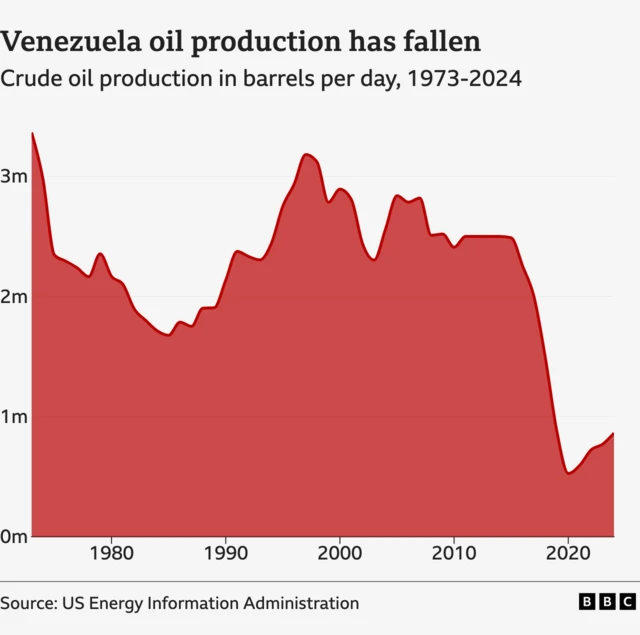
But separate figures from the US Energy Information Administration show that it produced around 860,000 barrels of crude oil per day on average in 2024, just 1% of global output.
Venezuelan oil production was above 3 million barrels per day in the late 1990s and stood at 2.5 million per day as recently as 2014.
The drop in the last decade is due to a number of factors including a lack of investment, extraction difficulties and economic sanctions.
Several US oil companies left Venezuela after President Hugo Chavez exerted more state control over their assets in 2007, which led to a loss of investment, infrastructure and technical support in the industry.
Venezuela’s oil is mostly heavy crude which requires extra processing compared with oil produced in other parts of the world.
The country was also hit with sanctions imposed by US President Donald Trump in 2019, during his first term.