Standing across the kitchen from my husband, James, I saw the distress on his face and silently told myself to stay strong and stick to the plan. I felt a pang of guilt, because a part of me still loved him. But that didn’t negate my certainty that our 27-year marriage was over.
That morning I had signed a 12-month lease on a flat and would, I insisted, start moving my things over there in the coming days.
I was absolutely clear; there was no going back. James listened, dumbfounded.
‘I don’t understand,’ he said. ‘Where has this come from?’
‘From almost three decades of your love affair with alcohol taking precedence over me, our boys and the life we could have had together,’ I replied, my voice shaking with anger.
‘But I’ve stopped drinking,’ James, 57, exclaimed, looking at me now as though I’d lost my mind. ‘I haven’t touched a drop in almost a year.’
True, he had stopped. In fact, his ‘soberversary’ was coming up – a full year of sobriety – and our sons, Adam, now 24, and Elliot, 22, were asking how we were going to celebrate.
And it was at that point I knew there was no way I’d be marking this ‘joyful’ occasion – I was done with the relationship. After putting up with his drunkenness for so long – and the rows, the ruined holidays and even the infidelity that came with it – I was finally walking away.

Marian Trevlin says even her two sons are shocked that she is finally leaving her husband now (picture posed by models)
I know that might sound confusing, especially if you haven’t, like me, lived with someone who lets alcohol run their life, and yours.
Even the boys are shocked that I’m leaving their dad now, when he’s finally sober.
They grew up with his drinking, but I shielded them from what it did to me – the anxiety, the loneliness, the grinding responsibility of being the only sober parent almost every evening, weekend and social situation.
You might well wonder why, if I endured so much, I didn’t leave him sooner, when he was in the thick of alcoholism.
For years, I’d convinced myself that it wasn’t his fault; that eventually he would see how he was hurting me and stop.
But when he finally did quit, he didn’t do it for me but purely for self-serving reasons. I could see, finally, that he was never in the grip of a disease, but just a deeply selfish man.
James was a high-functioning drinker, who, I now realise, always had the ability to control his intake but chose not to – when the person suffering wasn’t him.
It was only a health scare, affecting him and him alone, that made him go sober.
James wasn’t what most people see as a classic problem drinker. A successful marketing manager, admired by colleagues who only ever saw the best of him, James could keep it together at work dinners and in front of clients.
He wasn’t a violent or aggressive drunk, either. It was more that he embarrassed himself (and me) when we went out together, while at home he’d pass out on the sofa most evenings.
By the time the boys were in bed, my choices were bleak: sit next to someone getting quietly sloshed, who wouldn’t remember our conversations the next day, or go to bed alone.
He’d be grumpy in the morning until the painkillers kicked in. He’d go to work, come home cheerful for an hour, then the cycle would start again.
We’d met in our late 20s through mutual friends, me a teacher and him a copy writer for an advertising agency.
Back then, I liked that he was a drinker; I enjoyed a tipple myself and he was fun to drink with. Once I became pregnant, I stopped drinking completely. And while I didn’t expect James to do the same, I assumed he’d at least cut back.
It wasn’t until I was eight-and-a-half months pregnant with Adam, uncomfortable and scared about giving birth, that I first recognised just how big a problem James’s drinking was.
I’d wanted support and reassurance, but instead he arrived home from the pub one Friday evening completely plastered and crashed out fully clothed on the sofa.
The next morning, I snapped. I told him if he didn’t stop drinking now, he could miss the birth and that I’d never forgive him if that happened.
He stayed dry until after the baby was born, but it was tactical – the start of a pattern of him reining it in when the stakes were high, then drinking again once the threat had passed.
Even with a newborn baby in the house, he’d go to the pub most evenings after work, then top up on beer and wine when he got home. At the weekends, he’d disappear to a local bar during the afternoon; even on trips with the boys he’d find a way to work a pub lunch into the day.
Five years later, when the boys were aged four and two, came the biggest betrayal.
He came back from a work trip distracted and short-tempered. He wasn’t interested in talking to me or having sex. I kept asking what I’d done wrong.
A week later, with the boys asleep and me crouched on the lounge rug throwing Lego into its tub, he walked in, perched himself on the sofa and with shaking hands said he needed to tell me something.
His voice cracked as he admitted meeting a woman – a complete stranger – in the hotel bar. One drink had turned into several and he’d ended up sleeping with her.
‘It meant nothing,’ he told me, crying with remorse. ‘I was too drunk to even remember it properly.’ Adding that it wasn’t him who had betrayed me, but the idiot he became when he got drunk.
I remember the ordinary mess of home colliding with his words – the abandoned toys and cartoon still burbling on the TV – while he trotted out clichés as though they made everything OK.
Fury took over me. I threw a piece of Lego at his head and yelled at him to get out.
He looked shocked and didn’t move. So, I marched into the kitchen, yanked a bin bag from under the sink, then ran upstairs and stuffed it with random belongings: shirts, a pair of trainers, his shaving bag.
‘I’ll quit drinking,’ he said when I reappeared. ‘I’ll do anything to put this right.’
I threw the bin bag into the hall, and he left to stay with his brother.
But, for all my apparent resolve, I agonised for days. Watching the boys play I thought about how ending the marriage would see them living between two homes, with the constant fear James might get drunk without me there to police him.
I thought about money, the house, birthdays, Christmas – and the fact I still loved him. Or rather, the sober version of him, someone who was warm, funny, loving and affectionate.
I told myself that if this shock finally made him face up to his drinking, perhaps the pain of this betrayal would be worth it. And so… I let him come home.
For a while, James seemed determined to prove I’d done the right thing.
He came straight home every evening, ate dinner with us and read the bedtime stories. He held my hand in the park, and we made holiday plans.
It lasted two months. The first time he poured himself a drink again was at his father’s 60th birthday party. ‘It’s been ages,’ he hissed as I looked at him aghast. ‘I’ve proved I can stop. It’s a special night.’ Then he asked how long I planned to punish him.
I wanted to believe him, so I smiled weakly and let it pass. Within weeks, he was back drinking more than ever.
‘I just drink too much sometimes, that’s all,’ he’d insist. ‘If that makes me an alcoholic, then so is half the country.’
But does ‘half the country’ come home from work early to watch their boys’ nativity play, then nip out to get milk, take a detour to the pub for a ‘swift one’ and end up forgetting all about their family when one pint became four?
The examples are countless. There was my friend’s 40th, where he made a drunken speech no one had asked for, slopping red wine down my new dress when I tried to get him to sit down.
And the family barbecue, where he went to the corner shop to fetch ice and returned two hours later smelling of whisky and mints.
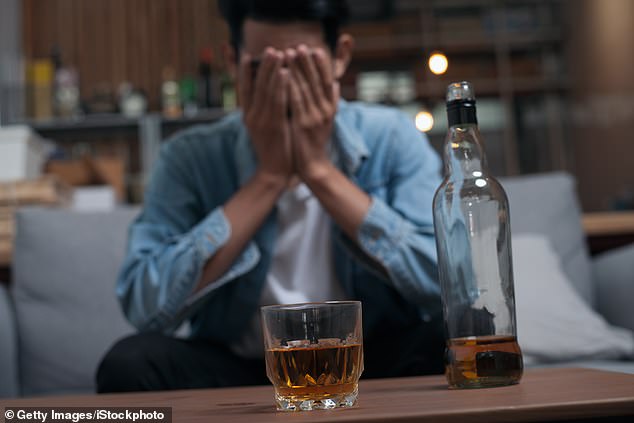
She has made the decision to move out because James always had the ability to stop drinking (picture posed by model)
Each time, afterwards, he swore things would change. Each time, I wanted to believe him.
But actually, everyday reality was worse than the big scenes. The ongoing, year-on-year burden of knowing everything – from after-school pick-ups to emergency trips to A&E – was always down to me because James was invariably over the limit by 6.30pm.
I came close to leaving a couple of years ago on our 25th wedding anniversary.
We were staying in a beautiful hotel in the Lake District and on the first night he ordered wine with dinner, finishing the bottle before I was halfway through my first glass. When he waved the waiter back, my stomach dropped.
‘Please don’t,’ I said quietly. He just laughed and ordered another. Soon he was loud and slurring, trying to hold court with the next table, while I sat there, cheeks burning.
Back in the room, with James passed out on top of the covers, I caught my reflection in the mirror. Is this really the marriage I am going to grow old in, I thought?
He apologised the next morning and vowed to drink less for the rest of the trip. But his version of cutting back was one bottle instead of two. And, inevitably, it didn’t last.
Until finally, a year later, James’s doctor achieved what I never could.
James had just turned 55. His blood pressure was sky high, and his bloods showed raised liver enzymes and dangerously high cholesterol.
‘Your lifestyle is going to put you in an early grave,’ his doctor warned.
Compounding James’s panic was a colleague who’d recently suffered a fatal heart attack and another drinking friend who’d been diagnosed with incurable liver cancer.
James came home talking about how stupid he had been, adamant he would now go sober, quit smoking and join a gym.
‘I’ve heard this all before,’ I thought. But within a week he had done all three.
He started waking at 5am to run and tracking routes on Strava.
The fridge, once stacked with wine, was now filled with protein shakes and zero-per-cent beer.
I found his evangelical approach – early nights, meditation apps and posting sunrise photos – nauseating.
People commented online saying how amazing he looked, while inside I fumed.
I kept reflecting on everything his drinking had taken from me, and how different things would have been if only he’d chosen to stop sooner.
Now, suddenly, he wanted to make plans and spend time together. Only I didn’t want that.
By then our sons had grown up and I had finally started to do more for myself. I’d begun meeting friends for dinner again, enjoying being able to relax in a restaurant without counting James’s drinks.
And now, at 57, having already mentally moved on, that ‘soberversary’ tipped me into doing something about it.
Recently I saw Wayne Rooney say his wife, Coleen, saved his life from alcohol. I know he meant it as praise. But there is nothing romantic about living with a drunk.
Women like me do not save our husbands. We absorb the damage until there is nothing left of ourselves to give.
Six months ago, I moved into my flat. Soon, I’ll start divorce proceedings.
I do miss James sometimes – the private jokes, the periods when he chose not to drink. We have met a few times for coffee and each time he says he is lonely and sad, as though he’s the victim in all this.
I remind him that is how I felt for years. He looks wounded and says he didn’t mean to do that to me.
James remains sober. I haven’t worried about our separation leading to him falling off the wagon – I’m honestly ambivalent now as to whether he drinks or not.
Maybe one day James and I will become friends. But, right now, I’m focused on enjoying this feeling of being unburdened.
When James finally decided he wanted to save himself, I decided to save myself too. I just wish that one of us had made that choice so much sooner.
Marian Trevlin is a pseudonym. All names and identifying details have been changed