
‘I could have you all in tears with their stories’
17:40, 08 Jan 2026Updated 18:46, 08 Jan 2026
 ‘We share the frustration, we’ve trained staff, invested in them. They’re incredibly important to us and the running of our trust, and we can’t find a way round it,’ said the chair of Manchester University NHS Foundation Trus(Image: Sean Hansford | Manchester Evening News)
Thousands of migrant NHS and social care staff could be forced to leave the UK, or become victims of exploitation, if ministers go ahead with plans to dramatically change UK visa and settlement rules, health leaders have warned.
In November, Home Secretary Shabana Mahmood announced the qualifying period for indefinite leave to remain will be extended from five to 10 years, and will apply to the estimated 2.6 million who arrived since 2021.
The changes have prompted outrage in Greater Manchester, where around 30 per cent of social carers are working on a visa, higher than the national average of around 21 per cent. And the departure of migrant workers who have propped up the system could wreak havoc on an NHS desperately trying to cut waiting lists – especially in Manchester, host to the country’s largest NHS organisation and hospital trust.
Greater Manchester Mayor Andy Burnham has now hit out at the proposed changes, saying: “Can you imagine working in our health and care system… and your employment situation is in a place where the rug has been pulled, or you’re in an exploitative arrangement that you can’t change? It’s not acceptable.”
Settlement, also known as Indefinite Leave to Remain (ILR), allows someone to live in the UK permanently, work without restrictions and access public services. It is also a key step towards British citizenship. Currently, most work and family visa holders can apply for settlement after five years.
Last year, Mahmood said becoming part of the UK was “not a right but a privilege – and one that must be earned”.
Under the proposed changes the standard wait will be 10 years – with a range of criteria that would lengthen or shorten that period. Doctors and nurses working in the NHS will be able to settle after five years, according to reports.
But people who arrived on post-Brexit health and social care visas would have to wait 15 years, up from five years currently. That includes social care workers, health care assistants, and other staff that hospital leaders say are essential to keeping services running.
The government plans to roll out changes from spring 2026, after a consultation ends on February 12.
 Home Secretary Shabana Mahmood(Image: PA)
Other changes to immigration rules in the last year include an increase of the minimum salary threshold for jobs classed as ‘skilled work’, which allow for sponsorship of migrant workers, to £25,000 per year, from £23,200. Following the 25/26 pay award, ‘band three’ staff working in the NHS will no longer meet the salary threshold of ‘skilled workers’ that can be sponsored, as their wages fall below that number.
Band three workers include emergency care assistants, dental nurses and assistants, maternity support workers, and senior healthcare support workers who cover tasks like monitoring blood pressure, checking blood glucose levels, and wound dressings.
“Two things are going on here. In social care, there is clear evidence across the system of the abuse of sponsorship arrangements in terms of employment, which is leaving people in a terrible [situation],” Mayor Burnham told a public meeting of the Greater Manchester Integrated Care Partnership Board on December 12.
“People who’ve given everything to come here, dedicate themselves to caring for people here, only to find themselves completely exploited in an employment situation by some scrupulous providers, who exercise inordinate control over their circumstances. A
“We must not forget some of the issues that are going on in the NHS as well. I have been raising the issue of band three workers… Members of staff who came when it was perfectly legal to do so, and they were asked to do so to support the front line – healthcare assistants, largely from overseas, to whom a change has now been applied in relation to the salary threshold, which basically pulls the rug from underneath them, having made the commitment to the country.
“This is an indirect form of discrimination, isn’t it? Given they signed up on one basis and all of the sudden things are changed on them.
“Can you imagine working in our health and care system… and your employment situation is in a place where the rug has been pulled, or you’re in an exploitative arrangement that you can’t change? It’s not acceptable. We do need to give advocacy to these members of our health and care workforce in a strong way.”
 Band three NHS workers carry out vital checks on patients
UNISON presented a Migrant Care Workers Charter to the meeting, asking for support from the region’s health and political leaders, saying the country’s health and care systems ‘depend’ on migrant workers.
Without Indefinite Leave to Remain, workers won’t be able to move easily between jobs with their visas tying them to potentially exploitative employers, said the charter, ‘some that were hoping they would be able to escape in the next year, now looking at a potential further six years’.
The charter continues: “The exploitation of many of these workers is also compounded by the fact that despite being taxpayers, migrant workers do not have recourse to public funds in order to redress the disadvantages they face, unlike UK citizens.”
UNISON representatives also told the meeting that: “Workers have been charged extortionate amounts of money to come into employment in the UK by rogue agencies, where they’ve had substandard accommodation, where they’ve had employment rights not respected. In the past year, the rise in anti-immigrant sentiment in some quarters, and changes to immigration rules have made things even harder.”
 Andy Burnham is ‘sympathetic’ to the M.E.N. campaign(Image: Getty Images)
A survey launched in mid-Dec of migrant care workers by UNISON found in early results that just under a third of 60 respondents said they’ve never had an employment contract provided to them. Half who lived in accommodation provided by their employer said it was overcrowded, and a quarter said they were paying over market rate.
Some 37 per cent said they had to pay over £10,000 to an agency to get employment in Greater Manchester – two or three times over what they should be paying the Home Office for a visa.
Mayor Burnham asked if the final results could be passed to Greater Manchester Police, as the city should be taking the findings with the ‘utmost seriousness’.
Councillor Keith Cunliffe, the adult social care and health lead in Wigan, said the proposed changes come ‘at a time when the Secretary of State for Health is trying to improve waiting lists in the NHS… and suddenly we should remove visas from people working in this country’.
He invited his MP for a 12 hour shift in an acute medical unit ‘to see how low-skilled it is’.
The difference in the highest figure a band three worker can earn and the new £25,000 threshold is £63-a-year, continued the councillor. “People will not have their visas replaced for £1-a-week. Clearly there needs to be an answer to this,” he said.
Kathy Cowell CBE is the chair of the biggest hospital trust in the country, Manchester University NHS Foundation Trust – which runs all of Manchester hospitals, including the Manchester Royal Infirmary, Royal Manchester Children’s Hospital, North Manchester General, Wythenshawe Hospital.
She said her trust has tried every way to resolve the issue, but are bound by the legally-enforced pay structure of the NHS, Agenda for Change. The only route to change is through the Home Office, she explained.
Ms Cowell told the meeting: “If you’re at the top of your band, it is £63. We are bound by Agenda for Change and we cannot move those staff out, and give them an increase to accommodate that.
“We share the frustration, we’ve trained staff, invested in them. They’re incredibly important to us and the running of our trust, and we can’t find a way round it.
“We’ve taken legal advice asking ‘how do we do it?’ And we are absolutely confined within the restrictions within the law on this. If you can find us a way through this, we’d be eternally grateful.”
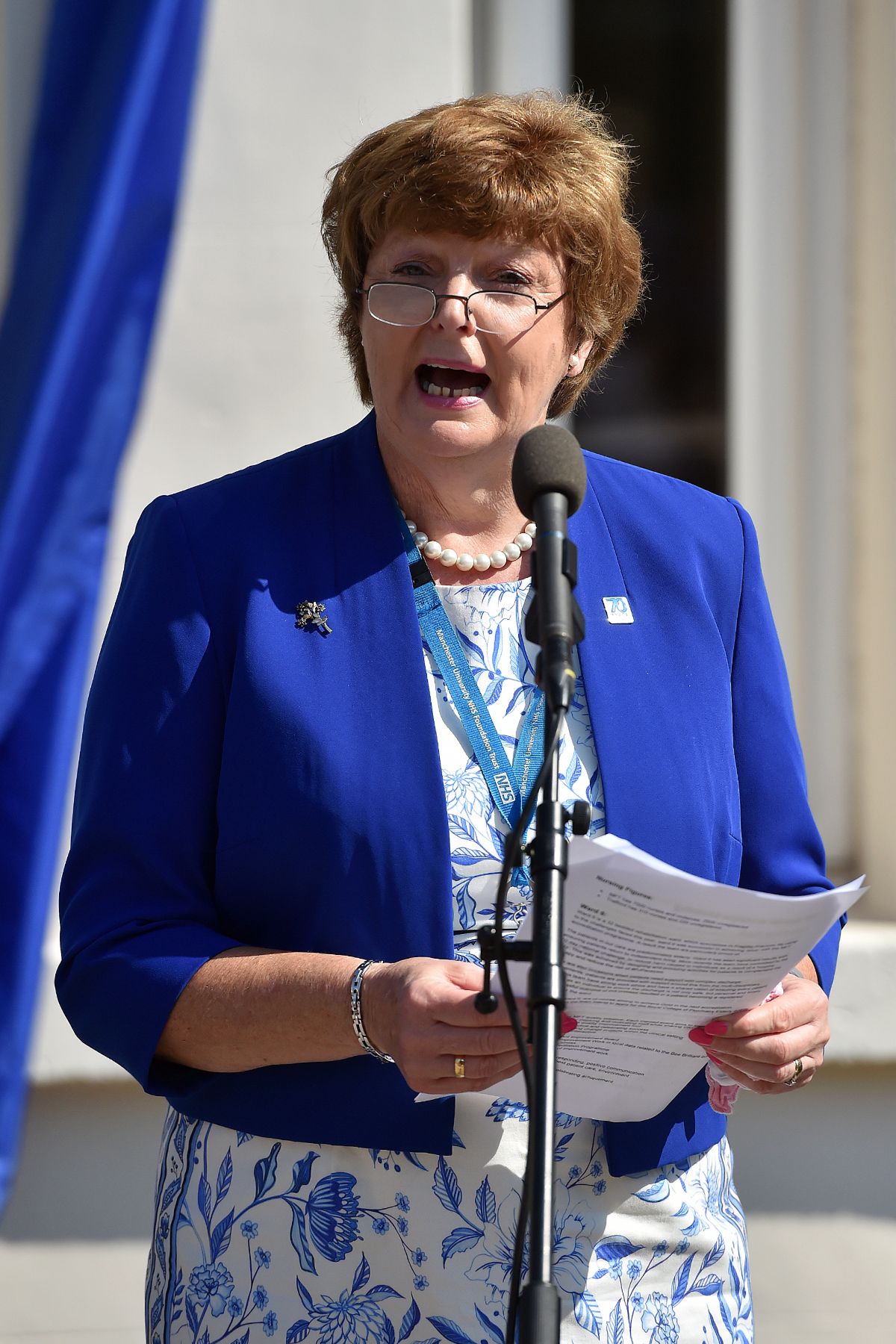 Kathy Cowell CBE(Image: Eddie Garvey)
“There’s a very simple way to do it,” suggested Ms Cowell, when asked by Mayor Burnham. “All that needs to be said is that this rule is not retrospective, it applies to all new staff you bring in. Don’t apply it retrospectively to staff already here. That would solve it in an instant.
“We have looked at every possible avenue on this, and we are bound by the law. We’ve got visas for this cohort of people, but across the organisation.
“The important thing is not to break the law in any of this, and find a solution to help these people within the law. I’ve got some heartbreaking stories, I could have you all in tears around some of the stories I’ve heard.
“We’ve offered legal and holistic advice to people, and wellbeing support. But we need to find a solution to this because this is our people, who look after our patients and our families, who we are not treating well.”
A government spokesperson said: “We hugely value our international care workers – but too many have seen unacceptable levels of abuse and exploitation.
“To stamp this out and to reduce reliance on international care workers, the government has put an end to overseas recruitment. We are focusing on boosting domestic recruitment and retention by launching the first ever adult social care fair pay agreement, improving training and qualifications and creating the first universal career structure for carers.”
The Department for Health and Social Care has been contacted for comment.