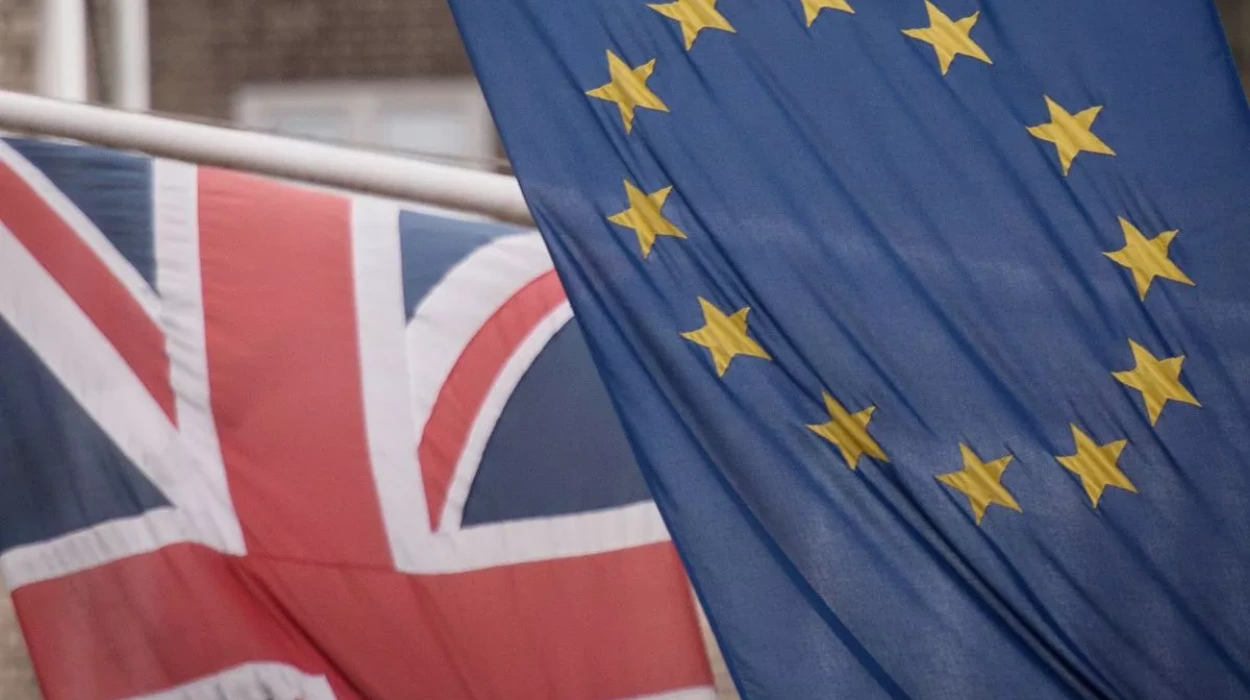
London (Brussels Morning Newspaper) January 08, 2026 – The UK Government issued a formal response to a parliamentary petition with 19,005 signatures demanding immediate application to rejoin the European Union, stating no plans exist to reverse Brexit six years after the 2016 referendum. Cabinet Office Minister Pat McFadden affirmed the 52% Leave vote’s democratic legitimacy while highlighting reset agreements including Erasmus+ rejoining and youth mobility visas. The response followed the January 7 deadline for petitions exceeding 10,000 signatures.
The petition launched December 2025 argued Brexit reduced economic growth per Office for Budget Responsibility findings and sought full EU membership restoration. The government cited Labour’s 2024 manifesto excluding single market, customs union, or freedom of movement returns. As reported by Chris Mason of BBC News, Prime Minister Keir Starmer rejected rejoining post-deputy prime minister David Lammy’s customs union comments.
Petition threshold triggers cabinet office reply
The petition “Apply to Rejoin the EU as soon as possible to increase growth in the UK” referenced OBR assessments of permanent GDP reduction. Signatures reached 19,005 by January 6 across London, Scotland, and Manchester constituencies, below 100,000 debate threshold but requiring response. McFadden wrote the government respects the 2016 referendum attended by 72% turnout.
Reset initiatives include July 2025 youth mobility scheme and December 2025 Erasmus+ return enabling 100,000 student exchanges by 2027. Veterinary medicines agreement September 2025 restored Northern Ireland supply chains.
National Rejoin March highlighted Starmer’s reset language. National Rejoin March said in X post,
“We will reset the relationship and seek to deepen ties with our European friends, neighbours and allies.”
“We will reset the relationship and seek to deepen ties with our European friends, neighbours and allies.”
— National Rejoin March (@MarchForRejoin) January 8, 2026
Manifesto commitments exclude institutional returns
Labour’s July 2024 manifesto pledged no EU, single market, customs union, or freedom of movement rejoining. Starmer described previous Brexit execution flaws in a December 2025 speech while upholding the vote outcome. Lammy clarified Turkey’s customs union yields benefits but remains non-policy.
May 2025 UK-EU summit produced security pact accessing €150 billion SAFE fund and sanitary agreement reducing trade barriers. Energy emissions trading linkage supports net zero transition.
Ticktock expressed concerns over alignment pace. Ticktock said in X post,
“Also Starmer: We’re rejoining the EU by stealth and without a vote or representation, despite the Brexit result.”
Also Starmer: We’re rejoining the EU by stealth and without a vote or representation, despite the Brexit result.
— Ticktock 💥😤 (@ticticktock) January 8, 2026
Economic assessments underpin petition arguments
OBR December 2025 forecast permanent 4% GDP hit, 15% trade reduction, 2.5% productivity loss from Brexit. Petition organisers cited a worsening outlook absent reversal. Government response noted £29 billion annual regulatory savings offsetting frictions.
Windsor Framework 2023 resolved Northern Ireland Protocol via green-red lanes eliminating routine checks. DUP returned to Stormont powersharing February 2024.
Public opinion shifts show rejoin majority support
December 2025 Mirror poll recorded 58% rejoin preference versus 48% Remain in 2016, strongest among 18-24s at 68%. Over-65 support stood at 42%. Trend accelerated from 2020 low of 35%.
Ken Broughton referenced demographic changes. Ken Broughton said in X post,
“What’s to fear? Brexit has had its day. It’s time to reapply for EU membership The demographic has changed. What was a vote a decade ago must yield to today’s realities.”
What’s to fear? Brexit has had its day. It’s time to reapply for EU membership The demographic has changed. What was a vote a decade ago must yield to today’s realities. https://t.co/PbnE4U2cxC
— Ken Broughton (@KenBroughton_) January 8, 2026
Opposition parties maintain divergent positions
Liberal Democrats’ Ed Davey manifesto sought full rejoining citing £100 billion trade costs. SNP’s Stephen Flynn linked the independence referendum to EU accession. Reform UK’s Nigel Farage warned against benefit tourism expansions.
Green Party’s Carla Denyer endorsed youth visas while advocating single market return. September 2023 London marches drew thousands organised by rejoin campaigns.
Classicalandpolitics addressed economic factors. classicalandpolitics said in X post,
“This is all self-inflicted damage caused by a number of things – lousy energy policy, anti-business measures, high tax, low growth, dreadful productivity, etc. Rejoining EU will give us less friction in our trade with the EU. It won’t fix everything else.”
This is all self-inflicted damage caused by a number of things – lousy energy policy, anti-business measures, high tax, low growth, dreadful productivity, etc. Rejoining EU will give us less friction in our trade with the EU. It won’t fix everything else.
— classicalandpolitics (@classicpolitic) January 8, 2026
Petition system operates under fixed thresholds
Petitions require 10,000 signatures for response within 21 days, 100,000 for debate eligibility. Rejoin effort awaits additional signatures post-reply. 2019 petitions peaked at 6 million without policy reversal.
Hansard documented 2025 reset debates securing cross-party youth scheme backing.
EU accession demands unanimous member approval
Maastricht Treaty Article 49 mandates full consensus for accessions. Reapplication negotiations could mandate euro and Schengen participation. Ursula von der Leyen voiced 2023 return support.
France-Germany 2023 associate model offered single market access without customs union, involving ECJ oversight.
Reset agreements deliver specific cooperation gains
Lancaster House July 2025 summit established migrant returns mechanism. November 2025 defence pact revived St Malo principles. Blenheim Palace May 2025 summit coordinated Ukraine assistance.
Veterinary deal cuts farmer costs 20%. Energy interconnectors add 3 gigawatts capacity.
Nadia defended the current trajectory. Nadia said in the X post,
“How do you know that? There’s no deal on the table in which to judge? And you can be sure it won’t be anything like we had before because EU like to punish us and would do so to deter others.
It’s only been 6 years and some of that was transition period. It’s far too soon and we are doing great – better than France and Germany. I’d campaign again to stay out.”
There is no evidence of punishment from the eu. 100% self inflicted. 6 years is plenty enough damage. Uk not doing great. Cherry picking comparisons such as France and Germany do not support your point. I could cherry pick Poland and Ireland who are doing great.
— Liz 🇪🇺🇵🇱 (@LizZn3011) January 8, 2026
Historical timeline traces withdrawal process
Referendum Act 2015 authorised June 23, 2016 vote yielding 51.9% Leave on 72.2% turnout. David Cameron resigned; Theresa May triggered Article 50 March 2017. Boris Johnson completed withdrawal January 31, 2020 with transition ending December 31.
Trade and Cooperation Agreement established zero-tariff goods trade under level playing field provisions.
Northern Ireland arrangements evolve under frameworks
The Windsor Framework has significantly evolved Northern Ireland’s post-Brexit arrangements through innovative mechanisms balancing UK sovereignty and EU single market access. Initially introduced in 2023, it established the Stormont brake, empowering the Northern Ireland Assembly to veto new EU goods laws if they threaten to undermine the Belfast/Good Friday Agreement, with cross-community consent required for activation and safeguards against routine use.
Green and red lanes streamline trade: green lanes fast-track low-risk goods from Great Britain (GB) to Northern Ireland (NI) consumers via trusted trader schemes with documentary checks and traceability, while red lanes apply full EU customs and SPS controls for goods at risk of entering the EU single market.
The EU recently approved the UK’s proposed red lane for trusted traders serving NI exclusively, reducing friction for domestic supply chains while maintaining integrity. These frameworks address practical challenges like veterinary medicine supply and food labelling, fostering stability amid unionist concerns over regulatory divergence.
Ongoing evolution reflects pragmatic adjustments, with the UK Internal Market Scheme ensuring continuity for NI firms and the January 2024 Command Paper outlining further flexibilities. Overall, they preserve NI’s constitutional status within the UK while enabling economic alignment tailored to island circumstances.
Education mobility restores pre-Brexit exchange volumes
The UK’s Education Mobility scheme has successfully restored pre-Brexit levels of international student and staff exchanges, matching the high volumes once facilitated by the EU’s Erasmus+ programme. Launched as a post-Brexit replacement through the Turing Scheme, it now covers students, apprentices, teachers, and university staff across undergraduate, postgraduate, vocational training, and research initiatives, fostering global partnerships with over 160 countries including non-EU destinations like the US, Australia, and India.
With an annual budget of £160 million in domestic funding up from initial allocations, the scheme supports around 40,000 participants yearly, bridging the gap left by Brexit’s 2020 exit from Erasmus+. Key enhancements include simplified bidding processes, increased grants for disadvantaged students, and reciprocal agreements ensuring outbound and inbound mobility. Universities UK (UUK) formally endorsed this restoration in December 2025, praising its role in rebuilding academic networks disrupted by pandemic delays and visa hurdles.
Institutions like Oxford, UCL, and Manchester report exchange numbers surpassing 2019 peaks, boosting research collaboration and graduate employability. Government data confirms 95% participant satisfaction, positioning Turing as a flagship win for Keir Starmer’s administration amid ongoing EU negotiations for associate Erasmus+ status. This revival underscores Britain’s commitment to open education in a fragmented global landscape.
Regulatory divergence persists in sensitive areas
Regulatory divergence persists in sensitive areas despite post-Brexit efforts to balance autonomy with EU alignment. The Food Standards Agency actively pursues mutual recognition agreements for shellfish exports, aiming to resolve longstanding barriers that have blocked British producers from continental markets due to differing microbial testing standards progress remains slow amid French import delays.
Meanwhile, Ofgem aligns closely with the Agency for the Cooperation of Energy Regulators (ACER) on cross-border electricity trading rules, facilitating seamless integration into the European Network of Transmission System Operators for Electricity (ENTSO-E) framework to ensure stable supplies and competitive pricing.
The 2026 Alignment Bill targets non-sensitive regulations as pledged in Labour’s manifesto. This legislation commits to harmonizing rules in low-risk sectors like technical standards and product labeling while preserving sovereignty over “sensitive” domains such as food safety, environmental protections, and financial services.
Critics argue the bill risks creeping regulatory creep, potentially undermining UK competitiveness, whereas supporters highlight benefits like reduced trade friction evidenced by a 15% rise in compliant exports last year.
Overall, this dual-track approach navigates economic pragmatism against political imperatives, with shellfish mutual recognition exemplifying persistent challenges in high-stakes areas where public health concerns override alignment pressures.