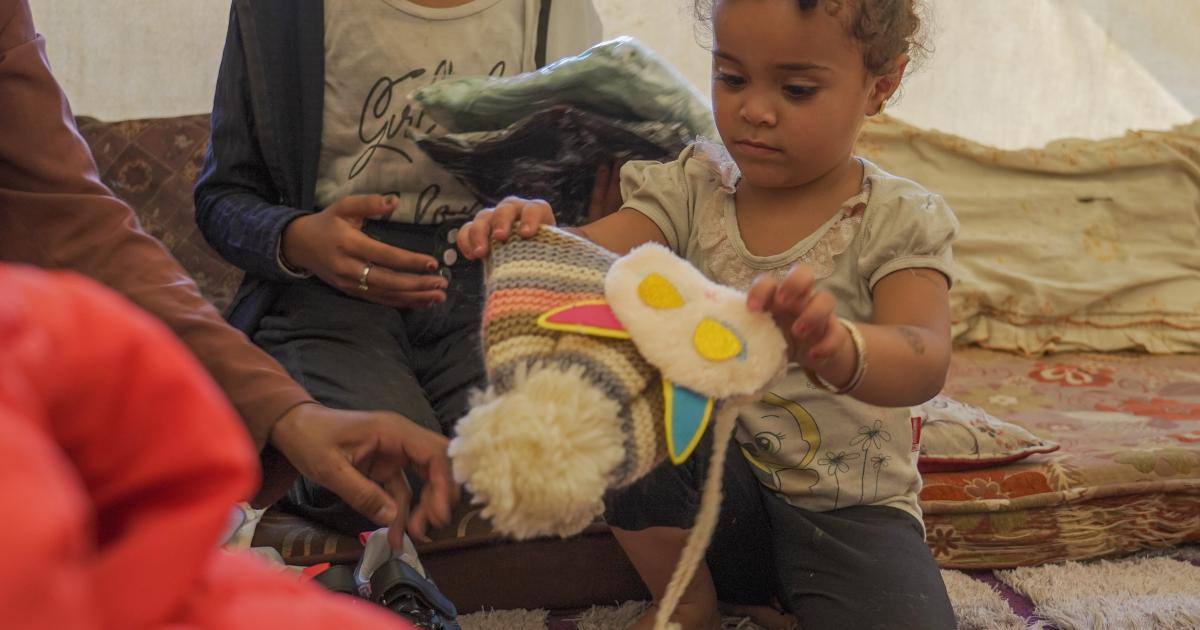
Winter in Gaza: displaced families face harsh conditions
Winter in Gaza can be very harsh. Cold winds sweep through the hundreds of thousands of makeshift tents where families are forced to live, often accompanied by heavy rainfall that transforms camps into muddy fields.
These tents, built from canvas and wood, offer no insulation, pavement, heating and electricity.
Meet Mervat
‘There’s nothing, not even a wall to lean on,’ said Mervat, a mother of 5 from Rafah. ‘Sometimes it’s cold, and it takes a toll on the children. It’s just fabric; there’s just not much safety.’
Mervat is one of the nearly 1.9 million Palestinians who have been displaced since October 2023, many of them multiple times. She and her 5 children now live in a tent in Khan Younis.
Before the war, Mervat’s life was modest but stable. Her husband worked as a builder, earning enough to provide for their family.
‘We lived in a house that sheltered us,’ Mervat recalled. ‘It wasn’t big or fancy, but it held us together.’
That stability vanished when displacement orders came without warning. ‘I spent half the day crying after they told us to leave,’ she said. ‘My daughters, God bless them, gathered a few clothes. We barely managed to carry 2 bags and walked.’
Mervat and her family have now been displaced 9 times. They currently shelter in a displacement camp, surrounded by thousands of other families. Mervat’s husband has been struggling to find work for months.
Each day revolves around securing food, water and warmth. Mervat’s son regularly walks long distances to fetch water. Her daughters wait in long lines for food distributions, sometimes coming back empty-handed as supplies run out.
The humanitarian crisis in Gaza
Humanitarian needs in Gaza are at their highest.
Over 92% of homes have been damaged or destroyed. Families, including those with infants, live entirely exposed to the elements.
Access to food, clean water, and health care remains extremely limited.
Children are amongst the most impacted: assessment conducted by the International Rescue Committee (IRC) conducted in August 2025 found that 1 in 3 young children had gone an entire day without food in the previous 24 hours.
In December 2025, the Integrated Food Security Phase Classification in analysis found that acute food insecurity and malnutrition remained at critically high levels, especially amongst children.