Your support helps us to tell the story
From reproductive rights to climate change to Big Tech, The Independent is on the ground when the story is developing. Whether it’s investigating the financials of Elon Musk’s pro-Trump PAC or producing our latest documentary, ‘The A Word’, which shines a light on the American women fighting for reproductive rights, we know how important it is to parse out the facts from the messaging.
At such a critical moment in US history, we need reporters on the ground. Your donation allows us to keep sending journalists to speak to both sides of the story.
The Independent is trusted by Americans across the entire political spectrum. And unlike many other quality news outlets, we choose not to lock Americans out of our reporting and analysis with paywalls. We believe quality journalism should be available to everyone, paid for by those who can afford it.
Your support makes all the difference.Read more
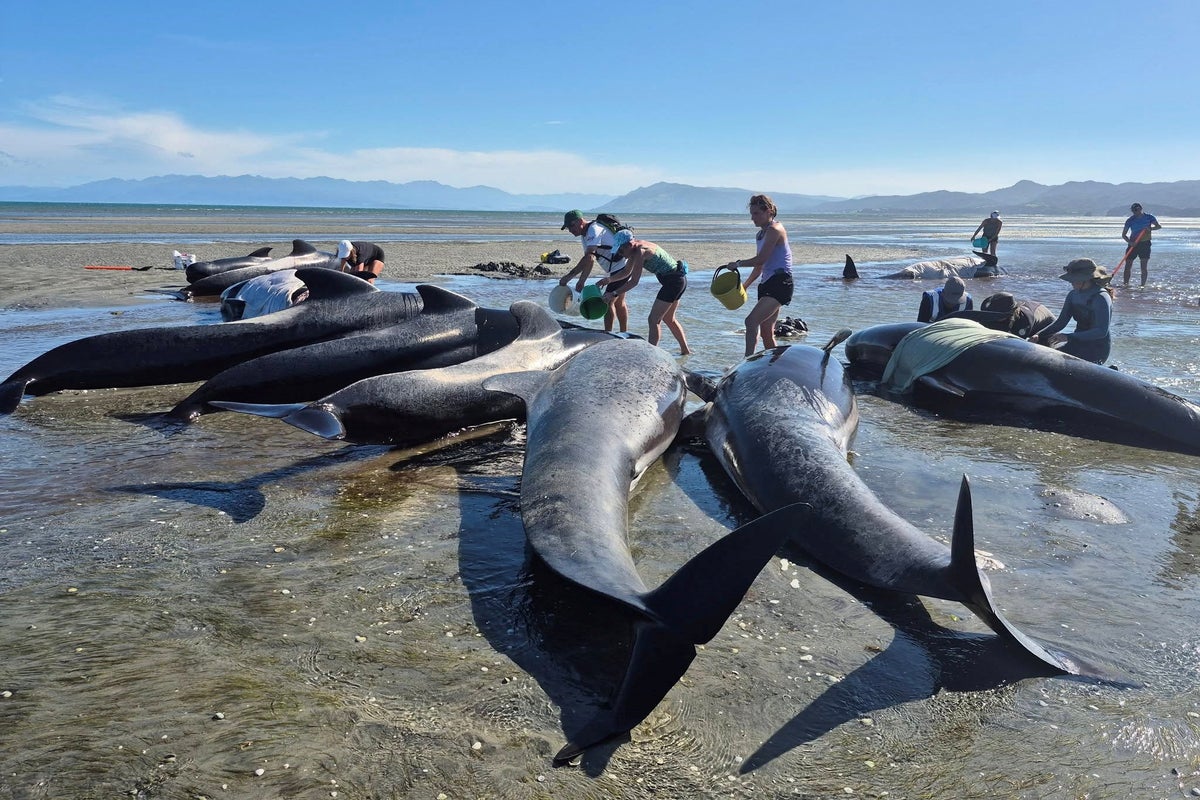
A large-scale rescue effort was underway on a remote stretch of New Zealand’s South Island after dozens of pilot whales became stranded, leaving six dead and 15 fighting for survival on Thursday.
The animals washed ashore on Thursday at Farewell Spit, a narrow sand formation known for repeated strandings. Though the majority of the pod initially managed to return to the sea, a group of whales later became stranded again, scattered across roughly a kilometre stretch of the beach.
Footage released by the marine conservation charity Project Jonah showed volunteers surrounding the whales and dousing them with buckets of water in an effort to prevent overheating while they waited for the tide to rise.
“When the tide comes in, we’re going to have to move really quickly to bring these whales together, then move them out to deeper waters,” Louisa Hawkes of Project Jonah said, according to the BBC.
Pilot whales are social animals and rescuers believe their strong group bonds can improve the chances of survival if they are reunited.
Volunteers are aiming to herd the remaining whales into what Ms Hawkes describes as a “nice tight group” so they can regain contact with one another before attempting to swim out together. On Friday, Project Jonah said they were in the tidal zone and were showing signs of encouraging behaviour, according to New Zealand’s RNZ.
Rescue teams are working against the clock as conditions must align precisely for the re-floating attempt to succeed.
“We have to do all of that before the tide turns and drops again,” Ms Hawkes said.
Project Jonah issued an urgent appeal for additional volunteers to assist with the operation, while New Zealand’s Department of Conservation dispatched rangers, along with a boat and a drone, to watch for further strandings.
The department said that it first received reports about a group of whales in shallow waters off the area at around 11am on Thursday.
“We have been lucky with the tides until now, but unfortunately the pilot whales are starting to strand as the tide goes out,” a spokesperson said.
Farewell Spit has a long history of such incidents. The conservation department has previously described the area as a “naturally occurring ‘whale trap’” given its location along a migration route for long-finned pilot whales.
According to the department, the geography of the spit makes it particularly dangerous.
“The spit hooks around the northern entrance into Golden Bay, forming extensive intertidal sand flats flanked by gently shelving waters offshore. Whales may be easily deceived and caught out by the gently sloping tidal flats and a rapidly falling tide,” it said, according to Stuff.
“Pilot whales have strong social bonds, and if one whale heads into shallow water, the rest of the pod will follow due to their natural instinct to look after one another.”
One of New Zealand’s worst-ever mass strandings occurred at the same location in February 2017 when more than 400 long-finned pilot whales washed ashore.