The European Union has finalized a controversial trade deal with Latin American nations more than two decades in the making that will result in the largest global free trade zone on record.
On Friday, European Commission President Ursula von der Leyen announced that the EU-Mercosur Partnership Agreement (EMPA), which will facilitate trade and cooperation between the EU’s 27 member nations and Argentina, Brazil, Paraguay and Uruguay, was finalized by the European Council.
More from Sourcing Journal
“With 2026 just underway, today Europe has sent a strong signal that we are serious about our priorities. On our commitment to Europe’s competitiveness and creating growth and opportunities for businesses and citizens. On our commitment to diversify our trade and reduce our dependencies. And in the face of an increasingly hostile and transactional world, a clear commitment to strengthen our international partnerships,” she wrote, no doubt referencing the punishing and widespread duties levied by the United States on more than 100 of its trading partners.
“With the Mercosur agreement, we are creating a market of 700 million people—the largest free trade zone in the world,” she added.
According to von der Leyen, 60,000 European companies currently export to the Mercosur region—half of them small- and medium-sized businesses that she said will benefit from the lowering of trade barriers like tariffs. The deal is projected to save such European enterprises 4 billion euros (about $4.6 billion) annually in export duties and will create more streamlined, “simpler” customs procedures and greater access to raw materials.
Calling the deal a “win-win” for both sides, the European Commission president said the EMPA would boost business opportunities and Europe’s investment in strategic sectors in Latin America, while also creating a booming market for European exports, which are expected to grow by nearly 50 billion euros ($58.1 billion) by 2040. Mercosur exports, in turn, are slated to grow by up to 9 billion euros ($10.4 billion) during that time.
The provisions of the agreement were not just designed for economic cooperation, but to bolster collaboration on issues like sustainable development and climate action, human rights, digitalization and multilateral national security. The deal’s Interim Trade Agreement (iTA), which will remain in place until the EMPA enters into force, will immediately offer tariff reductions and open market access for an array of goods and services, including agriculture, automotive, pharmaceuticals and chemicals.
Story Continues
In her statement, von der Leyen acknowledged the chorus of concerns emanating from Europe’s agricultural sector. “This agreement contains robust safeguards to protect their livelihoods. We are also stepping up our actions in relation to import controls, because rules must be respected, also by importers,” she said.
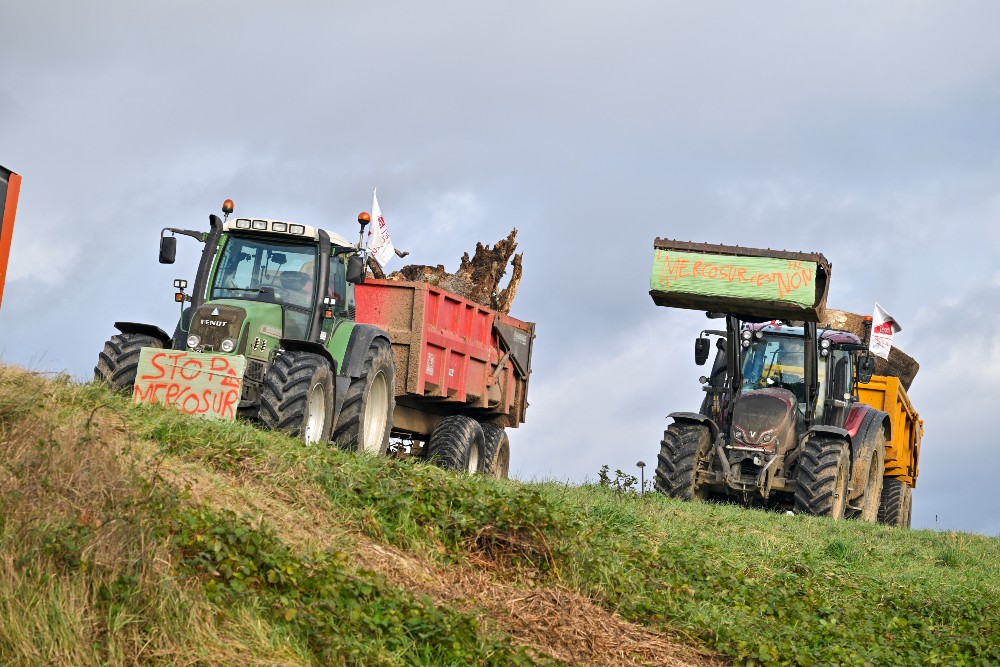
Farmers across countries like France, Poland, Austria and Ireland have bemoaned the changes that the deal could invite—shifts they say could be a threat to their livelihoods. COPA-COGECA, a union comprised of two of Europe’s largest agricultural organizations, has long resisted the formation of a trade agreement. For one, the deal could open the European consumer market to a deluge of cheaper options for products like beef and poultry, rice and sugar from Latin America, undercutting local producers, they believe.
Europe’s regulatory environment and environmental standards could also pose a disproportionate burden for local farmers adherent to the laws, farmers have said. While they are subject to strict policies under the EU Green Deal, they argue that the EU-Mercosur deal doesn’t do enough to force foreign entities to play by the same rules. The framework’s protections when it comes to labor and ecology are lacking in enforcement mechanisms or sanctions, farmers and some European states have argued.
Euronews reported that Poland, Austria, Hungary and Ireland also voted against it, while Belgium abstained. Germany and Spain were proponents of the EMPA, while Italy, which ultimately voted in favor, was regarded as a key decider in the matter.
Italian Prime Minister Giorgia Meloni said in a press conference Friday that she never had “any ideological objections” to the EMPA, though she underscored the need for enhanced protections for local industry. “We have always said we will be in favor of it when there are sufficient guarantees for our farmers,” she said. “The agreement’s potential is good, but not at the expense of the excellence of our products.”
French President Emmanuel Macron, a major detractor of EMPA, said the country would vote against the deal.
“France is favorable to international trade, but the EU-Mercosur agreement is an agreement from another age, negotiated for too long on bases that are too outdated,” he wrote on X.
Macron said that the projected 0.05 percent European GDP growth projected by 2040 by the Commission “does not justify exposing sensitive and essential agricultural sectors to risks to our food sovereignty.”
However, the French leader acknowledged that the Commission acquiesced to some of the country’s government’s demands, including a safeguard clause that would create an “emergency brake” on agricultural imports from Mercosur countries if Europe’s market becomes destabilized, to be activated upon a 5 percent variation in price or volume of imported agricultural products.
Brazilian President Luiz Inácio Lula da Silva, who has become the de facto dealmaker of the Mercosur region as leader of its largest country, called Friday a “Historic day for multilateralism.”
“In an international scenario of growing protectionism and unilateralism, the agreement is a signal in favor of international trade as a factor for economic growth, with benefits for both blocs,” he wrote on X, noting that the deal will represent the interests of 718 million people and a GDP of $ 22.4 trillion.
The expansion of export markets and the possibility of productive European investment will be a boon to Brazil’s economy, he said, and EMPA’s trade rules will ultimately benefit both sides of the arrangement. He characterized the agreement as “A victory for dialogue, negotiation, and the bet on cooperation and integration between countries and blocs.”