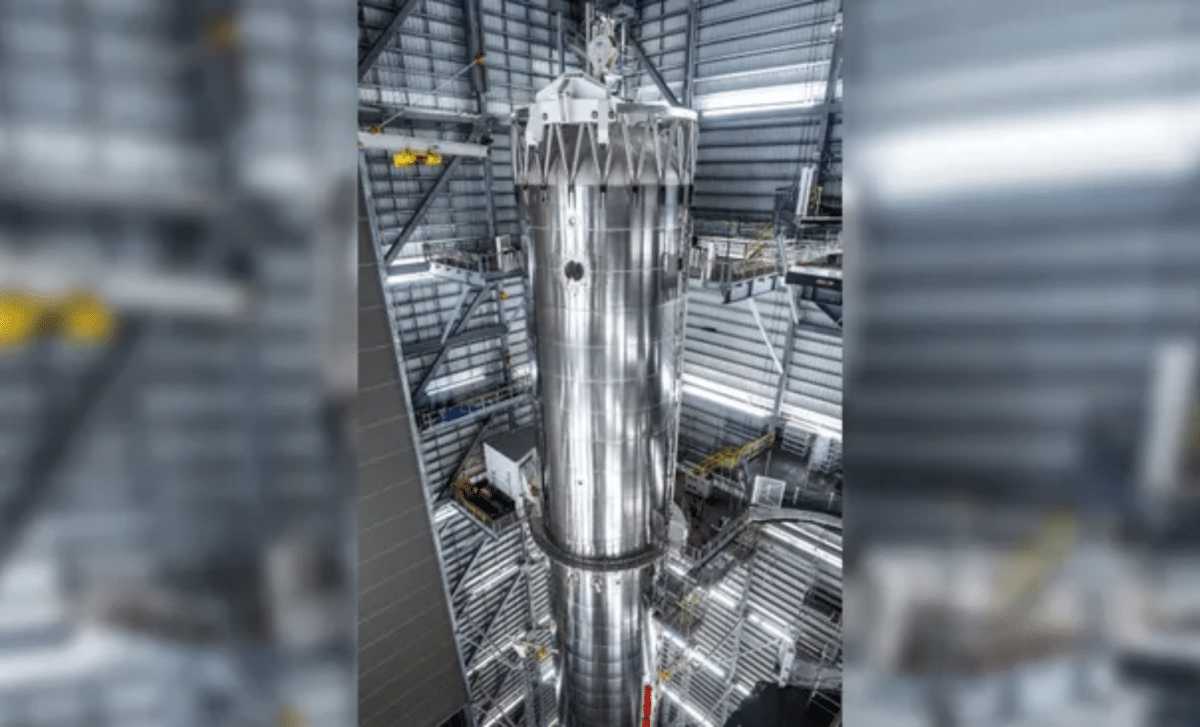
SpaceX has made significant progress towards its next major milestone for the Starship program. The company recently completed the stacking of its Super Heavy booster for Starship’s 12th test flight. This marks another pivotal moment for the ambitious project that aims to revolutionize space travel, with the ultimate goal of sending humans to Mars. As SpaceX pushes forward with its testing schedule, the focus is on ensuring the Starship system, including the massive booster, can perform successfully in its upcoming flight.
The Super Heavy Booster: A Giant Step for SpaceX
SpaceX’s Super Heavy booster is a critical component of the Starship system. Standing as tall as a 40-story building, it plays a central role in lifting the Starship’s upper stage into orbit. The booster itself is powered by Raptor engines, which are designed for reusability and efficiency. The sheer scale of the Super Heavy is impressive: it towers over 230 feet (70 meters) tall, making it one of the most powerful rockets ever built. Once stacked together with the upper Starship stage, the combined rocket reaches over 400 feet (122 meters) in height.
For Starship’s 12th test flight, the Super Heavy booster has been outfitted with the latest technology and modifications. According to Space.com, this includes upgraded Raptor engines, capable of producing higher thrust levels for a more powerful lift-off. These improvements aim to help SpaceX achieve a fully reusable spacecraft capable of reaching Mars and beyond. The booster’s design is also optimized for rapid refurbishment, a key factor in SpaceX’s goal of cutting the costs of space travel significantly.
Delays and Setbacks: Overcoming Challenges
While the stacking of the Super Heavy booster is an exciting development, the road to this point has not been without challenges. Initially, SpaceX had planned to use a different Super Heavy booster for Flight 12. However, during testing in late November, the original booster encountered some issues, forcing SpaceX to bring in a new vehicle for the mission. This delay is part of the normal process for testing such a complex system, and SpaceX has a proven track record of overcoming setbacks.
Despite this setback, the pace at which SpaceX has been able to progress with Starship is remarkable. The company continues to innovate and refine its designs, learning from each test flight. The ability to quickly recover from challenges and continue moving forward is one of the hallmarks of SpaceX’s approach to space exploration. SpaceX’s founder and CEO, Elon Musk, has long emphasized the importance of iterative testing and rapid improvement, and the company’s ability to adjust and adapt remains one of its greatest strengths.
Booster 18, the first Super Heavy V3, is beginning prelaunch testing. The first operations will test the booster’s redesigned propellant systems and its structural strength pic.twitter.com/VUcFbmswpP
— SpaceX (@SpaceX) November 20, 2025
Version 3 Starship: A Leap Forward for Space Travel
Starship’s 12th test flight will showcase the new “Version 3” of the spacecraft, a key upgrade designed to make the rocket more efficient and capable of flying to distant destinations like Mars. The new version of Starship will be taller than its predecessors and feature a number of improvements, including enhanced heat shields and updated engines. One of the biggest changes is the incorporation of SpaceX’s new Raptor 3 engines, which offer better performance and reliability compared to the earlier Raptor engines.
This version of Starship is specifically designed with interplanetary travel in mind. Musk has stated that the vehicle’s ultimate goal is to carry humans to Mars, and the changes to Version 3 bring that dream closer to reality. As Musk has pointed out, Starship must first master Earth orbital launches, and this test flight will be another step toward achieving that. With the new Raptor 3 engines and other enhancements, Version 3 of Starship represents SpaceX’s commitment to refining its spacecraft for long-duration missions and exploration of the solar system.