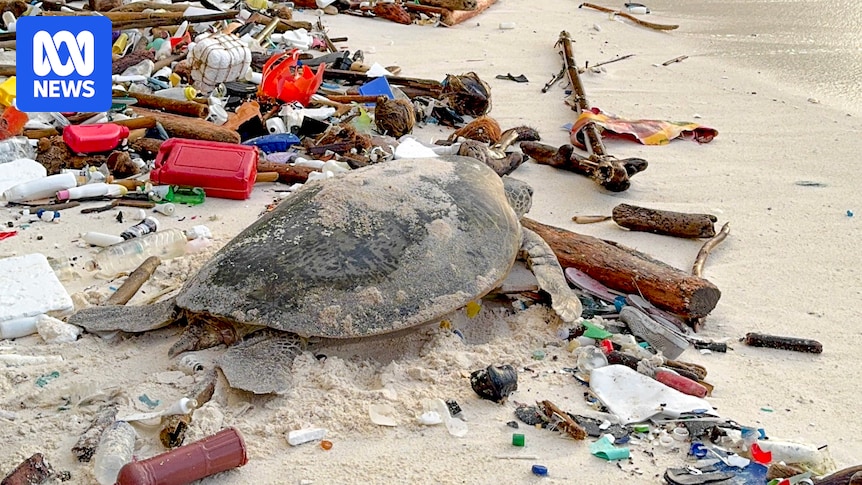
Christmas Island’s Greta Beach should be one of Australia’s most prized stretches of sand and a haven for nesting green sea turtles.
Instead, it is silently choking on a tsunami of plastic waste.
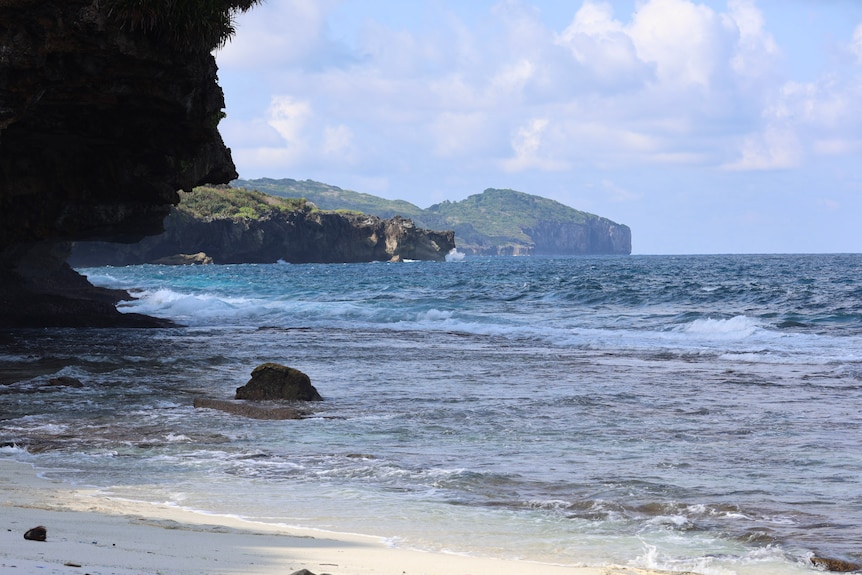 The Christmas Island Marine Park was established in 2022.(ABC Pilbara: Mietta Adams)
For several months of the year, Greta Beach, 350 kilometres south of Indonesia, could be mistaken for a remote holiday paradise.
But during the dry season, and especially from the beginning of June to the end of August, Indian Ocean currents bury the beach under tonnes of plastic.
Much of it is rubbish carelessly discarded by consumers who live thousands of kilometres away.
Greta Beach is a vital nesting ground for green sea turtles, which have only recently been taken off the global endangered list.
It is one of the few locations where they can lay eggs year-round.
Increasingly, however, the waste smothering this beach makes nesting difficult, according to Lin Gaff, who has been volunteering with Island Care for 25 years.
The female turtles struggle over an obstacle course of sharp plastic, nylon ropes, discarded shoes, bottles, and styrofoam remnants.
It is a desperate effort to find sand deep enough to incubate their eggs.
Most of the time, they hit plastic debris.
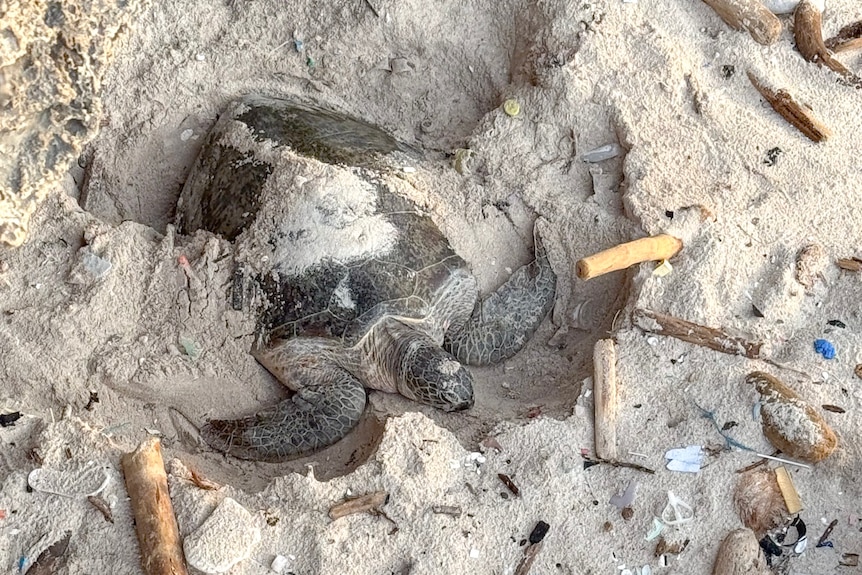 A green sea turtle lays eggs on Greta Beach.(Supplied: Robyn Stephenson)
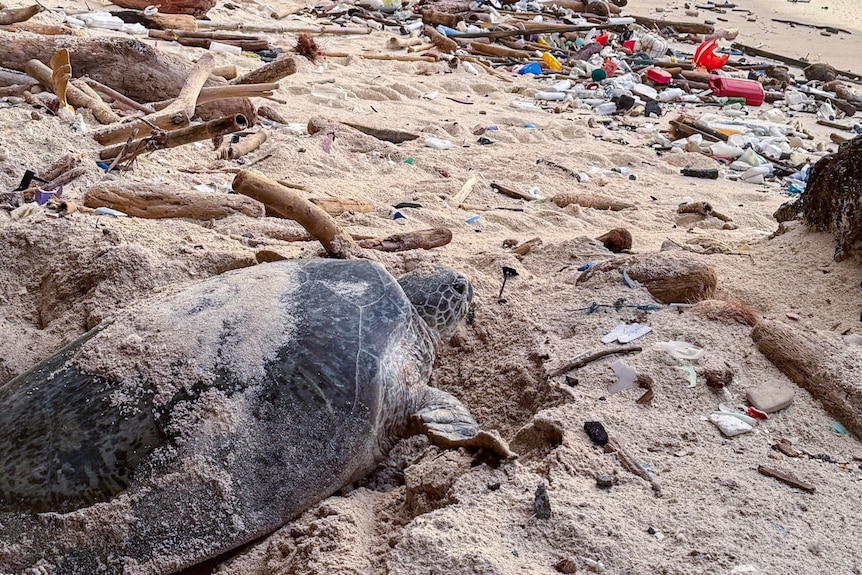 Nesting is year-round on Christmas Island.(Supplied: Robyn Stephenson )Loading…
“It’s a constant battle for them. It’s heartbreaking to see all of their attempts fail,” Ms Gaff says.
If the eggs survive, tiny hatchlings struggle to reach the sea beyond the mountains of rubbish surrounding them.
Many do not survive the climb over the unnatural objects trapping them.
Loading…
Ms Gaff says community beach clean-ups are “never-ending” because the tides never cease.
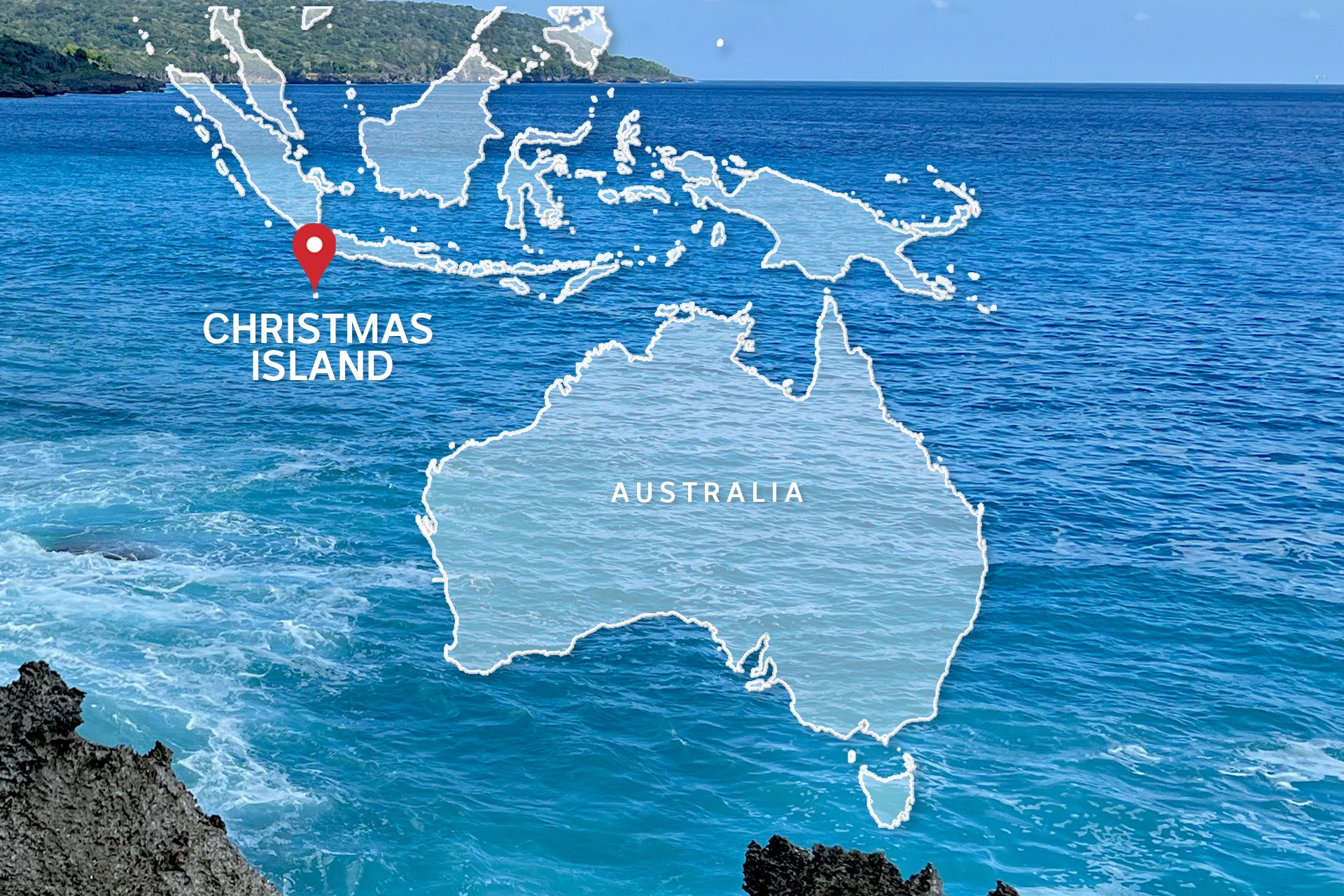 Christmas Island sits south of Indonesia.(ABC News: Sharon Gordon)
“You can remove thousands of kilos of plastic and the next day it’s back. It’s just insidious,” she says.
In 2025, environmental group the Tangaroa Blue Foundation gathered 2.8 tonnes of rubbish from Greta Beach during clean-ups — more than double the amount collected in 2023.
The foundation, which focuses on removing marine litter and finding solutions to prevent it, then transports the waste to the island’s inland rubbish tip.
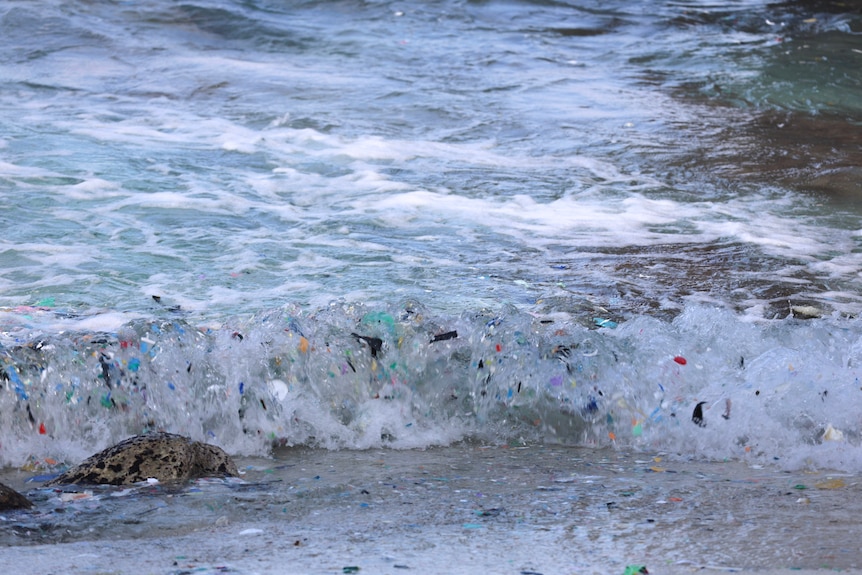 Crashing waves speckled with shards of plastic.(ABC Pilbara: Mietta Adams)
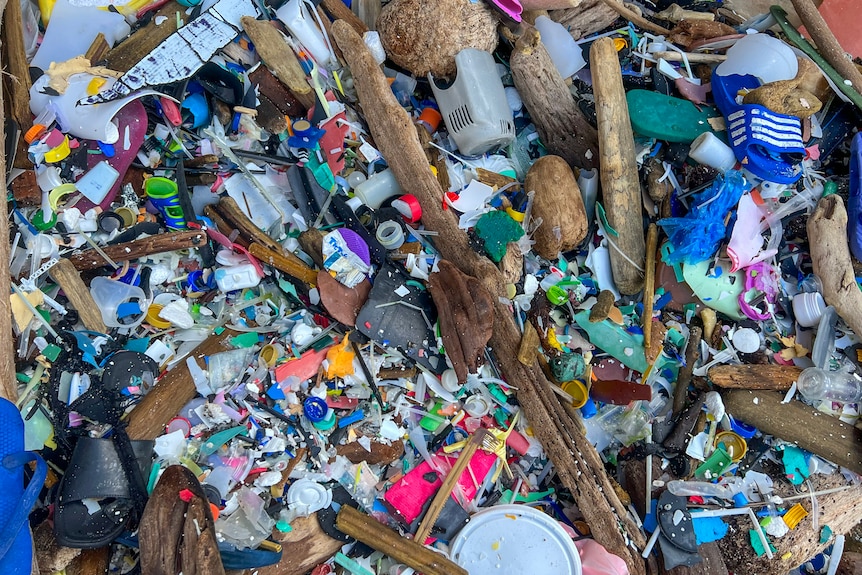 Rubbish gathers in piles.(ABC Pilbara: Mietta Adams)
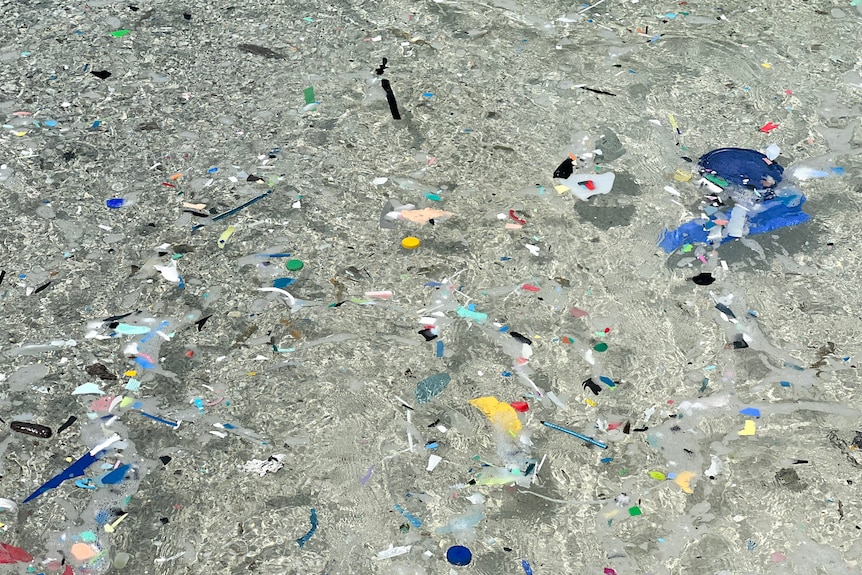 Plastic pigments are bright in the clear water.(ABC Pilbara: Mietta Adams)
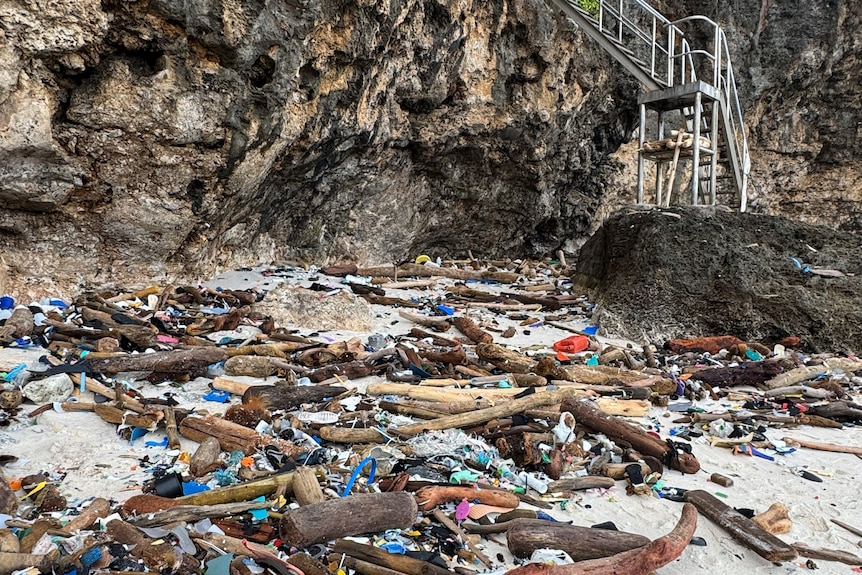 Greta Beach is carved into a cliffside.(Supplied: Eco Crab Industries)
A recent study published in the Marine Pollution Bulletin found that most of the debris on the beach originated in Indonesia and Malaysia.
Only 1.8 per cent originated on Christmas Island itself or came from the Australian mainland.
Yet the small community of 1,700 people who live on the remote territory bears the burden of the endless waste washing up on their doorstep.
“It’s something that we are all a part of, even though that rubbish doesn’t come from here,” Ms Gaff says.
 Island Care volunteer Lin Gaff.(ABC Pilbara: Mietta Adams)’Distressing’ to locals, visitors
While islanders have become accustomed to the plastic-choked beach, Kyoto University Associate Professor Dr Saskia Abrahms-Kavunenko says many people are shocked to learn the problem exists on Australian soil.
“I was showing one of my brother’s friends some video footage of Christmas Island,” she explains.
“He said, ‘There would be a massive outcry if this material was in Western Australia.’
“And my brother said, ‘This is Australia.'”
Loading…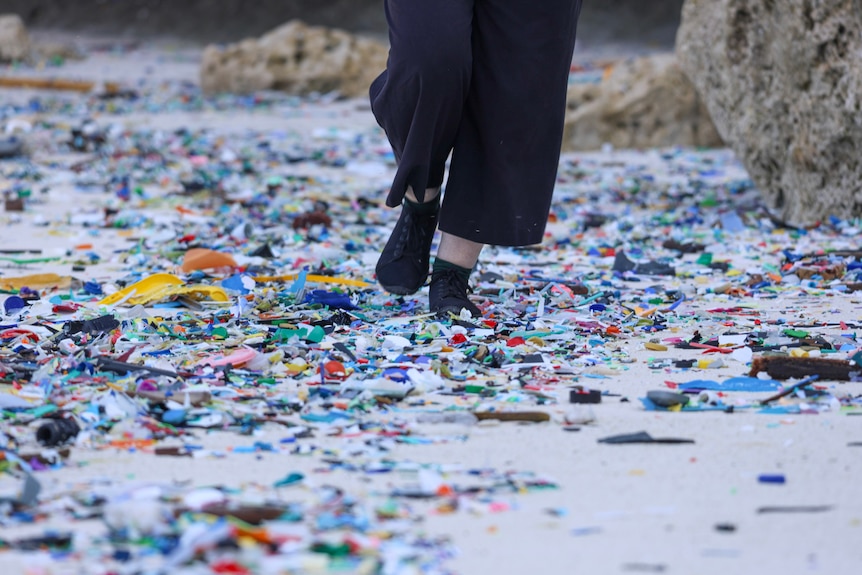 It is difficult to see the sand in the plastic.(ABC Pilbara: Mietta Adams)
 Researcher Saskia Abrahms-Kavunenko explores the community’s relationship to plastic.(ABC Pilbara: Mietta Adams)
Ms Gaff agrees that many Australians are unaware of the problem.
“There are not a lot of places in Australia where that would be acceptable,” she says.
In fact, just two kilometres south, the island’s famous Dolly Beach has been listed as one of Australia’s most beautiful.
Data collected between 2023 and 2025 found debris deposition was 50 times higher on Greta Beach than Dolly Beach, potentially due to the shape of its surrounding cliffs.
The plastics on Greta Beach have been a focus of Dr Abrahms-Kavunenko’s anthropological research since 2022.
“The things that you can see are just the tip of the iceberg into what’s actually in the ocean,” she says.
A bigger, less visible problem is the impact of microplastics, which absorb and spread chemicals throughout marine ecosystems.
Loading…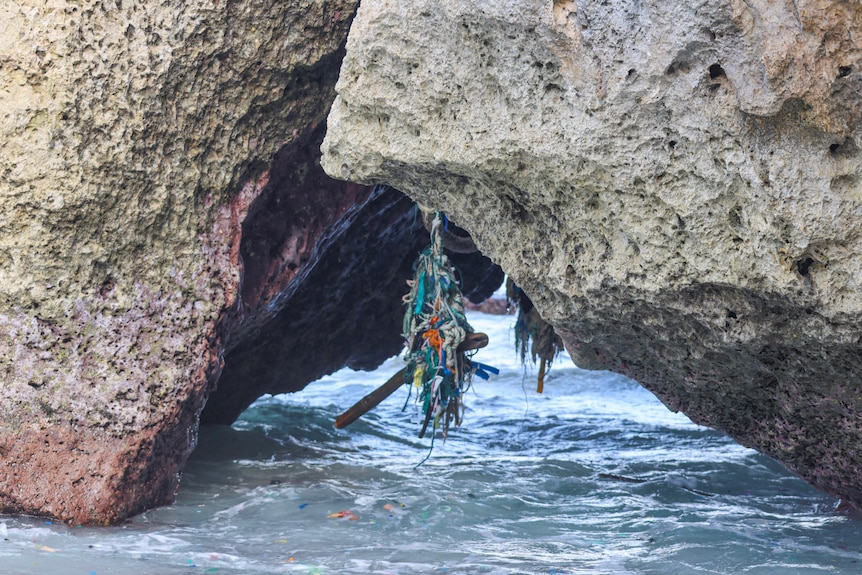 Knotted debris is caught between boulders.(ABC Pilbara: Mietta Adams)
Dr Abrahms-Kavunenko says communities in Indonesia are not able to manage the materials that enter the country due to the overproduction of plastics.
“So it makes people a lot of money to bring plastics in, but they’re not really willing to bring those plastics out,” she says.
“It’s a really big problem we are facing.”
It is also plaguing Christmas Island’s closest neighbours, the Cocos (Keeling) Islands, with plastics in the Indian Ocean travelling as far west as the Seychelles, 5,500 kilometres away.
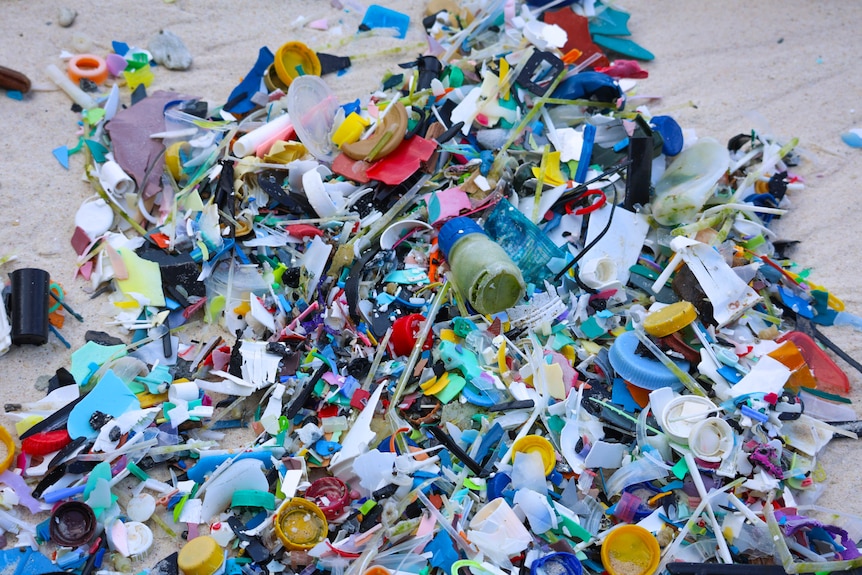 Plastics compile on Greta Beach, Christmas Island.(ABC Pilbara: Mietta Adams)
Dr Abrahms-Kavunenko says limiting the production of plastics and a Global Plastics Treaty are essential.
But the future of a worldwide treaty is uncertain after talks between 185 nations fell apart in August.
At the time, federal Environment Minister Murray Watt said he was disappointed by the result.
He acknowledged that plastic pollution was particularly detrimental to islands, and said the Australian government would invest more in new recycling infrastructure on small islands.
Christmas Island has no recycling facilities, after its only local recycling workshop stopped operating in 2023 due to external difficulties.
Push against plastics
Statistics recorded by the Australian Marine Debris Initiative (AMDI) — a national network of volunteers, communities, and organisations coordinated by the Tangaroa Blue Foundation — make for grim reading.
In 2025, the AMDI database recorded that 55,723 pieces of hard plastics, 4,404 plastic lids and bottle caps, and 4,142 pieces of foam insulation and packaging had been collected during clean-ups of Greta Beach.
Loading…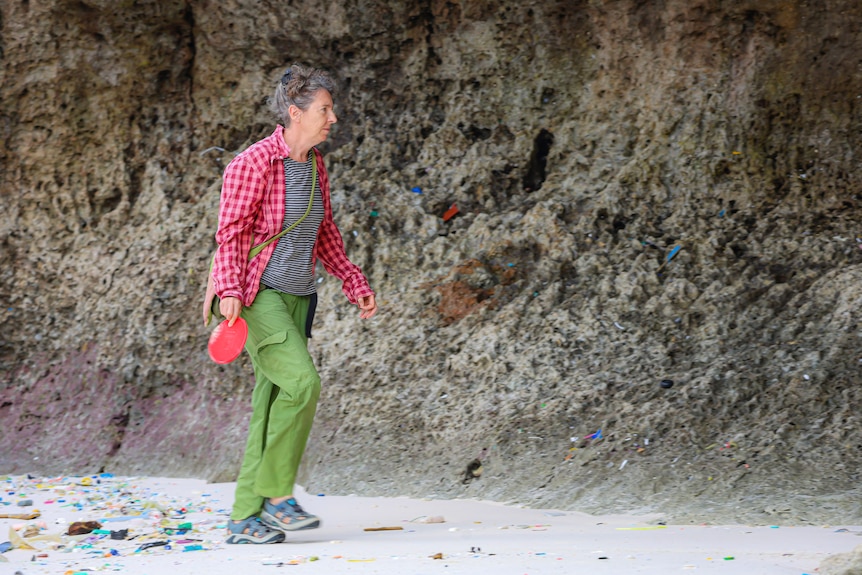 Greta Beach is a trove for artist Cecile Williams.(ABC Pilbara: Mietta Adams)
Locals say the types of materials that wash up on the beach vary.
For example, Tangaroa Blue said foam insulation fragments increased by 11.5 times between 2023 and 2024.
Most recently, the island’s beaches have been awash with hundreds of rubber thongs.
The variety of debris inspires artist Cecile Williams, who returned to the island to present a community exhibition.
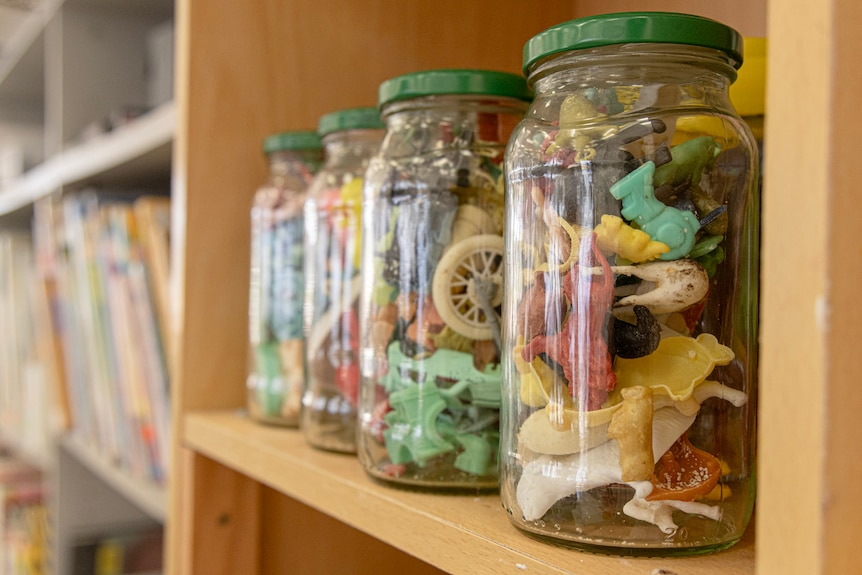 Long lost toys are kept in the school art room.(ABC Pilbara: Mietta Adams)
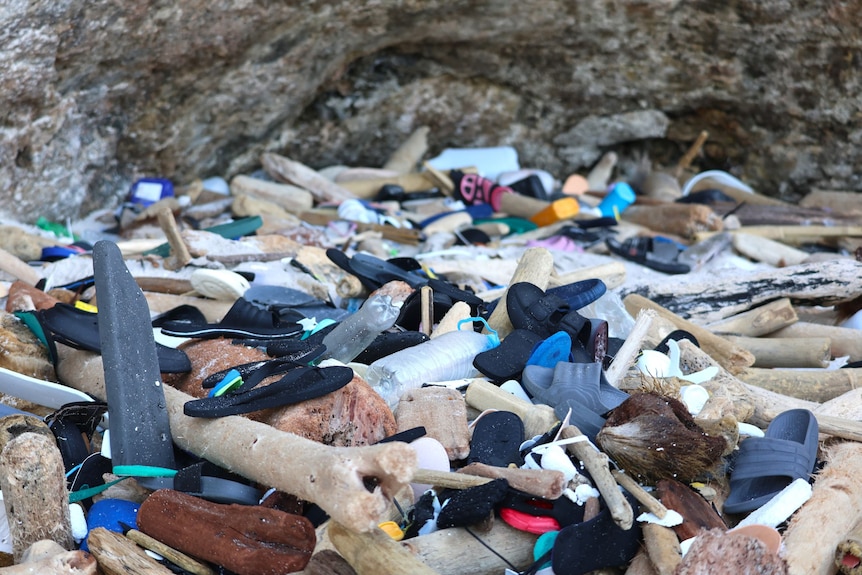 Plastic scuffs, rubber thongs, and other shoes wash up on Greta Beach.(ABC News: Mietta Adams)
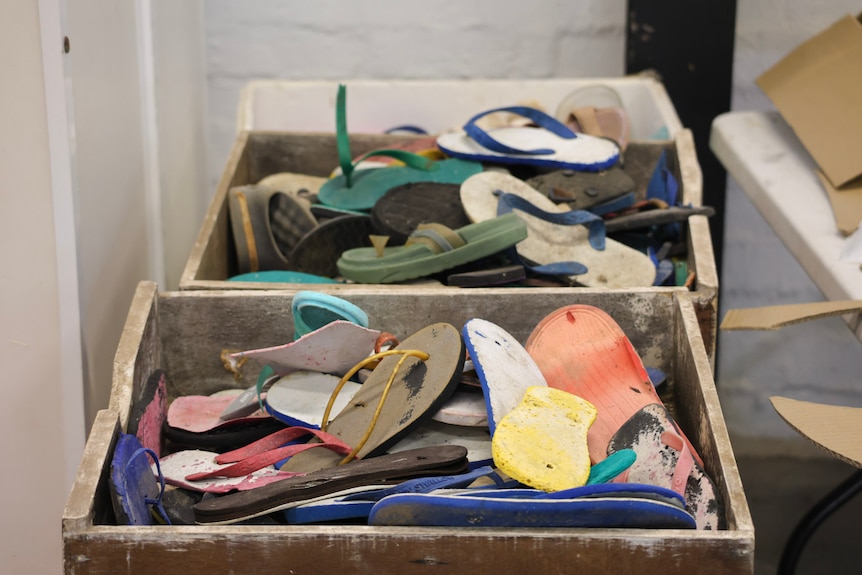 Thongs are particularly abundant.(ABC Pilbara: Mietta Adams)
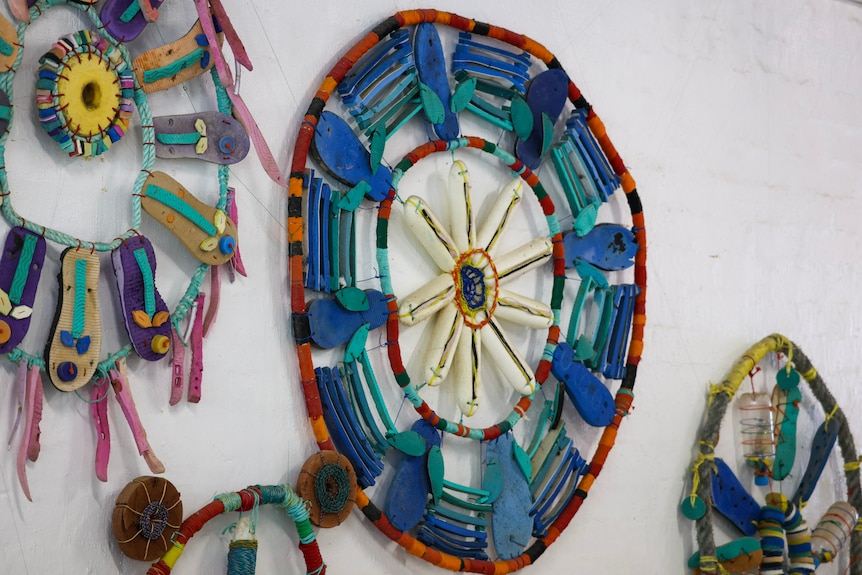 Trash becomes treasure in the art room.(ABC Pilabra: Mietta Adams)
“It’s a free material, it’s also helping clean the beach while we go down there, but it tells a huge story,” she says.
“It’s sort of finer plastics now.
“It’s probably the most plastics I’ve ever seen … the habitat’s getting destroyed.”
As artist-in-residence, Ms Williams worked with the community, from school students to those in respite care, to create artworks based on their encounters with nature.
Fifteen-year-old student Inayah Sultan Syed centred her artwork around phosphate bags — which are used to collect rubbish during the clean-ups.
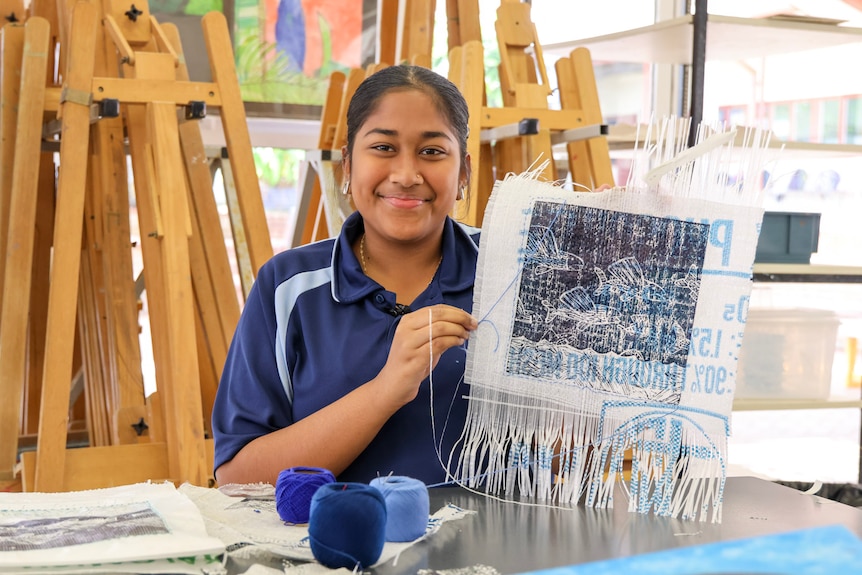 Inayah Sultan Syed’s lino print of flying fish on a phosphate bag.(ABC Pilbara: Mietta Adams)
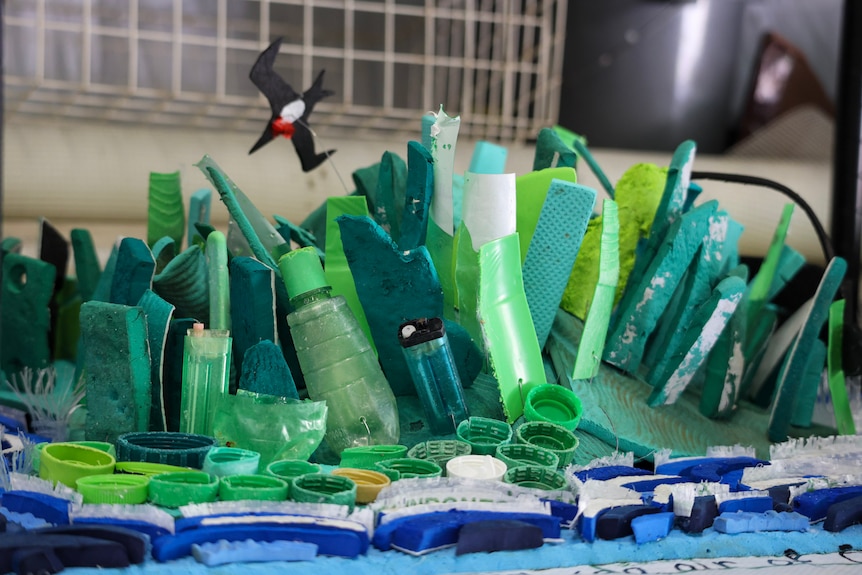 Christmas Island recreated in plastic.(ABC Pilbara: Mietta Adams)
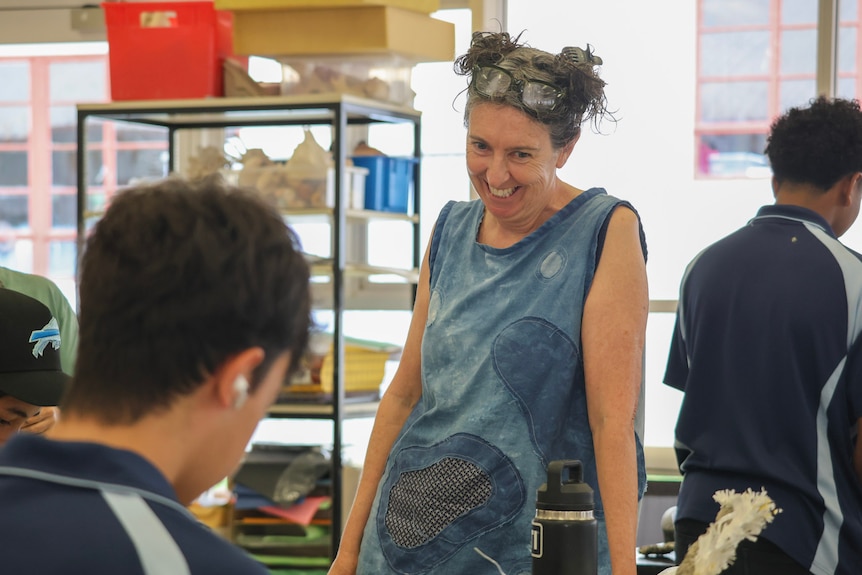 Ms Williams at Christmas Island District High School.(ABC Pilbara: Mietta Adams)
She helps organise the Christmas Island District High School’s marine debris audits at Greta Beach.
In 2025, the school collected 846 kilograms of rubbish in one clean-up.
“It was like a full truck filled with rubbish,” Inayah says.
“And the sad thing is the next day the rubbish would just come back up.”
Ms Williams’ community exhibition explored the dichotomy between the island’s unique natural environment and its pollution.
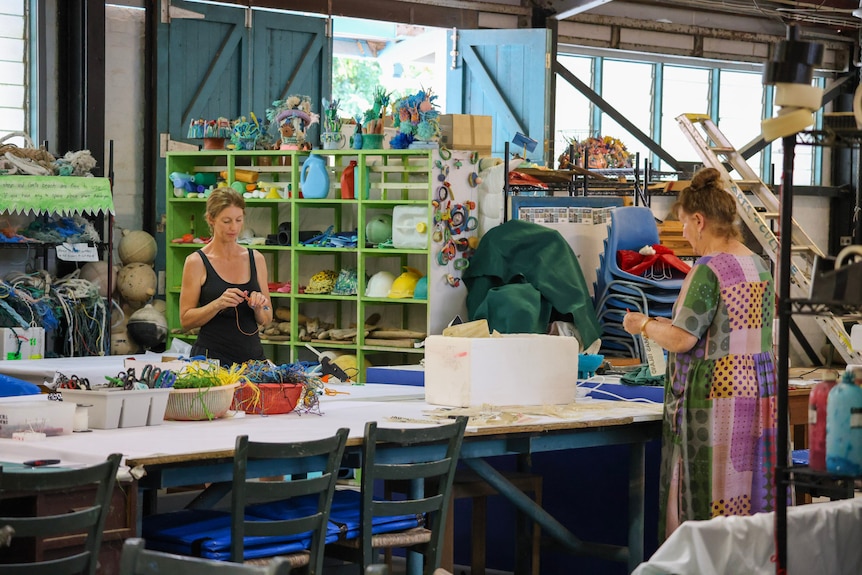 An artist workshop on Christmas Island.(ABC Pilbara: Mietta Adams)
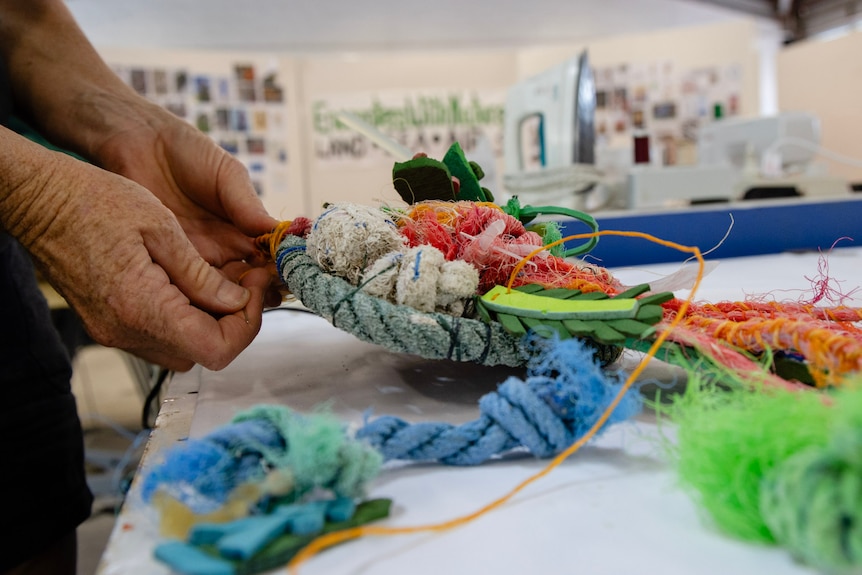 Nylon twine turned colourful embroidery.(ABC Pilbara: Mietta Adams)
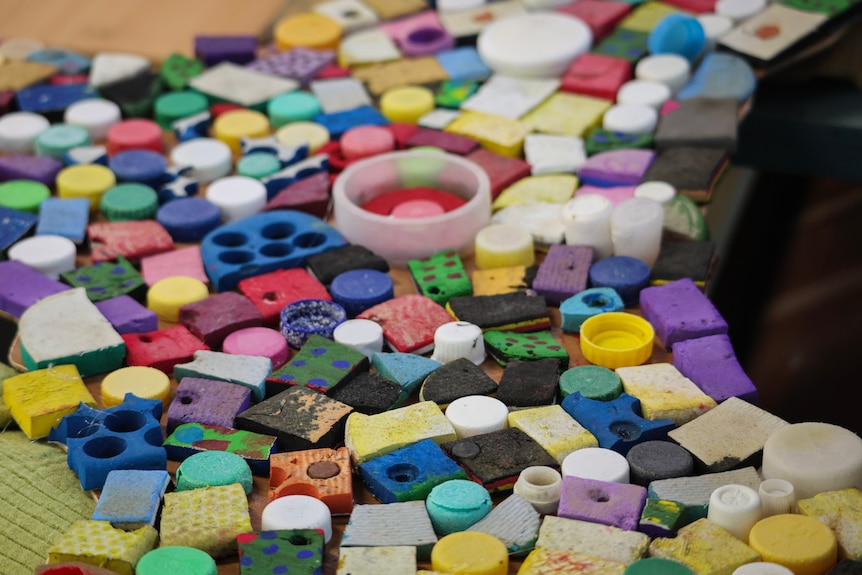 A mosaic of plastic detritus.(ABC Pilbara: Mietta Adams)
“It is shocking, but I think the more people can make and talk about it, the more it gets out into the world,” she says.
“It’s like equal to the Galapagos Islands in terms of what nature is here, and they really need to protect it.”
Community rallies for solutions
Each year, Tangaroa Blue runs volunteer trips to the Indian Ocean Territories, collecting data and cleaning up beaches.
Polystyrene is the most common marine debris found on the island.
More than 255 polystyrene boxes are delivered to the Indian Ocean Territories every fortnight carrying essential fresh freighted food.
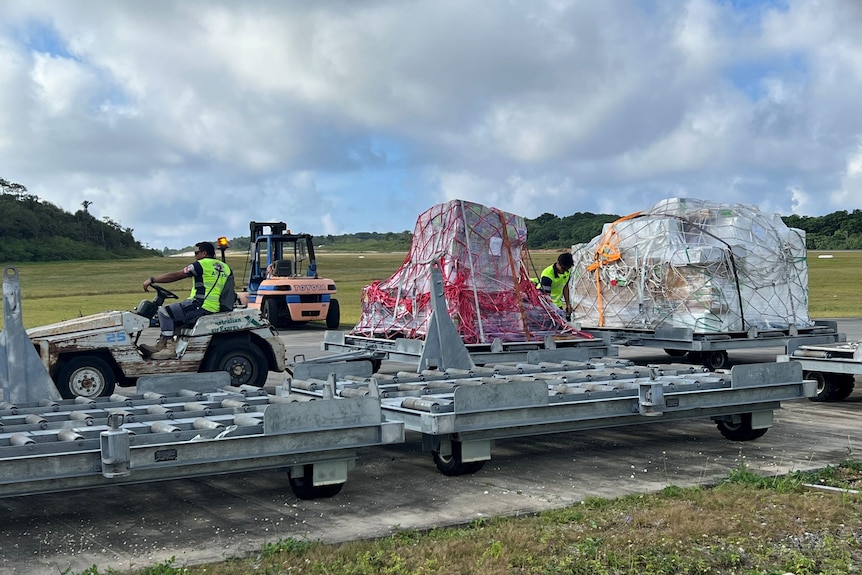 Polystyrene boxes arrive at Christmas Island airport carrying food and other essentials.(ABC Pilbara: Mietta Adams)
But these boxes become especially hazardous to the marine environment when they are irresponsibly discarded.
Under the tropical sun and in the thundering surf, the boxes break into smaller pieces and release millions of microplastics into the environment, harming marine life.
To tackle the problem, Tangaroa Blue has created Christmas Island’s esky library, in which eskies are re-purposed by businesses.
Recyclable packaging alternatives are also being trialled, with up to 30 different uses.
Meanwhile, a local urban farm initiative, Green Space Tech, has been converting the boxes into simple hydroponic systems to grow fresh produce.
 Eskies become planter boxes at Christmas Island’s Green Space Tech.(ABC Pilbara: Mietta Adams)
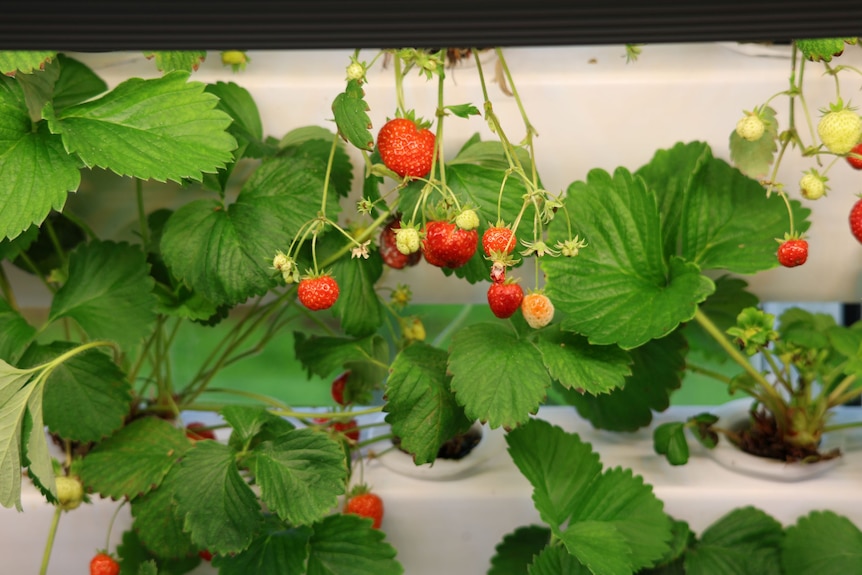 A freshly sprouted strawberry is a rare sight on Christmas Island. (ABC Pilbara: Mietta Adams)
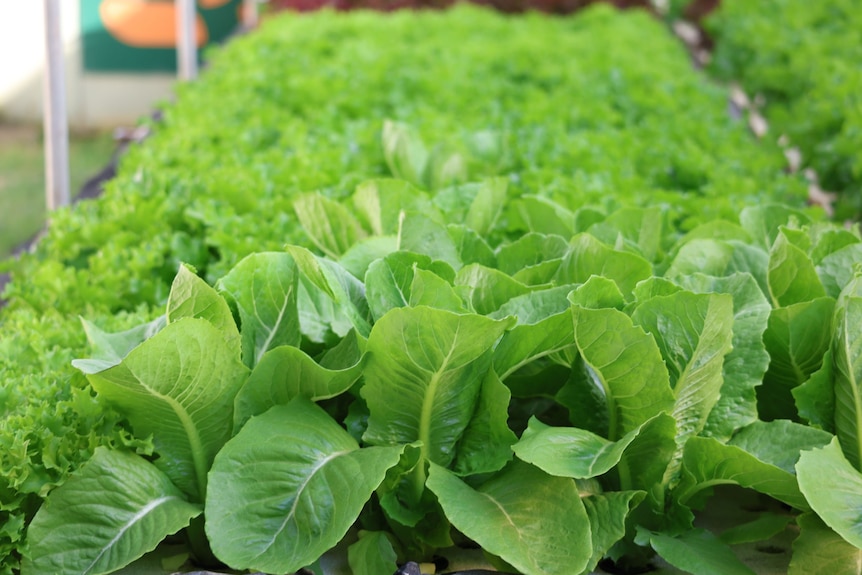 The Green Space Tech initiative is helping to supply fresh produce to islanders.(ABC Pilbara: Mietta Adams)
“Just about everything fresh is flown in on these boxes,” Green Space Tech manager Ken Hawkins says.
“What we’ve done is turn that into an opportunity to grow some produce.”
The kits are also sold to community members.
Eco Crab Industries founder Tanya Cross hopes to revive her plastic-recycling workshop on the island in the future.
The process involved shredding, moulding and compressing plastics into items like bowls and coasters.
She said Greta Beach presents a complex problem that needs multiple solutions.
“That is the biggest hope — that the tap can be stopped,” she said.
“If you can stop the plastic coming in, that would be one of the biggest achievements of the world.”
Island Care volunteers are also educating the community on reusable alternatives to plastics.
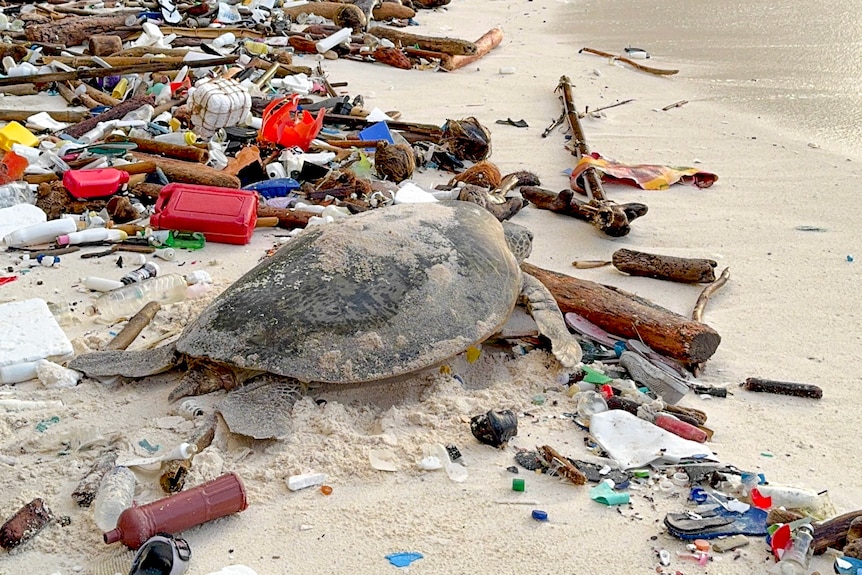 The unnatural sight of a turtle wading through plastic.(Supplied: Robyn Stephenson)
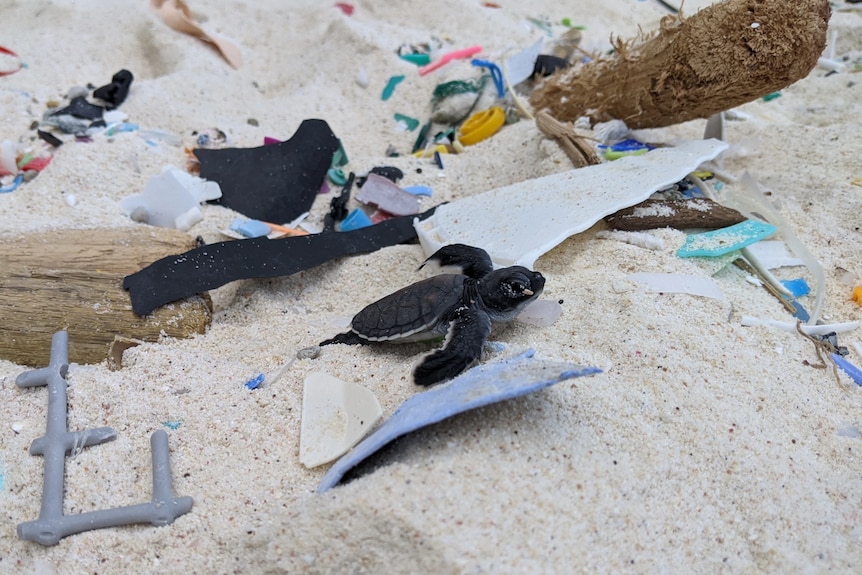 Born into a world of waste.(Supplied: Eco Crab Industries)
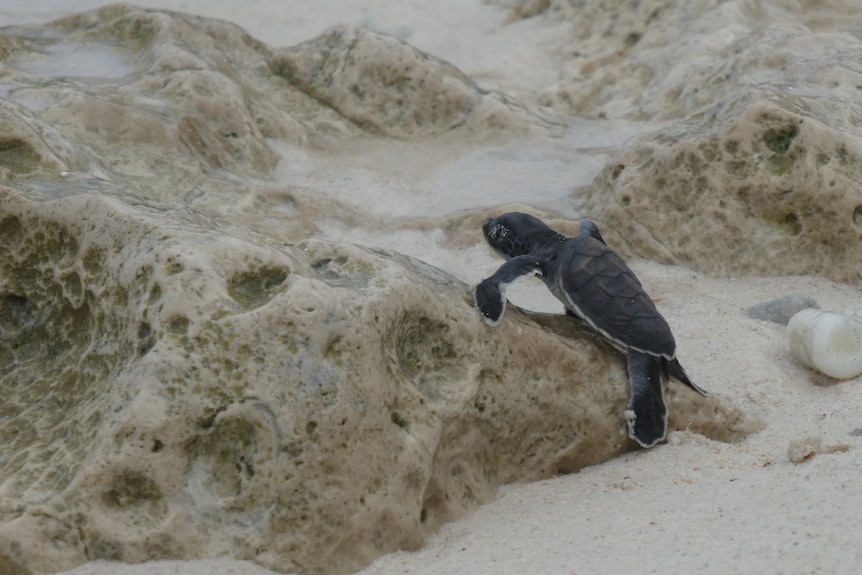 Baby green sea turtles struggle across the beach.(Supplied: Eco Crab Industries)
Ms Gaff believes the efforts to clean the island and change plastic consumption habits are not in vain.
“I feel like it’s too easy for people to go, ‘Oh, this is too big for me’ … but I just look at those baby turtles,”
she said.
“This is worth it to save those turtles.
“It’s a global problem that … we all have a part in.”
Credits
Reporting and photography: Mietta Adams
Reporting and videography: Alistair Bates
Editing and digital production: Rachel Kelly
Additional video: Robyn Stephenson and Eco Crab Industries
Video editing: Anthony Scully