Unlock the Editor’s Digest for free
Roula Khalaf, Editor of the FT, selects her favourite stories in this weekly newsletter.
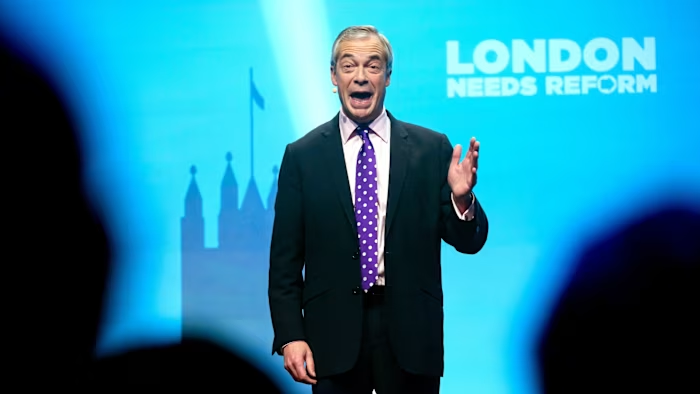
Nigel Farage has vowed to fight Sir Keir Starmer’s reset of EU relations and uphold Brexit, as he fired the starting gun on Reform UK’s campaign to win control of local councils across London in May.
Over the past couple of years, Farage has tended to avoid talking about the UK’s relationship with the EU and Brexit — the project for which he spent most of his political career fighting — given it remains so divisive in British politics.
But in the expansive Excel centre in east London’s docklands on Friday evening, the Reform leader lambasted Starmer’s efforts to secure an EU reset, declaring that the prime minister was “doing his best to give away our parliamentary sovereignty, to give away our rights as voters”.
He pointed in particular to Starmer’s decision to rejoin the Erasmus exchange programme, which he said would allow more students to come to Britain than the UK would send to Europe, while also claiming that the prime minister was committing the UK to adopting EU energy policy.
“I promise you, we will fight this giveaway, this surrender of our sovereignty, of our money, of our fishing grounds and everything else,” he told a cheering audience.
Starmer has ruled out rejoining the EU customs union but gave two speeches last month promising closer ties with the bloc, which allies say are aimed at re-energising talks on delivering a “reset”.
Detailed discussions are under way aimed at reducing barriers to trade in food and energy, alongside plans for Britain and Brussels to facilitate more youth movement and student exchanges.
Arriving on stage with his usual pyrotechnics, Farage said: “we know that Britain is broken, nothing works anymore. We know our politicians have been hopeless”, while he claimed Reform was “providing genuine hope”.
The hall was flanked on both sides by stands representing London’s 32 councils, where members could sign up to support local campaigns or put themselves forward as candidates.
In recent years the capital has been increasingly composed of onion-like layers with more left-leaning boroughs in the inner city and increasingly rightwing bands further out, with some held by the Tories.
Some of the outer boroughs, including Barking and Dagenham, Havering, Enfield, Sutton, Bexley and Hillingdon, are showing rising support for Reform.
In an interview last month, Farage told the Daily Mail he was hoping to win control of six of the 32 London councils in May.
Farage also touched on one of Reform’s big themes — “decline” and criminality in the capital.
A few decades ago, London was “thriving” but now it is “looked down upon by most of the world” because of “an epidemic, a crime wave, led by foreign gangs of epidemic proportions”, Farage said.
London mayor Sadiq Khan has strongly rejected this depiction, accusing people on the right of British politics of trying to tear down London “because it’s diverse, progressive, liberal, multicultural and incredibly successful”.
The Excel crowd gave a standing ovation to Reform’s recently announced mayoral candidate, Westminster councillor Laila Cunningham.
“The social contract between us and the state has collapsed,” the former lawyer told the audience. “Londoners are scared because London is more dangerous.”
Outside the conference centre, a 42-year-old taxi driver called Heda, born and raised in east London, said he did not recognise that characterisation.
“There used to be areas I wouldn’t go to, but now I feel like most places are pretty chilled,” he said. “I haven’t been robbed since I was a little kid.”