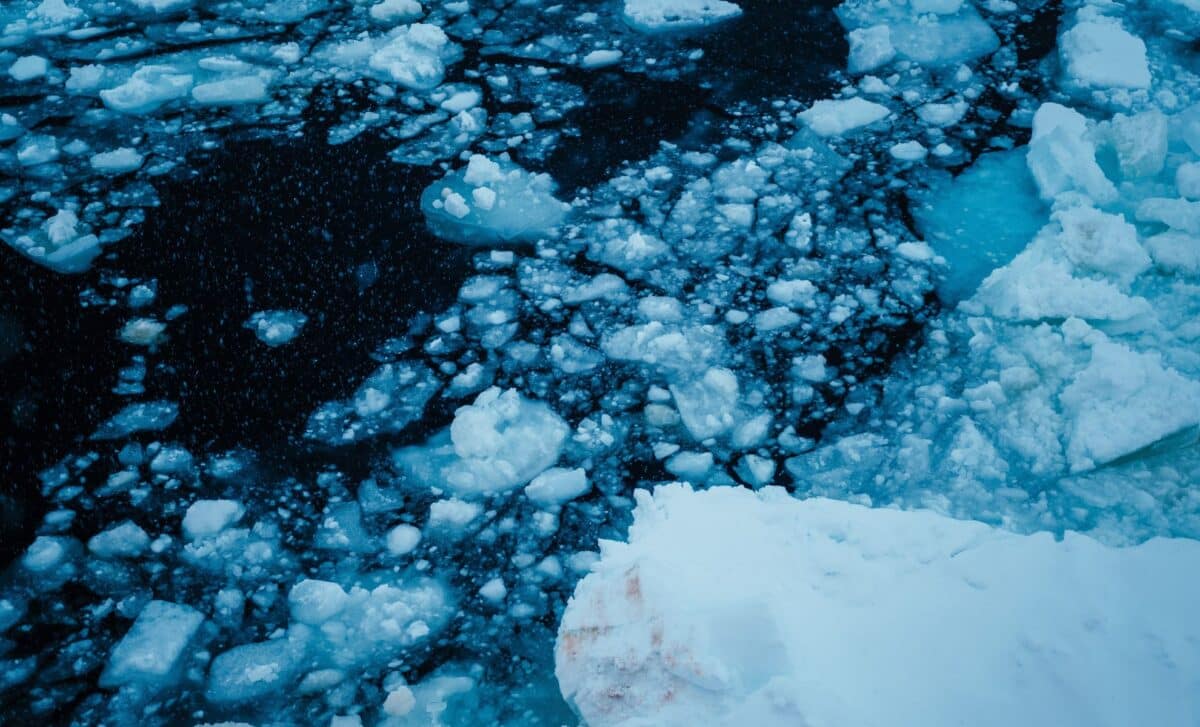
Iceberg A-23A, once the largest iceberg on Earth, is starting to show serious signs of its final days. Recent satellite images captured by NASA reveal pools of bright aquamarine water spreading across its surface, a clear indication that the massive chunk of ice is likely to disintegrate in the near future. According to scientists, this once colossal iceberg could be completely gone in just a matter of days or weeks.
For decades, it has captured the attention of scientists and researchers alike, as it has slowly shrunk and drifted across the oceans. And while this may just seem like another piece of ice breaking away, it’s actually a far more significant event.
A Journey Like No Other
This iceberg’s journey has been nothing short of extraordinary. Breaking off from Antarctica’s Filchner Ice Shelf in 1986, A-23A started as a massive slab of ice, about the size of Rhode Island. It was a true titan of the ice world, measuring 1,500 square miles. For decades, it remained stuck on the seafloor of the southern Weddell Sea until it finally broke free in the early 2020s, setting off on its long and unpredictable journey.
 A NASA astronaut aboard the ISS took this photo of Antarctica’s A-23A iceberg. Credit: NASA
Over the years, it has drifted across the oceans, and at one point, in March 2024, it got caught in a spinning vortex in the Drake Passage. After being tossed around for a bit, it ended up on the shallow coastal shelf south of South Georgia Island, only to eventually free itself again.
But it didn’t travel far before coming to a halt just north of the island. The iceberg’s size, even in its current state, is still pretty impressive, measuring 456 square miles (a little over a thousand square kilometers), which is still much larger than New York City, as noted by NASA’s Terra satellite.
Meltwater Pools: A Clear Warning
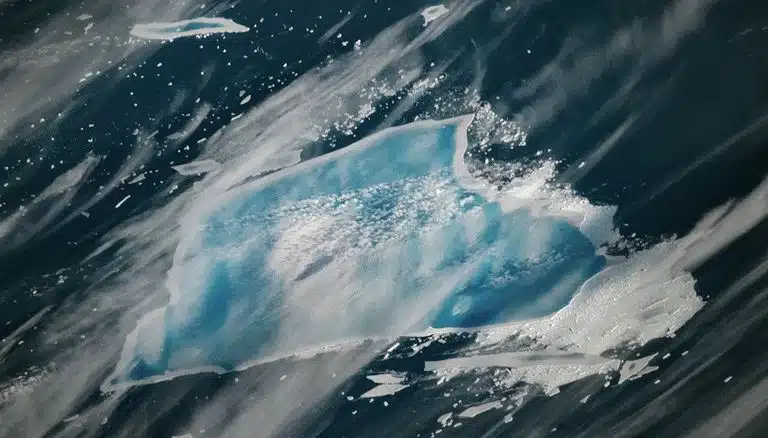
According to NASA’s Earth Observatory, one of the most concerning developments in recent months has been the formation of meltwater pools on A-23A’s surface. These pools, captured in stunning blue tones by NASA’s MODIS satellite on December 26, 2025, are a warning sign.
 the Moderate Resolution Imaging Spectroradiometer on NASA’s Terra satellite captured this image of the waterlogged iceberg. Credit: NASA
The iceberg is slowly being waterlogged as the ice melts at an accelerated rate, and that’s creating enough pressure to crack and weaken the structure. As reported by Walt Meier, a senior scientist at the National Snow & Ice Data Center:
“The striations formed parallel to the direction of flow, which ultimately created subtle ridges and valleys on the top of the iceberg that now direct the flow of meltwater.”
The markings on the iceberg, left from when it was part of a bigger ice sheet, are still visible even after a lot of melting. But the real worry is the meltwater pools. They show the iceberg is breaking down, and the white spots on satellite images could mean it’s leaking, speeding up its disintegration.
The End of an Era? Why It’s Significant
As A-23A drifts toward warmer waters, scientists are predicting its inevitable collapse. “I certainly don’t expect A-23A to last through the austral summer,” said Chris Shuman, a retired scientist from the University of Maryland Baltimore County.
“I’m incredibly grateful that we’ve had the satellite resources in place that have allowed us to track it and document its evolution so closely,” he added. “A-23A faces the same fate as other Antarctic bergs, but its path has been remarkably long and eventful. It’s hard to believe it won’t be with us much longer.”
Over the years, Antarctic icebergs like A-23A have been breaking apart more frequently as temperatures rise, and this iceberg seems to be following that trend. The image captured by the Terra satellite paints a worrying picture: The iceberg is floating in water that’s only 3°C (37°F), and with the arrival of even warmer waters, its fate appears sealed.
The current largest iceberg, A-23A
This is the course of planet’s current largest iceberg, A-23A. It separated from Antarctica in 1986. (Image Credit: NASA Visible Earth)
Area: approx 3,000 sq km (1,150 sq miles) (2024) pic.twitter.com/ADLxuSSVyC
— Geography Host (@geographyhost) February 16, 2025