
Three years ago the Seagreen wind farm off the eastern coast of Scotland was opened to quite some fanfare.
The development was Scotland’s largest, producing enough electricity from its 114 turbines to power 1.6 million British homes, and, ministers were quick to point out, was “proof” of Britain’s status as a green energy superpower.
SSE, the company behind the project, said it would “deliver on the UK’s net-zero ambitions to provide cheaper, cleaner and more secure energy around the country”.
Yet three years on Seagreen has turned into something of a green elephant.
Over three quarters of the power it was intended to generate was squandered in the year to March 2025 because Britain’s electricity grid couldn’t handle it. Instead the wind farm owner was paid tens of millions of pounds for it to stand idle.
This trend has continued: for the entirety of 2025, Seagreen was paid to switch off for 63 per cent of the time it was due to generate.
And it’s not just Seagreen. Viking, one of Britain’s biggest onshore wind farms, built by SSE on Shetland, was paid to switch off for 65 per cent of the time it should have been generating, according to data from GB Renewables Map.

Viking wind farm on Shetland
SSE/PA
Across Scotland, wind farms were paid not to produce 37 per cent of their planned output during the first half of last year, as the electricity could not be used locally or moved to where it was needed.
• Shetland’s politicians ‘could stand in way of green prosperity’
And it was expensive. In all, consumers spent £1.5 billion last year paying for wind farms to switch off when they planned to generate and paying for other plants to replace them. This wasted wind is expected to grow over the next four years as more windfarms come on line.
The fundamental problem, in layman’s terms, is a lack of cables.
Wind farms, often built offshore or in remote parts of Scotland, sell the electricity they generate on Britain’s national market.
But there are cabling bottlenecks that prevent the energy from getting to where it needs to go: one across the middle of Scotland, and one along the border between Scotland and England.
“There is more power being generated up in Scotland than Neso [the National Energy System Operator] can flow down into England, and Scotland can’t use it all,” says Tom Edwards, principal modeller at Cornwall Insight, the energy consultancy.
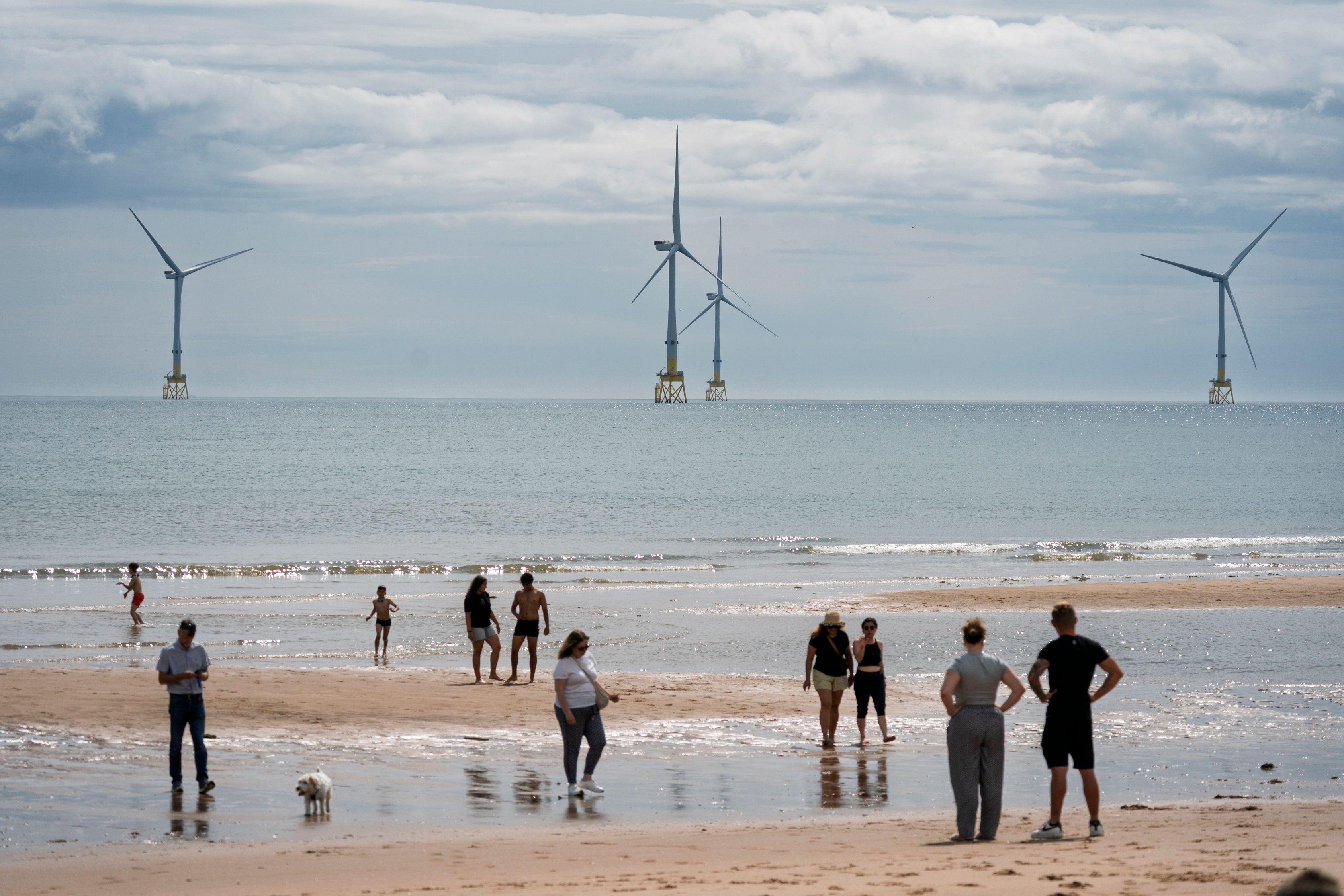
Another Scottish wind farm in Aberdeen Bay
ALAMY
A spokesman for the energy company SSE said: “The UK has built renewables where the resources are strongest, and now we need to upgrade the grid to eliminate bottlenecks so we can harness more of that energy, more of the time.”
When there is too much electricity being generated for the grid to cope Neso, the government-owned body responsible for keeping Britain’s lights on, intervenes.
It has to keep supply and demand across the network balanced in real-time to avoid blackouts and as a result pays wind farms to switch off while at the same time paying for power plants nearer to consumers to fire up and replace them.
But how did Britain arrive in this bizarre position of building wind farms without the required cabling?
The situation stems from a policy called “connect and manage”, introduced by Ofgem in 2009 and confirmed by the government in 2010.
It was designed to encourage investment in wind farms to help Britain hit its 2020 renewable energy targets by assuring investors they would be able to sell their power as expected, even if the required grid upgrades — for which they weren’t responsible — were delayed.
If the wind farms were curtailed because of grid bottlenecks, they would still receive the money they had made selling the planned generation, plus “constraint payments” — compensation for any extra costs or missed revenues like subsidy payments.
The theory was that wind farm investors would otherwise require much higher prices to make their projects viable, to insulate them against the risk of the cables not being built on time.
Initially, it seemed to work and constraint payments were relatively low.
“They did build the infrastructure for 2020, they just stopped paying attention around 2015,” claims one industry source, who says the government, regulator and the system operator — then part of National Grid — collectively dropped the ball and stopped planning properly to ensure the network would keep up with the expansion of wind farms. There was no strategic plan for 2025 — “and we’re now playing catch-up”.
Others say that Ofgem — which regulates the energy market, setting bills and determining how much money can be spent on upgrades — was too keen to focus on keeping consumer costs low in the short term without thinking of the long-term consequences.
“There hasn’t been enough anticipatory investment,” says Edwards. “The network companies haven’t been given the money to invest ahead of need, because the regulator was too keen on lowering costs without thinking about the total picture.”
The result for consumers is they now face a rising bill for constraints — as well as a rising bill to belatedly fund a massive expansion of the network of new cables to try to tackle the issue.
And it is going to get increasingly expensive. The concern in Whitehall is that as more wind farms come online, so-called constraint payments will continue to rise.
Already constraint payments are the biggest part of the overall cost of Neso balancing the network, which stands at about £2 billion a year and accounts for about £44 on an annual household bill. Neso has estimated that by 2030 constraint costs will drive balancing costs up to £8 billion, adding significantly to bills, before falling again in subsequent years as new cabling comes online.
“Everyone wants to see constraint payments minimised, so there’s an urgent need to build new grid capacity as fast as possible,” says Barnaby Wharton, head of flexibility grid at Renewable UK, the wind industry body. “Major new undersea cables are being laid including the powerful high-voltage Eastern Green Links connecting Scotland and England, which will go live from 2029 onwards.”
Last month Ofgem approved plans for a £70 billion spending programme to fund such upgrades to the transmission network over the next five years, which will in itself add about £60 to annual bills by 2030. It says this should negate about £55 per household of Neso’s forecast increased constraints and mean that by 2031 constraints are only about £10 per household higher than today.
But in the meantime, the unedifying spectacle of paying huge sums for wind farms to stand idle is set to continue — with a raft of big new offshore wind farms due to be given the go-ahead by the government next week as it scrambles to try to hit its 2030 decarbonisation target.
The biggest looming bottleneck is in East Anglia, where there isn’t enough transmission capacity between the grid in Norfolk and Suffolk and the rest of the country. This area accounts for about £4 billion of the forecast spike in constraint costs in 2030.
“There’s going to be the German and the Danish interconnectors and then lots of offshore wind farms in Norfolk,” says Edwards. There are also nuclear plants: “You’ve got Sizewell B in Suffolk, and then Sizewell C would also add to that [in the 2030s], which means that there’s going to be a lot of power in Norfolk, and not the capacity to flow it out.”

The site of the Sizewell C nuclear power plant, next to the existing Sizewell B, in Suffolk
CHRIS RADBURN/REUTERS
Neso has said that these costs can only be avoided if National Grid can deliver two big controversial cabling projects ahead of time to reinforce the network around East Anglia: SeaLink, offshore between Suffolk and Kent and Norwich to Tilbury, a 114-mile line involving 50-metre high pylons through Norfolk, Suffolk and Essex.
Few in the industry believe this is achievable, and expect constraints will only start coming down once they are completed, which is due in 2031.
Central planning will be key to getting the situation under control in the longer-term. Neso is drawing up a “strategic spatial energy plan” for the government that would help select where wind farms are built, factoring in networks.
A spokesman for Neso said: “We are determined to play our part in keeping the costs of balancing the electricity system as low as possible, and our development of new tools, reforms and close collaboration with industry, has already saved consumers at least £1.2 billion.
“But the delivery of new electricity network transmission infrastructure and future electricity market arrangements will be vital to lowering these costs for consumers in the long term.”
In other words: The green elephants will be around for quite some time yet.