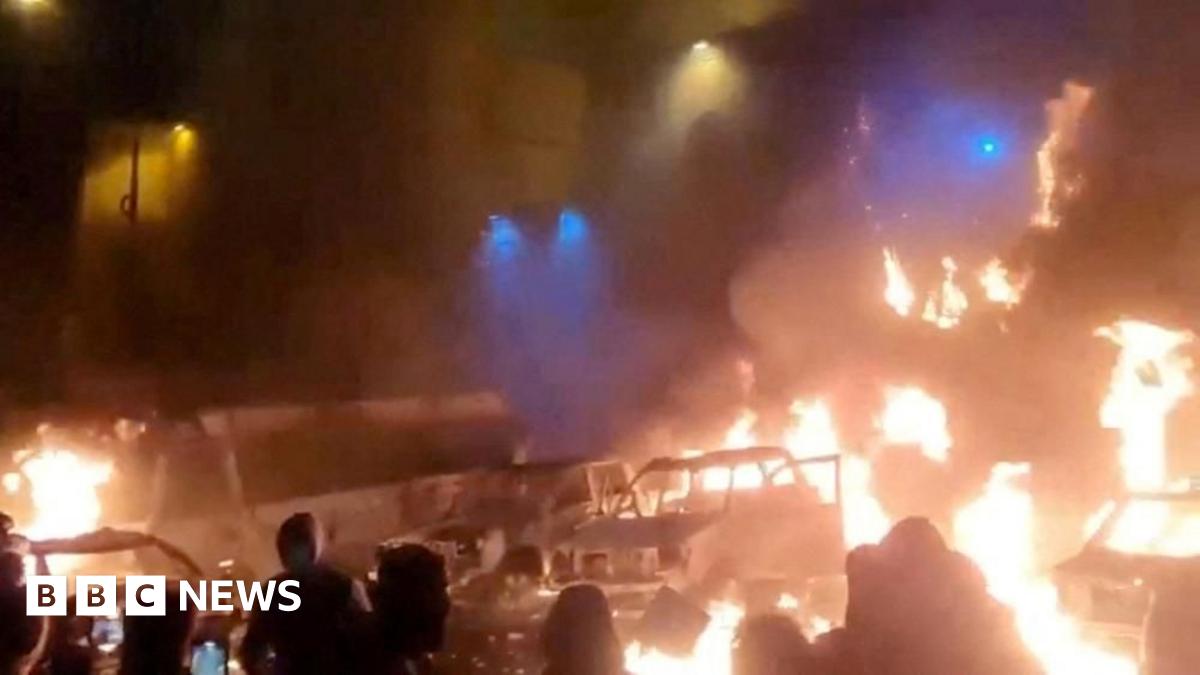
Former British ambassador to Iran, Sir Simon Gass, told BBC Radio 4’s Today programme “we really shouldn’t get too ahead of ourselves” when discussing regime change.
He said the lack of organised opposition within Iran means that people do not have anyone to coalesce around who presents an alternative to the regime as it stands.
He added, however, that these protests are different to previous ones in the country, which are bringing in “a much wider movement of protesters than we’ve tended to see in the past”, triggered by ordinary people finding it “almost impossible to make ends meet because of the disaster to the economy”.
At the White House on Friday, Trump said his administration was watching the situation in Iran carefully.
“It looks to me that the people are taking over certain cities that nobody thought were really possible just a few weeks ago,” he said.
He echoed earlier warnings to Iran’s leadership, saying: “We will be hitting them very hard where it hurts.” He added that any US involvement did not mean “boots on the ground”.
On Thursday, Trump said he would “hit them very hard” if they “start killing people”.
Later on Friday, the US said Iran’s foreign minister was “delusional” after he accused Israel and Washington of fuelling the protests.
“This statement reflects a delusional attempt to deflect from the massive challenges the Iranian regime faces at home,” a US State Department spokesperson said in response to the comments by Foreign Minister Abbas Araghchi.
Early on Saturday, US Secretary of State Marco Rubio posted on X: “The United States supports the brave people of Iran.”
Iranian political activist Taghi Rahmani, who spent 14 years in prison in Iran and whose wife, Nobel Peace Prize winner Narges Mohammadi, was re-arrested in December, told the Today programme he was dubious of American support.
“We believe foreign intervention will make the opposition dependent,” he said. “When the opposition is dependent, you have to sacrifice national interests for that government. This will not be acceptable for the Iranian people.”
The Iranian security and judicial authorities had issued a series of coordinated warnings to protesters on Friday, hardening their rhetoric and echoing an earlier message of “no leniency” by Iran’s top security body, the Supreme National Security Council.
Iran’s National Security Council said “decisive and necessary legal action will be taken” against protesters, which it described as “armed vandals” and “disruptors of peace and security”.
The intelligence arm of Iran’s Islamic Revolution Guard Corps (IRGC) said it would not tolerate what it described as “terrorist acts”, asserting that it would continue its operations “until the complete defeat of the enemy’s plan”.
Additional reporting by Soroush Negahdari