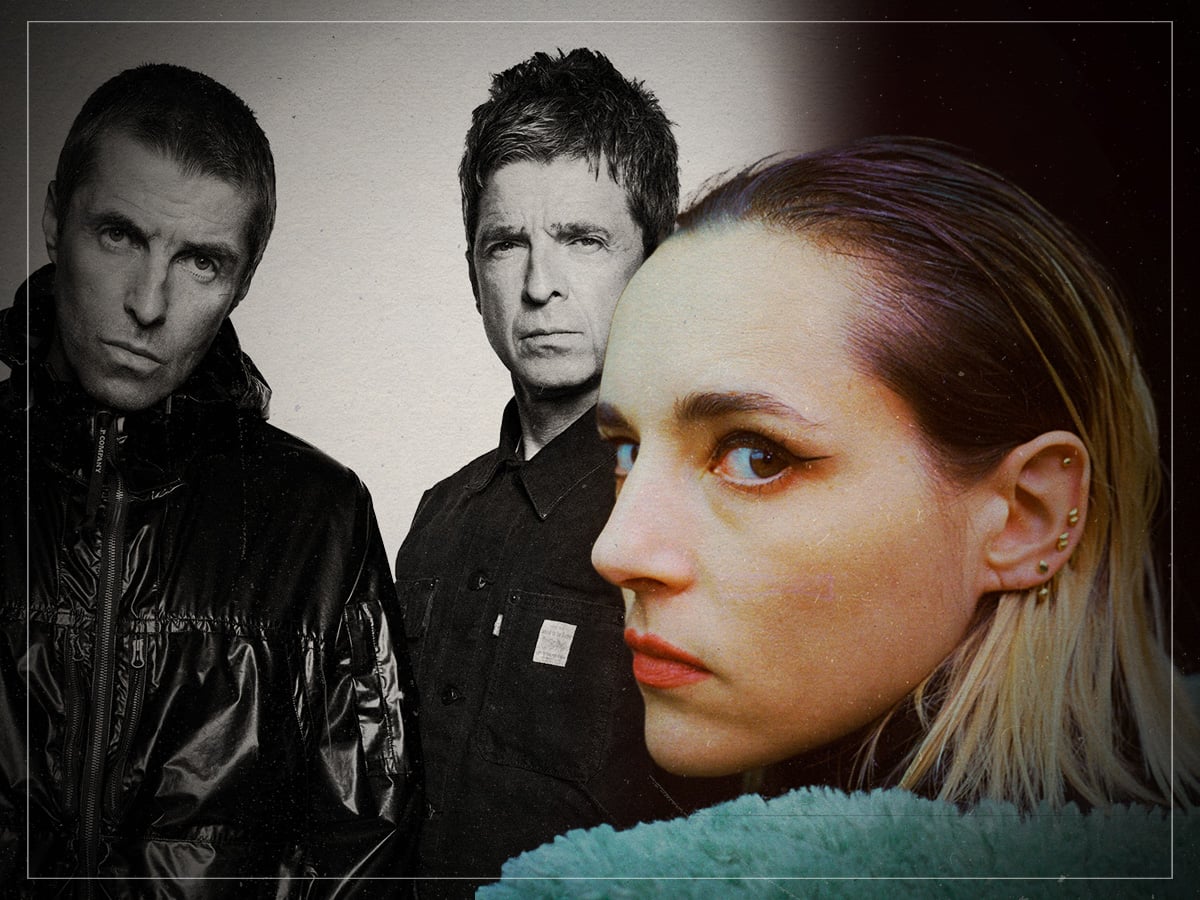
(Credits: Far Out / Simon Emmett / Johnny Hostile)
Sat 10 January 2026 8:00, UK
1994 was quite the year for popular culture.
Quentin Tarantino shocked the film world with Pulp Fiction, while Tom Hanks simultaneously broke and warmed everyone’s hearts playing the titular Forrest Gump. The world lost Kurt Cobain and, in his absence, the ascent of nu-metal, hip-hop and Britpop into the mainstream began. From this, Oasis shifted the culture with the release of their debut album Definitely Maybe, which featured the of ‘Live Forever’.
“‘Live Forever’ sounds so at odds with its time: 1994,” Jehnny Beth reflects to The Guardian. “I find it incredible that someone could wrap a ‘fuck you’ inside a song so openly positive.”
As one of modern rock’s most brilliant minds, it is fitting that Beth would resonate with the Gallagher brothers, all sharing a penchant for dual disruption and introspection. Beth (born Camille Berthomier) made waves as one half of the indie rock duo John & Jehn with her partner, Johnny Hostile (Nicolas Congé), before joining English post-punk revivalists Savages in the 2010s.
With her official emergence as a solo artist in 2016, opening for PJ Harvey, Beth leaned into the spirit of collaboration, eventually working with the likes of Julian Casablancas and Bobby Gillespie of Primal Scream. Her album To Love Is to Live saw her work with everyone from her close friend Romy Madley Croft of The XX, Joe Talbot of Idles and prolific producer Atticus Ross. In 2017, she would record with Noel Gallagher on the Gorillaz single, ‘We Got the Power,’ a world-colliding moment for the artist who’d grown up with Oasis’ music.
In 1991, Noel was working for a building company in his Manchester hometown, when his foot was accidentally crushed by a pipe. Resigned to the company’s storeroom, Gallagher found a silver lining in being able to use his newfound downtime to write songs. From this interim, ‘Live Forever’ was born, writing the opening line from the melody of the Rolling Stones’ ‘Shine a Light’: “Maybe I don’t really want to know…”
“In the wreckage left behind by Thatcher’s Britain and the shadow of Kurt Cobain’s pain,” Beth ponders, “Noel wrote an insolent, unapologetic love letter of self-belief from a place of nothing to lose, against a generation of moaners who have everything and still find reasons to complain.”
Indeed, Noel wrote the song as a sort of retaliation against Generation X’s nihilism, amplified in the grunge movement’s often downtrodden spirit. While emphasising that he was a fan of Nirvana and that ‘Live Forever’ was not intended as a direct response to their music, Noel named their single ‘I Hate Myself and Want to Die’ as one that sparked his change of heart.
“Well, I’m not fucking having that,” he thought to himself, stating, “That’s fucking rubbish. Kids don’t need to be hearing that nonsense.”
Instead, he decided to choose optimism in the face of pessimism, even if it meant acknowledging the hardships of a life filled with uncertainty. He may not have had much to his name, but he had a sheer hope at the possibility of something greater coming along. As Liam sings, “Now is not the time to cry, now’s the time to find out why.”
Released in August of 1994, ‘Live Forever’ was a rallying cry that resurrected a much-needed hope and, in turn, placed Oasis in the UK’s top ten charts for the first time. “The song is written to step over the corpses of the past, unearthing the flag of romance others have tried to bury,” Beth beautifully notes.
Concluding, “It’s a lesson in (working) class. The kind of optimism they summon is believable because it’s not polished or corporate. It’s radical. They’re not promising a future, they’re daring you to want one.”
Related Topics