(Credits: Far Out / Alamy)
Sat 10 January 2026 9:32, UK
For all John Lennon’s painfully authentic realisations of his deepest emotions and sentiments in song, he probably never wrote anything quite as tragic as Paul McCartney’s meditation on loneliness: ‘Eleanor Rigby’.
The Beatles released the track as a single alongside the far happier ‘Yellow Submarine’, and the two of them became one of the strangest song combinations to reach number one in British music history. One child-like and gleeful, the other deeply mature and romantic. One surreal, the other anchored to dreary realism: we’ve all seen an Eleanor Rigby, we’ve all shared an apartment block with one.
‘Eleanor Rigby’ was an astonishing musical achievement at the time, though, with its detailed vignettes of specific characters packing an emotional punch alongside haunting Hitchcockian strings, all wrapped up in a two-minute pop recording. The titular character’s name was famously taken from a tombstone in the graveyard of St Peter’s Parish Church in Woolton, the place where Lennon and McCartney first met as teenagers.
Perhaps even more intriguing, though, is the real identity of Father McKenzie, the song’s solitary priest who writes sermons “no one will hear”. We’re given images of him “darning his socks in the night when there’s nobody there” and “wiping the dirt from his hands” as he leaves Rigby’s otherwise unattended funeral in the churchyard. Eerie.
It’s the specificity of these images that makes them so heart-wrenching. McCartney executes the storytelling trick of showing without telling to perfection. We grasp the true measure of each character’s lonely isolation from the world from small physical or circumstantial details, such as the place where Rigby’s wedding has been or McKenzie’s indifference to working through the night.
The Beatles’ portrait of this priestly loner is so distinctive that we’re inclined to believe he must be based on a real person. And, in a sense, he is.
 The Beatles enjoying a cuppa. (Credits: Far Out / Alamy)So, who inspired Paul McCartney?
While Eleanor Rigby herself was simply a name from history that McCartney happened to come across on a gravestone, Father McKenzie was someone he was personally well-acquainted with. However, his real name had to be altered, and he wasn’t a church cleric either.
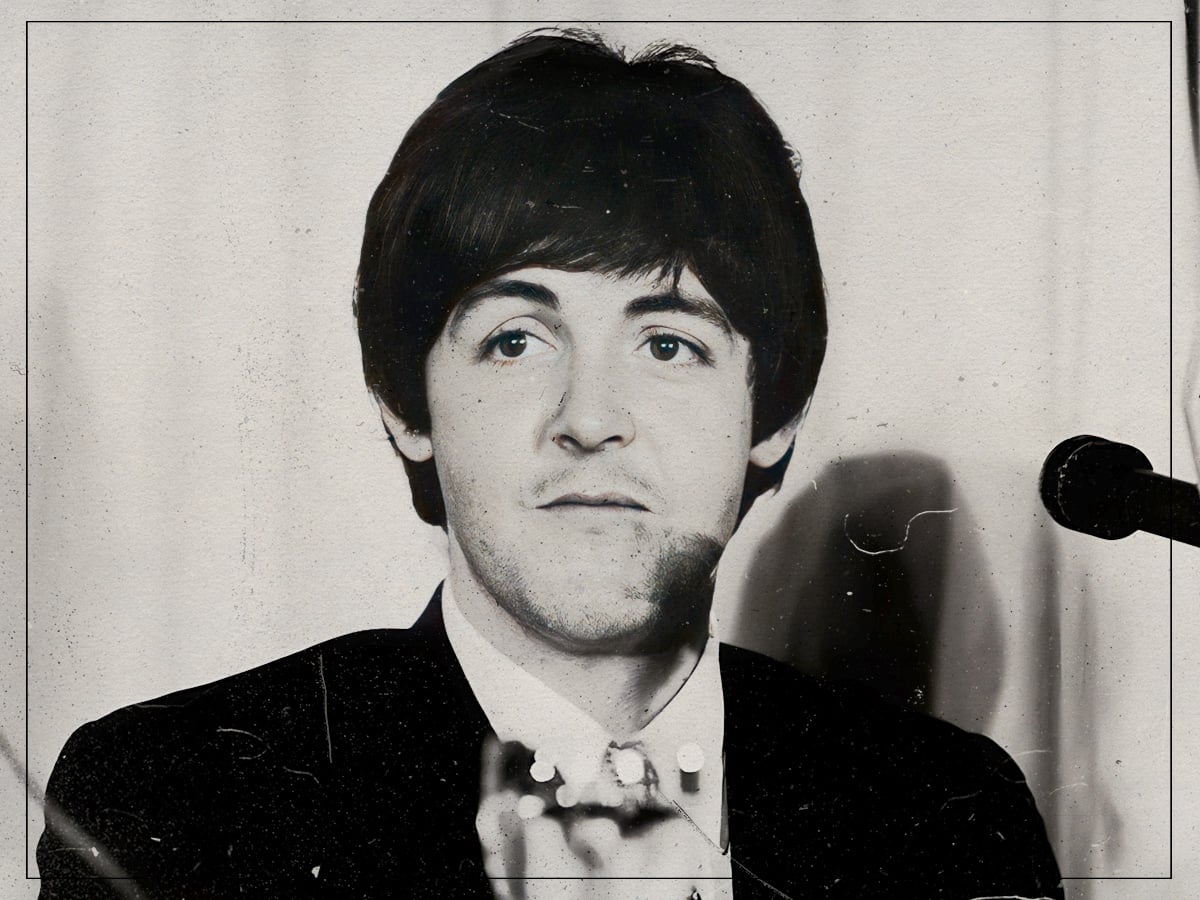
In fact, “Father McKenzie” was originally called “Father McCartney” in early drafts of the song’s lyrics and was based on Paul McCartney’s own father, Jim. McCartney’s family were practising Catholics of Irish descent, and so it wasn’t so much of a stretch for the songwriter to go from imagining his actual father, Jim McCartney, to the more metaphorical father figure of a catholic priest, like the ones he would have encountered in church as a child.
Only he felt embarrassed leaving his own family name in the song. He changed “McCartney” to the similar-sounding and equally Irish surname “McKenzie” to distance the lyrics from their personal connotations. Other than providing nominal inspiration for the character, apart from his Catholic heritage, Jim McCartney has nothing to do with the priest in Eleanor Rigby. Far from being a loner, he was, by all accounts, a gregarious and sociable man who regularly entertained guests at the McCartney family home.
While their names and occupations may have had some basis in reality, the characters Eleanor Rigby and Father McKenzie were ultimately inventions of McCartney’s imagination. His deeply empathetic portrayal of his characters puts paid to any reductive claim that he was an emotional and philosophical lightweight next to his songwriter partner, Lennon.
Not only could McCartney think and feel just as deeply on occasion, but he could also express his thoughts and feelings through compelling personal stories.
How the song defines McCartney’s outlook
This observational style of songwriting is something that McCartney describes as the key to the craft. “I’ve said it before and I’ll say it again: the secret to successful songwriting is the ability to paint a picture,” he openly explained in his recent book, The Lyrics: 1956 To The Present.
“It’s sheer observation, like painting en plein air,” he concludes – en plein air being the practice of setting up an easel outdoors and painting the scene beyond it. So, while the figures in ‘Eleanor Rigby’ might be a little bit more abstract, there’s no doubt that McCartney could probably describe what they were wearing in his imagination even. That’s what makes it a masterpiece. It resonates.
Related Topics
The Far Out Beatles Newsletter
All the latest stories about The Beatles from the independent voice of culture.
Straight to your inbox.