The oldest wildlife trust in the country was founded in Norfolk in 1926.
NWT now manages over 60 nature reserves and other protected sites including 10km of coastline, nine Norfolk broads, nine National Nature Reserves and five ancient woodlands.
The last century has seen the expansion of its reserves, and significant recoveries of breeding birds and other precious wildlife.
Chief executive Eliot Lyne said this year’s centenary was an opportunity to celebrate the trust’s many successes – but also to galvanise efforts to safeguard the county’s wildlife for the next 100 years, within a shifting landscape of climate change and political upheavals.
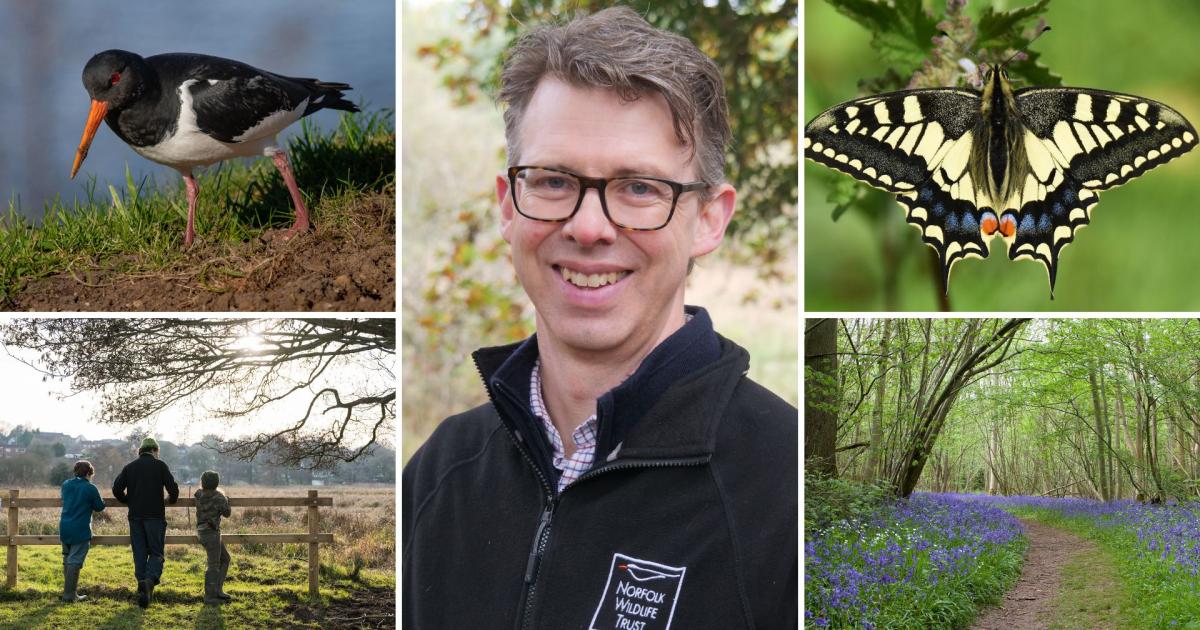
Eliot Lyne, chief executive of Norfolk Wildlife Trust (Image: Josie Collins)
“We are the oldest wildlife trust in the country, and what a great thing it is to arrive at our centenary – in rude health, and full of passion, commitment and purpose,” he said.
“We closed our 99th year with record membership and income; we are managing more land than ever for wildlife; and broadening our work to support landowners and communities to connect with and support the wildlife on their doorstep.
“Whilst we are succeeding, we do so in a troubling context – government support for our agenda is waning, nature has become politicised and the impacts of climate change are impacting our landscapes and communities.
Swallowtail butterfly on a nettle at Strumpshaw Fen (Image: Elizabeth Dack)
“Our centenary offers an opportunity to draw a line in the sand – to move from wildlife decline to recovery. As we reflect on all that we’ve achieved and learned over the past century, we intend on bringing all our passion and ambition to bear as we look forwards to the next 100 years with hope.”
We asked Norfolk Wildlife Trust to share its most significant nature successes from the last century – here are its highlights:
1. Cley and Salthouse Marshes
In 1926, Dr. Sydney Long bought 176 hectares of marsh at Cley, “sparking a century of tireless dedication to the care of Norfolk’s nature”.
By 2012, NWT had created a single coastal nature reserve spanning more than three miles – witnessing its first breeding bittern in the 1930s and, since then, avocet and redshank have followed suit.
An Edwardian photo of Cley Marshes (Image: NWT)
The trust said: “We watched in awe as tens of thousands of wildfowl arrived to make a winter home here and marvelled as marsh harriers returned to float through our vast skies.
“As wildlife faces new threats, our work here does not cease, and our attention must turn to the challenge of protecting Cley’s freshwater habitats from rising sea levels.”
Today, NWT welcomes around 100,000 visitors to Cley Marshes every year.
2. Protecting Broads wildlife
In 1928, Norfolk Naturalists Trust (NNT), later to become known as Norfolk Wildlife Trust, acquired its second nature reserve at Martham – its first in the Norfolk Broads.
The trust said: “Our landholdings across the Broads have continued to grow. 1945 saw the purchase of 715 acres of the Whiteslea Estate, Hickling which represented the beginnings of Hickling Broad and Marshes – a nature reserve that is now of international importance.
“In 1979, cranes returned for the first time in 400 years, and, among countless other rare species, the reserve is renowned as one of the most important sites for the endemic East Anglian subspecies of the swallowtail.”
In 2023 spoonbill chicks also successfully hatched at NWT Hickling Broad nature reserve – the first known breeding success in the Norfolk Broads for around 400 years.
Spoonbill in flight (Image: Barry Madden)
3. Roydon Common
NWT has been working to expand and restore Roydon Common in west Norfolk since its initial purchase of 140 acres in 1963 – thanks to generous support
Today, the nature reserves surrounding Roydon Common form one of the UK’s most important lowland wetland and heathland landscapes.
Roydon Common (Image: Julie Smart)
The trust said: “Last year, reserve staff watched lapwings, curlew and redshanks re-colonise areas of wet heath thanks to our recent two-year peatland restoration project.
“Fenland plants such as round-leaved sundew and lesser cow-horn bog-moss returned. Freed from the smothering effects of purple moor-grass tussocks and nourished by more consistent water flows, these peatlands will once again begin to store carbon and, in doing so, will support a diverse range of fen plants and wildlife.”
In 2024, the first pair of oystercatchers successfully bred on these sites.
Oystercatcher (Image: Steve Evans)
4. Connecting people to wildlife
NWT said it continues to be guided by “our commitment to welcoming people to enjoy the benefits of exploring and enjoying our unique wild landscapes”.
The trust added: “When NWT turned 50 in 1976, our first visitor centre at Ranworth Broad was opened by Her Majesty Queen Elizabeth II.
Outside Ranworth Village Hall on the day the Ranworth Centre was officially opened in 1976 (Image: NWT)
“Since then, we have created visitor centres at Cley Marshes, Hickling Broad and Holme Dunes – and many wildlife hides, walking trails and viewpoints now bring our visitors closer to wildlife right across the county.”
In 2024, NWT also became the first wildlife trust to own a pub – the Pleasure Boat at Hickling.
5. Foxley Wood
In 1988, NWT purchased Foxley Wood – the county’s largest remaining area of ancient woodland.
Bluebells at NWT Foxley Wood (Image: Rita Leggett)
Th e trust said: “In the 1960s, many of the ancient trees had been killed and the wood planted with non-native conifers.
“It took years for NWT wardens and volunteers to remove the conifers, allowing the regeneration of native trees, shrubs and woodland wildflowers. Amazingly, every flower mentioned in the diary of the 18th-century vicar of nearby Lyng has been recorded in the wood since its restoration.”
In 2025, NWT purchased two new areas of land, expanding Foxley Wood by 100 acres – increasing its size by over a third – allowing NWT to create vital new wildlife habitat and expand public access to the popular site.
In recent years, the purple emperor butterfly has returned to Foxley, and continues to thrive.
Purple Emperor butterfly (Image: Tom Hibbert)
6. Landscape-scale nature recovery
Norfolk’s 1,400 County Wildlife Sites cover 16,000 hectares – equivalent to around 3pc of the county’s land.
The CWS scheme was introduced in the mid-1990s, recognising wildlife-rich areas of land which sit outside of nationally-protected areas.
NWT’s nature recovery team was developed to care for wildlife across the landscape, to complement the work carried out on its own nature reserves.
The trust says: “The team advises planning authorities, developers, and others on the protection of CWS, and visits CWS across Norfolk each year, providing advice to landowners on wildlife-friendly management.
“Our team also helps nature recover across Norfolk by putting wildlife at the heart of decision-making, reconnecting important habitats, and supporting land managers, like farmers and communities, to create thousands of hectares of new, wilder spaces for nature.”
7. Sweet Briar Marshes and urban wildlife
In 2024, with support from Aviva, NWT opened a new nature reserve in the heart of Norwich – Sweet Briar Marshes.
The trust said: “As well as conserving and restoring valuable ecological habitats and biodiversity, we have created a wild space that offers easy access to nature for local residents’ wellbeing and enjoyment.
“We continue to design the site in collaboration with nearby communities and deliver projects in the surrounding area supporting Norwich neighbourhoods to enjoy and care for wildlife on their doorstep.”
NWT Sweet Briar Marshes (Image: Phil Barnes Photography)