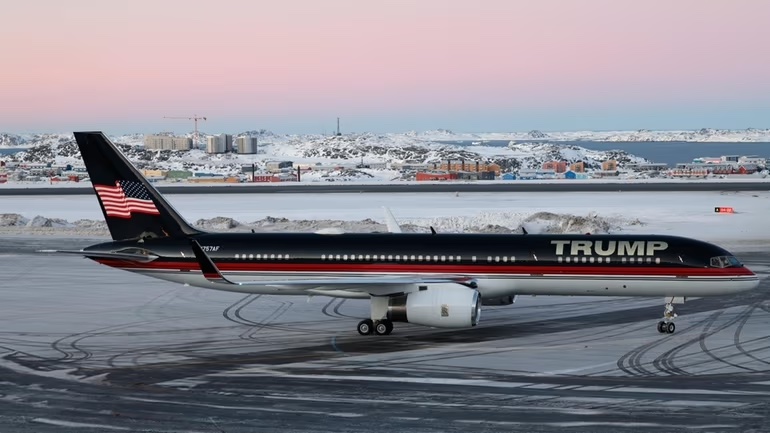
In the wood-panelled corridors of the European Parliament, a long-simmering trade truce between Brussels and Washington is beginning to crack, chilled by the winds blowing from the far north. What began as a renewed American interest in the world’s largest island has transformed into a high-stakes diplomatic standoff that threatens to dismantle years of delicate economic negotiations.
For months, European Commission President Ursula von der Leyen has championed a nascent trade agreement with the United States as a “necessary price” to pay for a stable relationship with President Donald Trump. But as the White House escalates its rhetoric over Greenland—citing national security as a justification for potential control, and refusing to rule out military options—that price has suddenly become too steep for many in Brussels to stomach.
By next Tuesday, a coalition of European lawmakers hopes to have enough signatures to force a total freeze on the trade deal. The move, led by a cross-party alliance of centre-left, liberal, and green deputies, marks a pivotal moment where territorial sovereignty in the Arctic has collided head-on with transatlantic commerce. If successful, the revolt would not only derail the agreement but signal a fundamental breakdown in the European Union’s strategy of pragmatic engagement with the Trump administration.
“I cannot imagine MEPs voting in the current situation for any trade measures that benefit the US,” said Anna Cavazzini, a Green MEP and chair of the European Parliament’s internal market committee. Her sentiment was echoed by Brando Benifei, head of the parliament’s delegation for relations with the US, who told Politico that a debate on suspending the deal is now “inevitable.”
The agreement in question has been a point of contention since its inception. Under its current terms, the EU would be required to eliminate all tariffs on US industrial goods—including a 10 per cent levy on American cars—and ease market access for seafood and agricultural products. In exchange, the US would maintain a 15 per cent tariff on the majority of EU exports.
Critics have long described the deal as heavily biased in Washington’s favour. Now, they are using Trump’s Arctic ambitions as the lever to topple it. “If we accept this deal at a time when Trump is threatening the international order and making direct territorial claims against Denmark, it will be seen as a reward for his behaviour,” said Danish MEP Per Clausen. He has circulated a letter to colleagues urging Parliament President Roberta Metsola to suspend all legislative work on the file.
The political arithmetic in Brussels suggests the threat is real. While the European People’s Party (EPP)—the parliament’s largest bloc—remains cautious, its lead member on trade, Jörgen Warborn, admitted that while the deal is a “basis for stable transatlantic trade,” the party is “ready to act if necessary.” Without the EPP’s full support, a unified front of Socialists, Liberals, and Greens would be sufficient to block the pact.
While Brussels debates tariffs, the ground is shifting in Nuuk, the capital of Greenland. Vivian Motzfeldt, Greenland’s Foreign Minister, has hinted that the autonomous territory might be willing to bypass Copenhagen to speak with Washington directly.
“It is clear that Greenland needs the US, and the US needs Greenland,” Motzfeldt told the Danish broadcaster DR. “What is wrong with us holding meetings with the US alone?”
Her comments have sent ripples through Copenhagen. While Denmark manages Greenland’s foreign and defence policy under a constitutional framework, the island has been moving toward statehood for years, seeking to eventually forgo the $700m annual subsidy it receives from the Danish crown. The prospect of Washington negotiating directly with Nuuk is viewed by some Danish officials as a strategic “divide and rule” tactic after Denmark flatly rejected previous offers to sell the island.
The tension has already boiled over in official circles. A recent video conference between the foreign affairs committees of the Danish and Greenlandic parliaments ended in a bitter row. Pipaluk Lynge, chair of the Greenlandic committee, accused the Danish parliament of discussing Greenland’s future without its representatives, labelling the approach “neo-colonial.”
Across the Atlantic, US Secretary of State Marco Rubio is preparing for a high-stakes trilaterial meeting next week with his Danish and Greenlandic counterparts, Lars Løkke Rasmussen and Motzfeldt. It will be the first formal sit-down since the White House intensified its claims on the territory.
As negotiators prepare to meet in Brussels this Wednesday to determine the fate of the trade deal, the shadow of the Arctic looms large. The “kernel” of the dispute is no longer just about car tariffs or agricultural quotas; it is about whether the EU is willing to trade its economic interests for the territorial integrity of one of its member states’ territories.
For many in the Arctic, the debate is simpler. “Everyone should stay away from Greenland and let Greenlanders talk to the US and decide what they want for themselves,” Pele Broberg, a Greenlandic opposition leader, told the CBC. Whether the European Parliament agrees to step aside, or uses its trade might as a shield, remains the defining question of the new transatlantic winter.