Thousands took to the streets of London on Sunday as protests against the Iranian regime and the brutal crackdown by its security forces spread around the world.
Activists now say that the death toll from the brutal suppression of nationwide demonstrations in the Middle Eastern nation is at least 538 people.
Meanwhile more than 10,600 people have been detained, the US-based Human Rights Activists News Agency has claimed.
Demonstrators rallied in London, Paris and Istanbul on Sunday in support of the protests in Iran that have been countered with lethal force.
In London the rally began in front of the Iranian embassy in South Kensington before uprooting to Whitehall, at the heart of British government.
The demonstrators demanded that Labour close what they called ‘the Mullah’s embassy’ – branding it a ‘terrorist factory’.
Later in the evening images showed people throwing objects towards the embassy and the police intervening to stop protesters scaling the embassy’s perimeter wall.
Footage showed the masses marching outside Downing Street and burning images of Iran’s Supreme Leader Ayatollah Ali Khamenei.
Others waved the country’s old pre-Islamic flag with its distinctive Lion and Sun emblem.
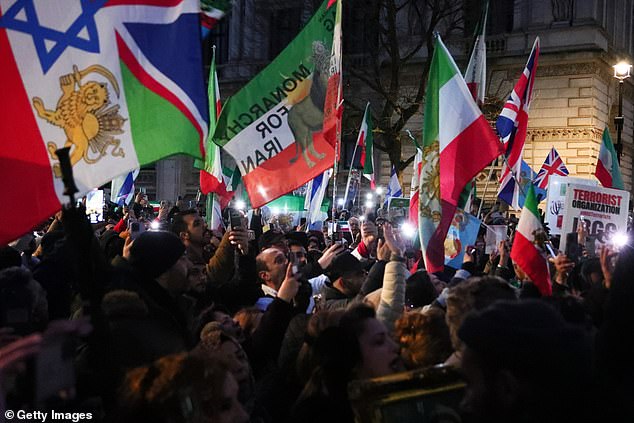
People take part in a rally in solidarity with protesters in Iran today outside Downing Street
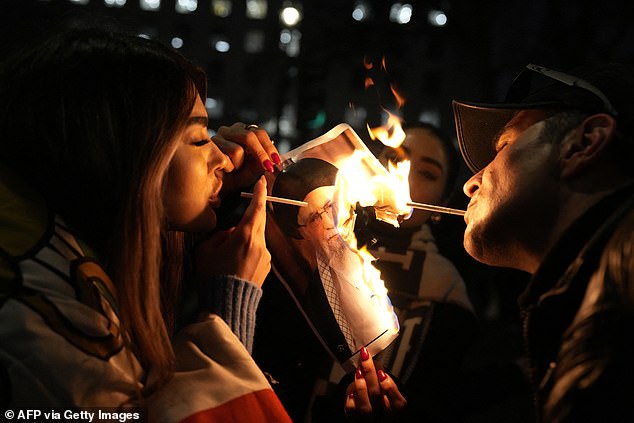
Protestors in London burn an image of Ayatollah Ali Khamenei during a rally held in solidarity with Iran’s uprising, organised by The National Council of Resistance of Iran on January 11
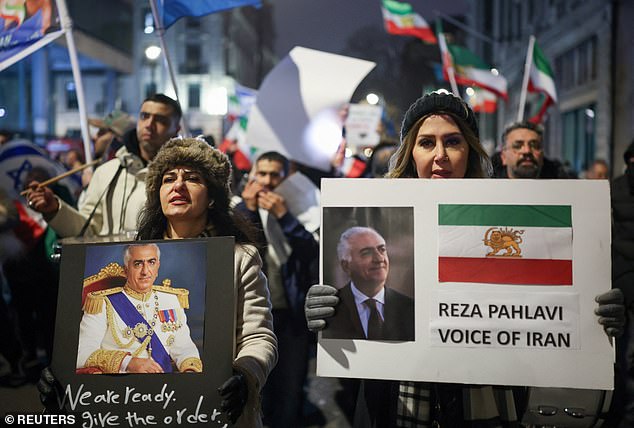
Protesters in London on Sunday hold placards carrying the image of exiled crown prince Reza Pahlavi, who fled to the US with his father, the deposed Shah, after the Islamic Revolution in 1979
Many protesters carried placards carrying the image of exiled crown prince Reza Pahlavi, who fled to the US with his father, the deposed Shah, after the Islamic Revolution in 1979 – who many believe should be the nation’s next leader.
‘We want revolution, change the regime,’ Afsi, a 38-year-old Iranian, who declined to give her last name, said during the rally in front of Downing Street.
She has lived in London for seven years but has not been able to contact her family in Iran because of an internet blackout imposed by authorities since Thursday, she said.
‘It’s so frustrating, but it’s not the first time,’ Afsi added. ‘This time, we have hope… we feel like we can do it this time.’
Another demonstator in London, Fahimeh Moradi, 52, said she was taking part ‘to support the Iranian people who are killed and murdered by the Iran regime – we don’t want the Islamic Republic of Iran, we hate them!’
She added: ‘My son is there, and I don’t know if he’s alive or not. We just want this murderous regime to leave Iran, that’s it!’
Protests in Iran began on December 28 over the ailing economy and have transformed into the most significant challenge to the regime for several years.
The internet and telephone lines have been cut off, but footage of events in Tehran and other cities has circulated widely on social media.
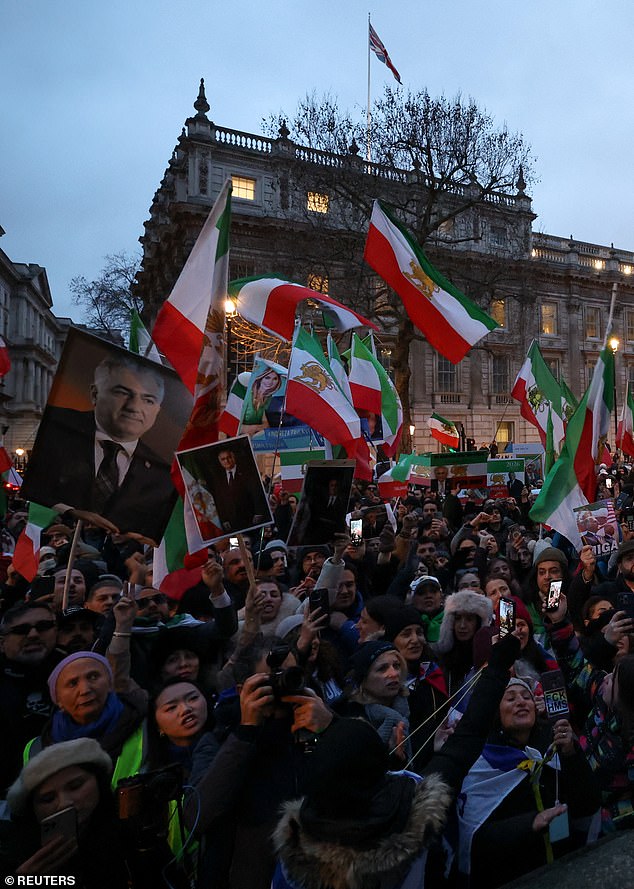
Demonstrators waved the country’s old pre-Islamic flag with its distinctive Lion and Sun emblem as they called on Prime Minister Keir Starmer to support the Iranian people and proscribe the Islamic Revolutionary Guard Corp as a terrorist organisation
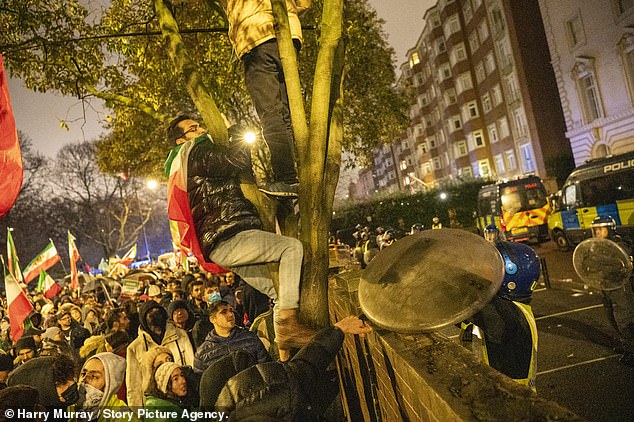
Police try to stop protesters climbing the outside wall toward the Iranian Embassy in London this evening as anti-government demonstrations intensified
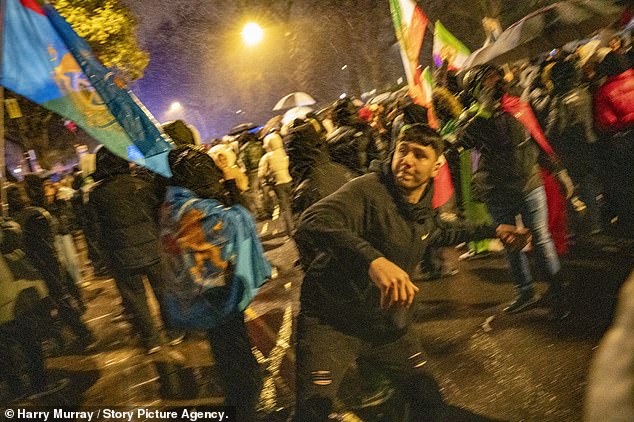
A protester throws an object toward the Iranian Embassy as they clash with police in London
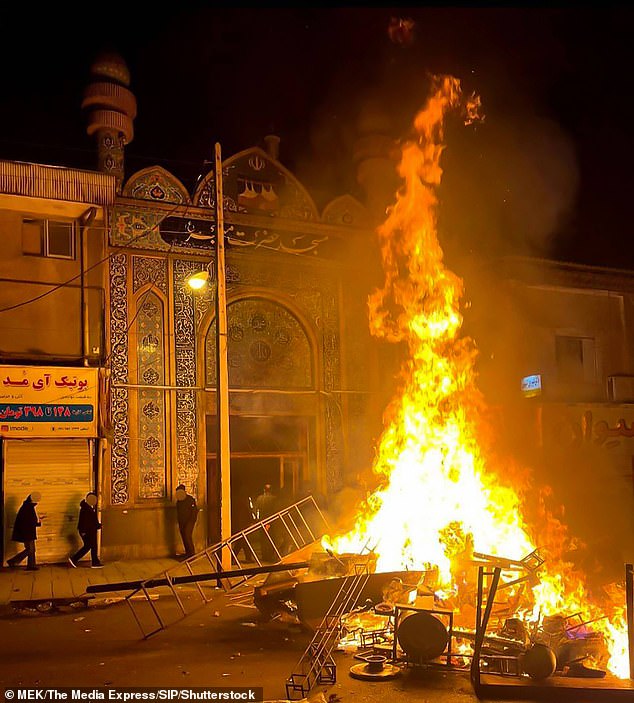
Flames rise from burning debris in the middle of a street in Gorgan on January 10, 2026, as protesters set fire to makeshift barricades near a religious centre during ongoing anti-regime demonstrations
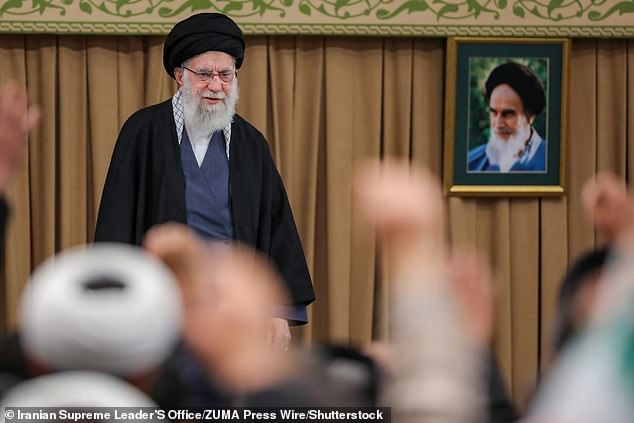
Iranian protesters have intensified their challenge to the clerical leadership of Iranian Supreme Leader Ali Khamenei (seen here attending a gathering of the people of Qom in Tehran on January 8, 2026)
The protest came as a group of Anglo-Iranian women called on the Government to ban the Islamic Revolutionary Guard Corps (IRGC) as the Tehran regime’s violent crackdown on protests continues.
The IRGC is a distinct branch of Iran’s armed forces which operates independently from the regular army, created after 1979 to protect the Islamic Revolution.
It retains significant influence over the country’s politics and controls many of its regional proxies via its Quds Force, making it a central part of the regime’s ability to project power and suppress dissent domestically and abroad.
Demonstrators called on Keir Starmer to proscribe the IRGC as a terrorist organisation, a status it already has in a number of countries including the United States, Canada, Australia and Israel.
The special armed forces organisation has already been heavily sanctioned in recent years, but there are growing calls for the Prime Minister to go further.
Laila Jazayeri, director of the Association of Anglo-Iranian Women in the UK, said the IRGC had already gone too far.
Speaking at the demonstration on Sunday, she told the Press Association: ‘The Prime Minister should prescribe the deadly force IRGC, that is killing people inside Iran.’
Ms Jazayeri explained: ‘There is no need for military intervention. There is no need for boots on the ground.

The nationwide protests started in late December at Tehran’s Grand Bazaar in response to worsening economic conditions
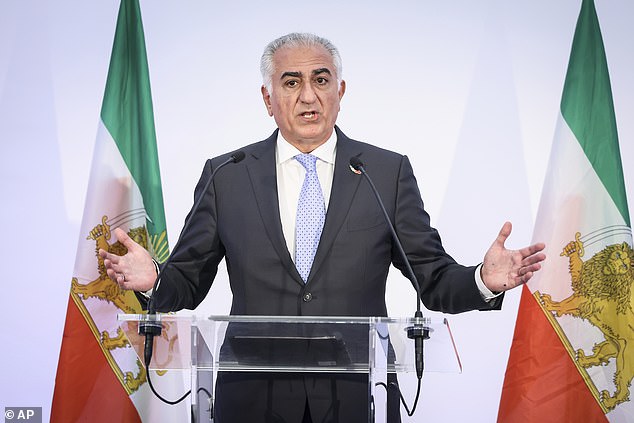
Many Iranians now believe exiled crown prince Reza Pahlavi, who fled to the US with his father, the deposed Shah, after the Islamic Revolution in 1979, will be their next leader
‘Iranian people are capable of bringing the regime down.
‘The protesters are empty-handed. They are dealing with heavily armed security forces in some towns and cities.
‘But the regime hasn’t been able to send the protesters back home. Why? Because there is a network of resistance.’
Most information coming out of the country is through Starlink satellite transmitters after the regime restricted internet access, and Ms Jazayeri said the UK Government could do more to get Iranians back online.
‘The regime has shut down the internet to kill in silence. [The UK Government] should help get access to internet for the Iranian people,’ she said.
Asked about the possibility of banning the organisation, Transport Secretary Heidi Alexander told Sky News: ‘It’s a very thorough process that the Home Secretary would go through in determining whether to proscribe an organisation… I’m not going to second-guess the decisions of the Home Secretary on a matter as significant as this.
‘She will follow due process and won’t leave any stone unturned in looking at all the information that is available to her.
‘As a government, we keep those decisions about the proscription of organisations under constant review and I have no doubt that Shabana Mahmood is doing that at the moment.’
Dissent against the Islamic Republic has spread around the world, with a protester in London tearing down the country’s flag from its embassy on Saturday.
In Paris, more than 2,000 people waved Iran’s flag from before the Islamic Revolution in 1979 to chants of ‘No to the terrorist Islamic Republic’.
Police did not allow them to approach the Iranian embassy.
‘Close the mullahs’ embassy, the terrorist factory,’ some demonstrators yelled.
A 20-year-old Iranian student living in Paris, who gave his first name as Arya, said: ‘In Iran, the people are rising up in the streets, and we Iranians outside Iran are here to show we are with them and they are not alone.’
He said he was waiting to hear what the son of Iran’s last shah, US-based Reza Pahlavi, ‘will tell us to do’.
The protests, initially sparked by anger over the rising cost of living, have lasted two weeks and become a movement against the theocratic system in place since the 1979 revolution.
Iranian authorities have called the protesters ‘rioters’ who are backed by the United States and Israel.
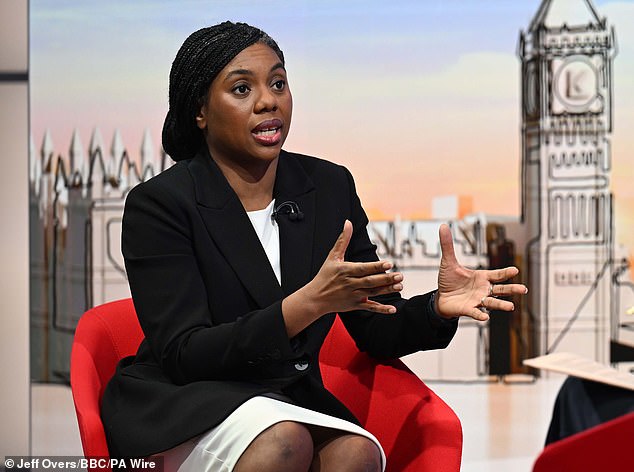
Tory leader Kemi Badenoch (pictured) said it would be right for the US to help oust the Islamic Republic’s leadership and indicated she would support RAF involvement if necessary
In Istanbul, demonstrators voicing support for the Iranian protesters gathered in steady rain.
Police cordoned off the area outside the Iranian consulate and the crowd was kept away from the mission.
‘It’s been 72 hours since we had any news from the country, from our families. No internet or television, we can’t reach Iran anymore,’ said Nina, a young Iranian living in Turkey who had the Iranian flag and red tears painted on her face.
‘The regime kills at random – whether families are on foot or in a car, whether there are children. It spares no one,’ she added.
The crackdown by Iran’s authorities has resulted in at least 192 deaths, according to the Norway-based NGO Iran Human Rights.
The US-based Center for Human Rights in Iran (CHRI) said it had received ‘credible’ accounts of ‘hundreds of protesters’ killed across Iran since the internet clampdown started.
The leaders of Britain, France and Germany on Friday condemned the ‘killing of protestors’ in Iran, while US President Donald Trump said Saturday his country stood ‘ready to help’ as Iranians protest.
The UK wants to see a ‘peaceful transition’ of power in Iran, a Cabinet minister said as the Tehran regime continued to violently crack down on protests.

Rubina Aminian, 23, had joined in the street protests after a day of classes in her textiles programme at Shariati College on Thursday

Iranians gather while blocking a street during a protest in Tehran, Iran on January 9, 2026
Transport Secretary Heidi Alexander said the UK’s priority was to ‘stem the violence’.
She told Sky News’s Sunday Morning With Trevor Phillips: ‘The British Government has always viewed Iran as a hostile state.
‘We know that they pose a security threat in the Middle East and beyond and we know that they have been a repressive regime in terms of their own population.
“And so I think the priority, as of today, is to try and stem the violence that is happening in Iran at the moment.’
She added: ‘It’s a concerning situation there and we would like to see anything that happens in future involving a peaceful transition where people can enjoy fundamental freedoms and we see proper democratic values back in the heart of Iran.’
Iran has warned it will target US troops and Israel if Donald Trump carries out his threat of military action against the Tehran regime.
Tory leader Kemi Badenoch said it would be right for the US to help oust the Islamic Republic’s leadership and indicated she would support RAF involvement if necessary.
She told BBC One’s Sunday With Laura Kuenssberg: ‘You’ve seen the recent RAF strikes, for instance, in Syria. Without over speculating – we are talking about hypothetical situations – we have worked in alliance with other countries.
‘I think this has to be something that we do with a broad coalition of countries. That is the right way to do it, and to make sure that we create a stable Iran.
‘The worst possible thing would be for this to escalate to a point where the situation gets worse, not better.’
She said Iran would ‘very happily wipe out the UK if it felt it could get away with it’ and ‘I don’t have an issue with removing a regime that is trying to harm us’.
Iran has ‘terrorist outposts with Hezbollah all across the world” and “I don’t think a lot of people realise just how scary the Iranian regime is and just how far it has spread its tentacles’.
Foreign Secretary Yvette Cooper has praised the bravery of those taking to the streets in Iran.
She said: ‘It takes real courage to speak up in an authoritarian system, especially for young women, but it should not require courage just to make your voice heard.
‘These are fundamental rights: free speech; peaceful assembly; and the exercise of those rights should never come with the threat of violence or reprisals.”
US secretary of state Marco Rubio said: ‘The United States supports the brave people of Iran.’