At the beginning of 2026, the Kremlin revived the topic of strategic deterrence by using demonstrative launches of the intercontinental missile Oreshnik as an instrument of informational pressure on Europe. This move took place against the backdrop of stagnating negotiations aimed at ending the war against Ukraine and Russia’s loss of positions in Latin America. In this context, the question of the true purpose of Russia’s missile demonstrations, their impact on European political dynamics, and the real security risks for Ukraine becomes particularly significant.
Volodymyr Solovian, Head of the Hybrid Warfare Analysis Group at the Ukraine Crisis Media Center (UCMC), spoke on FREEDOM TV about why the Kremlin uses Oreshnik as a tool of intimidation and which threats remain truly relevant for Ukraine.
Text version of the interview:
What is the real purpose behind Russia’s use of the Oreshnik missile?
I believe that the main purpose of Russia’s use of the Oreshnik missile is fairly obvious – to intimidate European countries, as it is precisely the European Union that the Kremlin views as the weak link of the West. Of course, today the threat of using intercontinental ballistic missiles against NATO countries is rather a Kremlin bluff.
Moscow’s tactic is to strengthen the positions of populist movements and parties that advocate reconciliation with Russia at the expense of Ukraine’s interests through acts of sabotage, threats, and the deliberate escalation of hysteria around the prospect of military confrontation. I think that in the near future we will see an intensification of Moscow’s network of information-influence agents in European countries, who will convey this message to ordinary Europeans.
At the same time, it is worth noting that the reaction of European governments and the media has so far turned out to be a total disappointment for the Kremlin. The use of the Oreshnik did not cause any noticeable hype in the European media space, being overshadowed by news about the Trump administration’s plans regarding Greenland and the situation in Iran.
How real is the threat posed by the Oreshnik missile to Ukraine?
Given the shortage of missile defense systems capable of countering Iskander and cruise missiles, which Russia regularly uses against civilian infrastructure, Kyiv’s priority remains obtaining additional Patriot and SAMP/T systems, as well as interceptor missiles for these platforms.
Oreshnik could be intercepted by THAAD or Arrow-3 systems, but in practice these systems have not yet been used against Russian ICBMs. Moreover, military experts, in my view quite reasonably, express skepticism about the real combat capabilities of the Oreshnik in a non-nuclear configuration. At the same time, the likelihood of Russia using nuclear weapons in the war against Ukraine is currently extremely low. This is primarily because one of China’s key positions is the principle of not using nuclear weapons against states that do not possess nuclear arsenals. The Kremlin understands that the loss of China’s economic and military-technical support would lead to Russia’s strategic defeat.
Therefore, for Ukraine, far more dangerous threats remain the massive drone and ballistic missile attacks targeting energy infrastructure facilities. This factor poses a much more serious challenge in terms of Ukraine’s ability to sustain the rear of the front line, which restrains the Russian offensive. Demonstrative PR actions by the Russian leadership involving ICBM launches – designed for a different adversary and a different type of war – do not affect the real dynamics of the war.
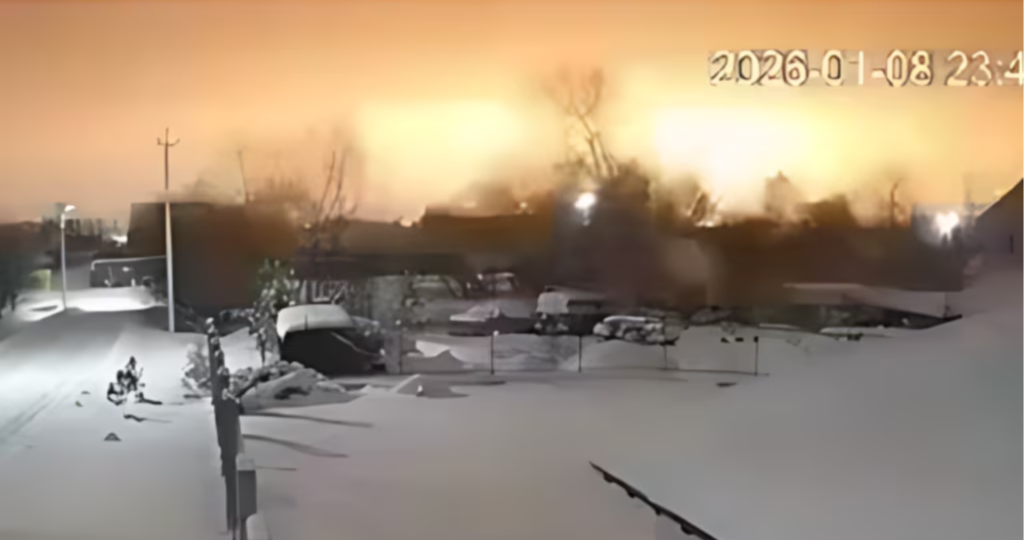 The moment a Russian Oreshnik ballistic missile strikes near Lviv
Given the loss of Venezuela as a Kremlin ally and the seizure by the United States of tankers from the so-called shadow fleet, the question arises: does Washington take into account the balance of the Kremlin’s strength and weakness?
After the capture of Venezuela’s president, the United States has been acting with confidence- this is evident from the active detention of barges and tankers transporting Venezuelan oil. At the same time, it should be noted that the U.S. is not acting on the principle of selectively targeting only Russian vessels. The White House’s main objective is to blockade Venezuela in order to force the country’s leadership into active engagement with American energy companies.
Neither China nor Russia has demonstrated a real ability – beyond rhetorical gestures – to support their key ally in Latin America. In practice, Caracas today has no alternative other than cooperation with the Donald Trump administration. In this way, the United States is sending a clear message to the world: Washington will not play by someone else’s rules in games involving changes of jurisdiction for barges suspected of shadow transportation of Venezuelan oil.
Overall, the story of detaining Russian tankers is rather a side branch of the broader narrative surrounding Venezuela. However, the very fact of precedents involving the detention of vessels flying the Russian flag is an important signal – particularly for Europeans – about the possibility of more radical and decisive actions to actually enforce sanctions. After all, despite sanctions having been imposed on hundreds of Russian vessels, they continue to freely navigate the world’s oceans and replenish Russia’s budget.
 Fragments of the Oreshnik missile complex, which Russian used to strike the Lviv region on January 8, 2026
In the statements of the U.S. president, clear irritation with Putin has emerged following the exposure of Kremlin falsehoods about an alleged attack on the Russian leader’s residence. Can we expect this dynamic in relations between Washington and the Kremlin to persist?
Trump is inconsistent in his attitude toward the Kremlin – we have observed different stages in their interaction. At present, this is less about irritation and more about an attempt to take a pause, a kind of time-out in the negotiation process.
Trump always seeks to demonstrate success and declare “breakthroughs” in negotiations, even when there are no real results. However, it is becoming increasingly difficult to convince American media of this, as the Kremlin’s unwillingness to end the war drags out the negotiation process. At the same time, without at least preliminary agreements with Moscow, the United States – like European countries – is not ready to provide Ukraine with security guarantees that could be presented as a tangible outcome of Trump’s diplomatic efforts.