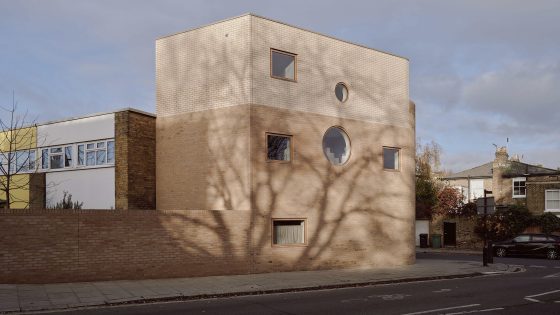
The three-bedroom family house, which won planning approval in 2024, sits on a previously neglected site on the corner of Lamble Street and Grafton Road.
The brick-clad, timber-framed project, named Runda, adjoins a row of 1960s terraces built as part of Powell & Moya’s Lamble Street Estate. The site was formerly a brick oven whose geometry became a driver for the scheme.
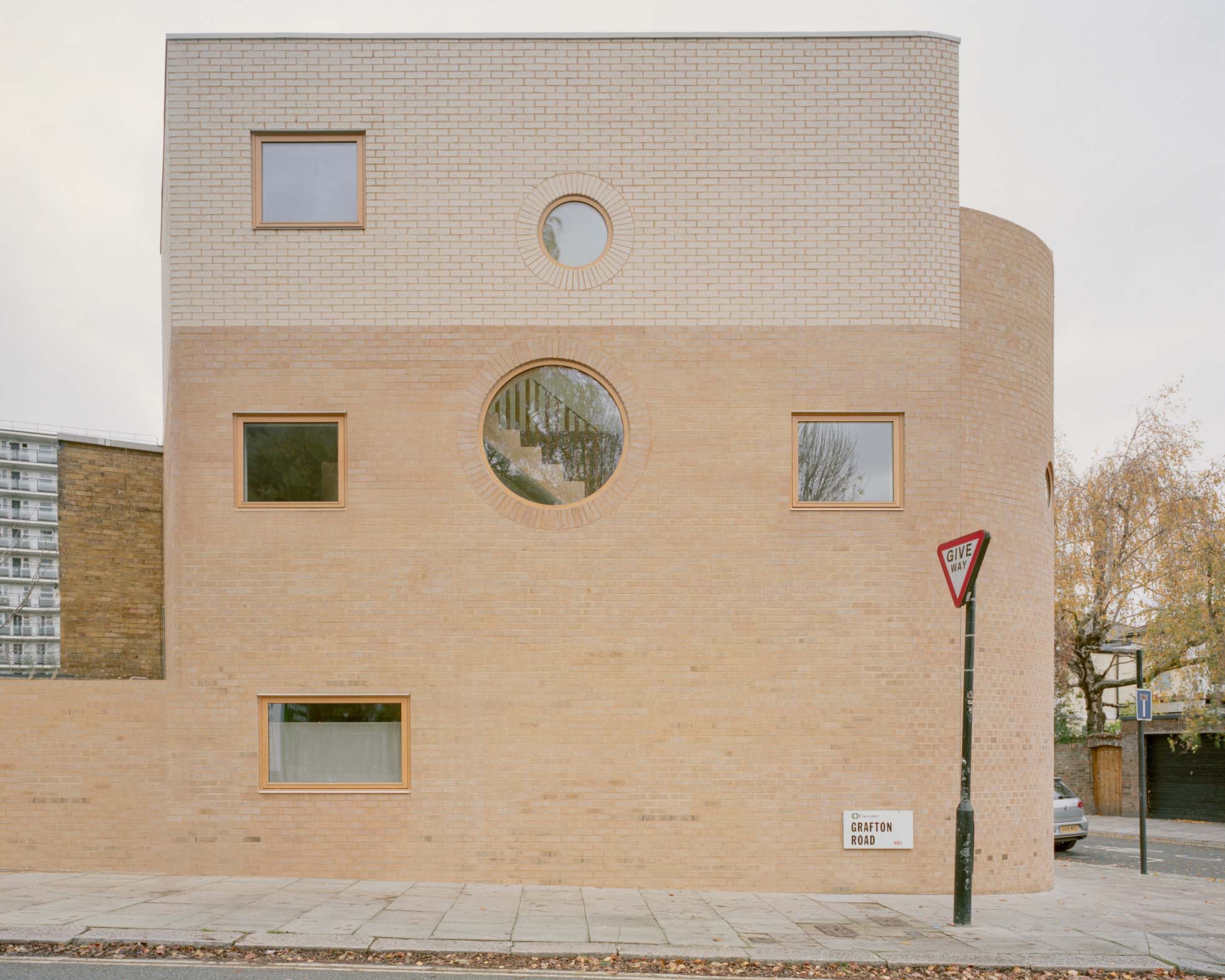
The scheme features double-toned brickwork – chosen to sensitively sit within the existing context as well as reducing the visual mass – together with rhythmic window placement, gently sloping walls and circular porthole windows.
Through material choices and energy strategy – including a green roof and air source heat pump – the home has achieved a 62 per cent reduction in CO2 emissions compared with current Part L1 standards.
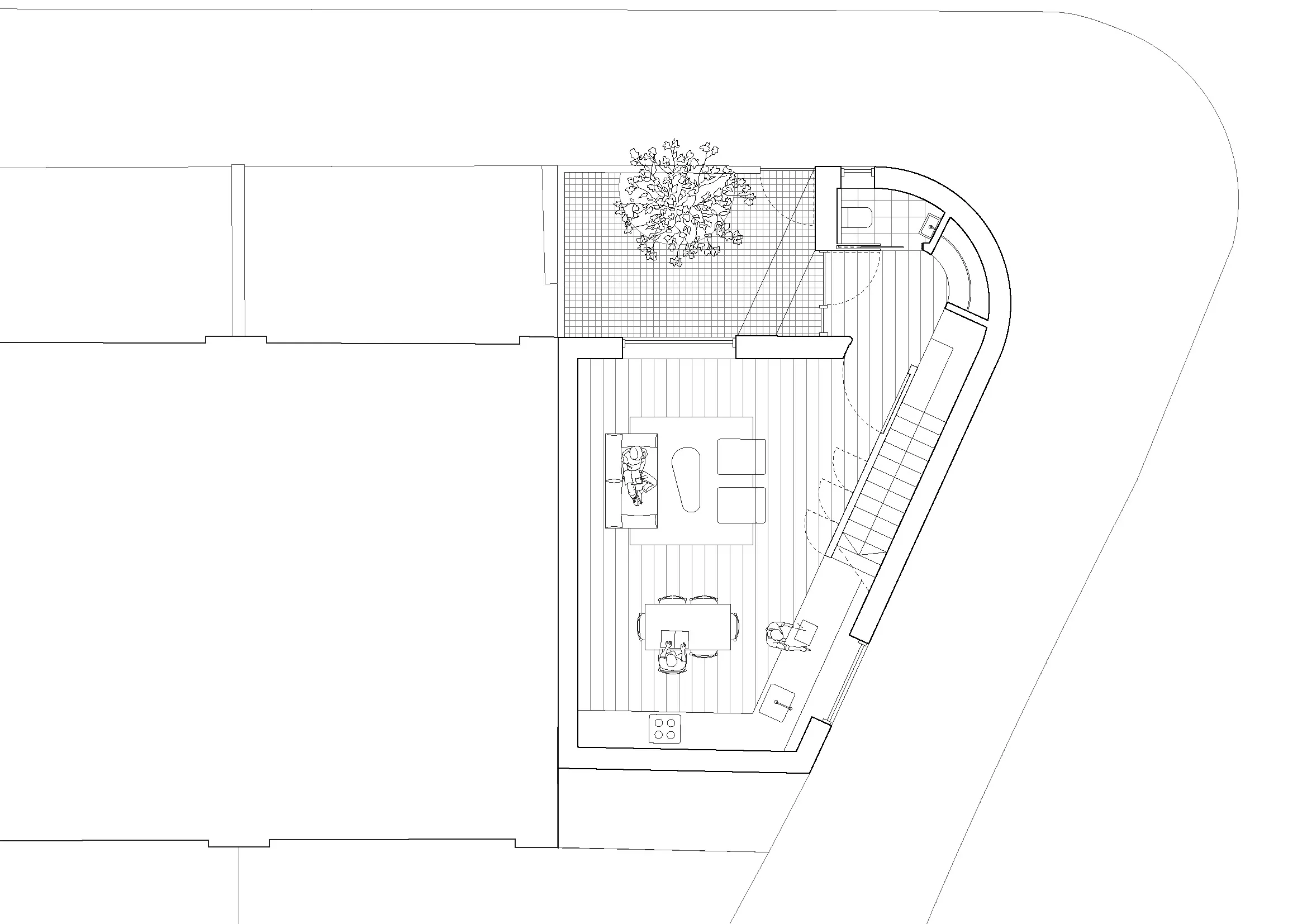
Internally, the entrance opens to an open-plan, wood-panelled kitchen and the living area featuring oversized glazing overlooking a planted courtyard garden.
The interior was designed and fabricated in-house by Flawk. In the kitchen, the material palette consists of pine, oak and cherry cabinetry with stainless steel worktop and detailing. A bespoke concrete ‘bean’ corner-counter reflects the curve of the site.
All three floors are connected by a sculptural staircase with skylight above, bringing light into the stairwell. A circular porthole to the mid-landing frames views of the surroundings.
On the first floor are two bedrooms and a family bathroom, while the top floor forms a main suite with opening onto a private terrace.
The team worked in collaboration with STORE Projects on the scheme. Building on the site’s history as a kiln, Flawk worked with STORE’s after school programme to support young people from under-represented backgrounds pursuing creative courses. Through this, students learned physically modelling, 3D scanning and ceramic casting to create the home’s hand-made ceramic knobs and handles.
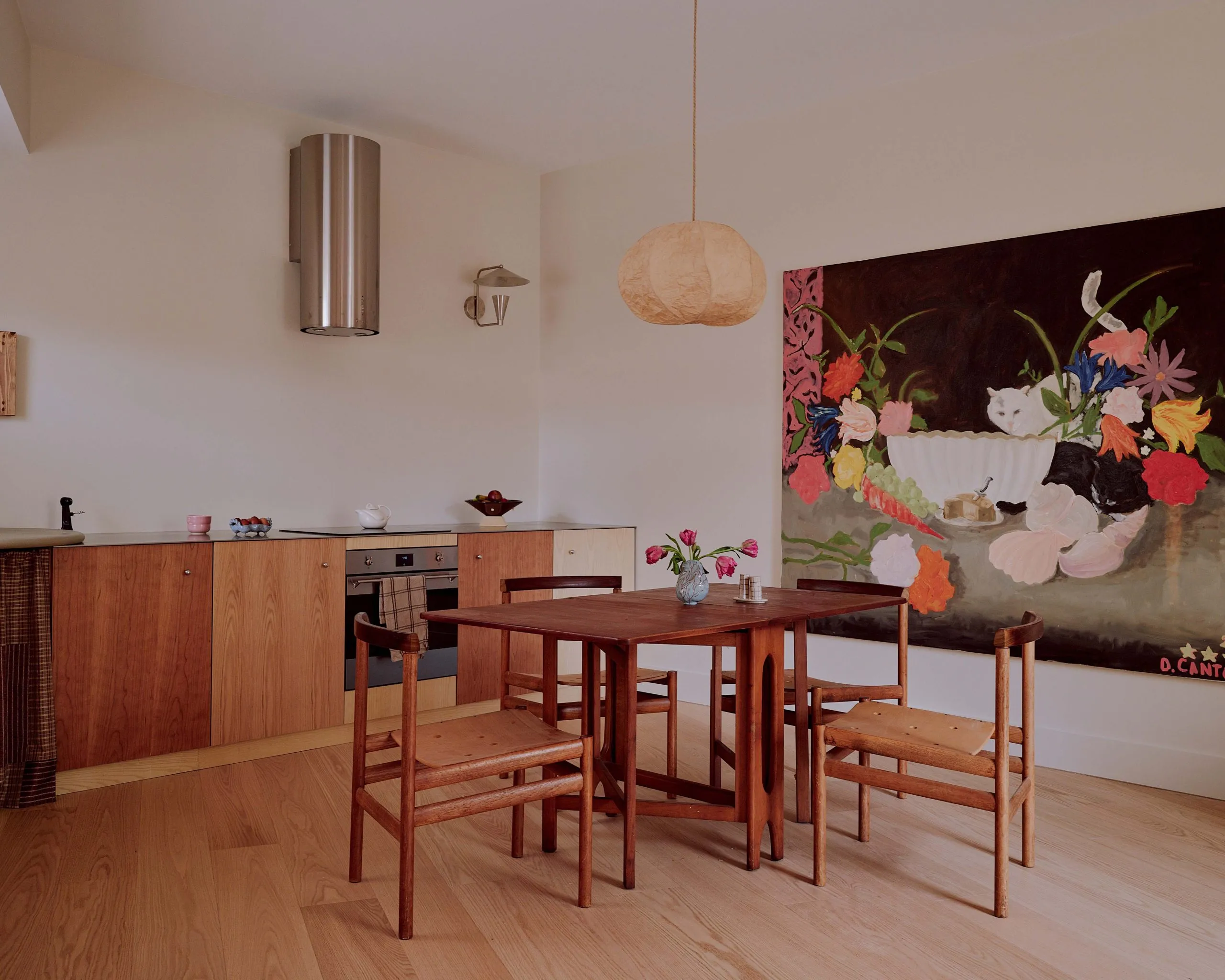
All artworks were curated with Miłość Gallery, featuring pieces by Douglas Cantor, Sophie Vallance Cantor and Katie Hackett.
The ‘distinctive, adaptable home’ is NIKJOO’s third scheme for Flawk, which was founded by Bartlett graduate Ashley Law in 2022.
In 2024, the team reimagined a post-war terraced house in Whitechapel, east London, with an extension finished in roughcast render. Last year, they completed Lode in Stoke Newington – another three-bedroom family home on a tight backland site also featuring distinctive porthole windows.
With all of projects, Flawk acted as a platform for independent, local design, commissioning fixtures and fittings from emerging makers.
A previous proposal for the site was drawn up by Hayhurst and Co for then site owner Camden Council. The site was later sold on at auction and bought by Flawk.
NIKJOO’s 9m-tall ‘low-carbon, low-energy’ scheme is more than 1m shorter than Hayhurst and Co’s 2015 consented proposal. However, it provides 128m² of internal space, compared with 104m² in the earlier scheme.
Architect’s view
The existing site and its context have heavily influenced the design. The immediate context is of modernist flats and terraced houses, Victorian homes and in-fill housing by Peter Barber. The design of Runda acts as a bridge between these various typologies.
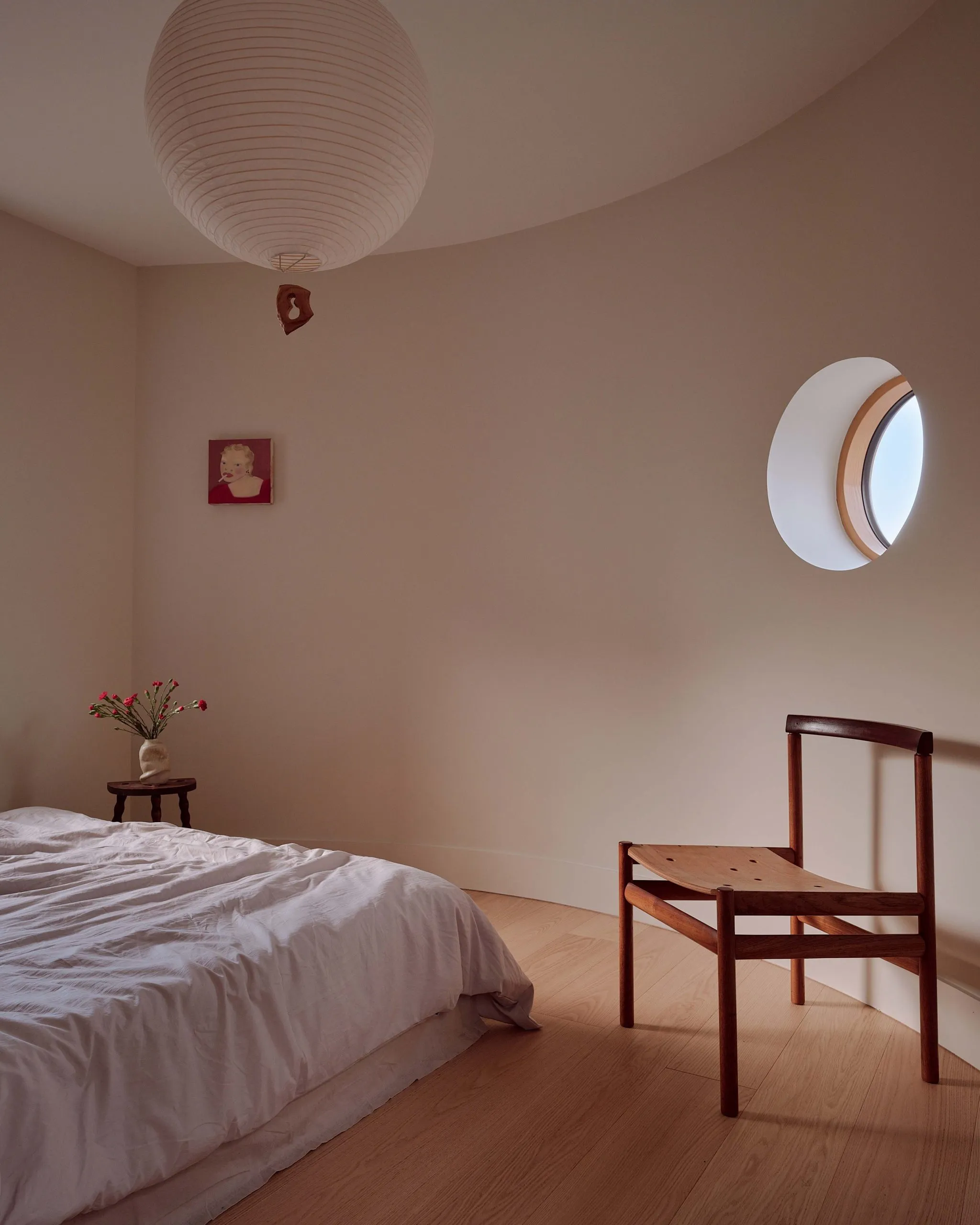
The existing site has a gentle curved form which has been incorporated in to home. This curve acts as a softening edge to the crossroads the house is situated on. This curve is further incorporated in to the design of the home through playful porthole windows, gentle curved partitions and ceilings, giving the home a uniquely sculptural form.
The site is an awkward in-fill plot featuring tapering sides and a curved corner. This presented a challenge of how to design a generous family home on what was a tight and awkward site. The solution was to create generous hallway on the first floor with a large rooflight above, flooding the space with natural light and opening up the floor plan.
The building process was particularly difficult due to the tight constraints of the site. We managed to negotiate to use a portion of the neighbour’s garden for storage, for example. The neighbour, who is an architecture academic, believed in our vision for the building and what Flawk are doing with a new type of development.
The history of the site was a brickworks and was a big reference for the design. As part of this we wanted to ground the building in is context through using complementary bricks for the external walls. However we have used a very low-carbon timber frame for the superstructure. This was a conscious design decision to lower the embodied carbon of the building.
Another inspiration for the design was the work of Edourdo Chillida, referencing space and material through positive forms and negative voids.
The two-tone facade was developed through two intentions, firstly to connect visually to the adjoining terrace homes through a similar toned, London stock brick inspired lower level bricks. And secondly to reduce the massing through a lighter-toned brick.
Alex Nikjoo, director, NIKJOO
Client’s view
The awkwardness of the site was an exciting puzzle and it was quite fun honing into the interior finishes through our bespoke joinery designs and our quirky custom stair rail. We focused on the materiality to converse with the soft curved shape of the plot. Our injections of playfulness worked well to complement and highlight the unorthodox yet beautiful elements of the architecture by NIKJOO.
Ashley Law, founder, Flawk

Project data
Location Gospel Oak, North London
Start on site January 2025
Completion November 2025
Project size 128m²
Client Flawk
Architect NIKJOO
Interior design Flawk
Structural engineer Constant SD
Drainage design Spillways
Main contractor Coste & Beno