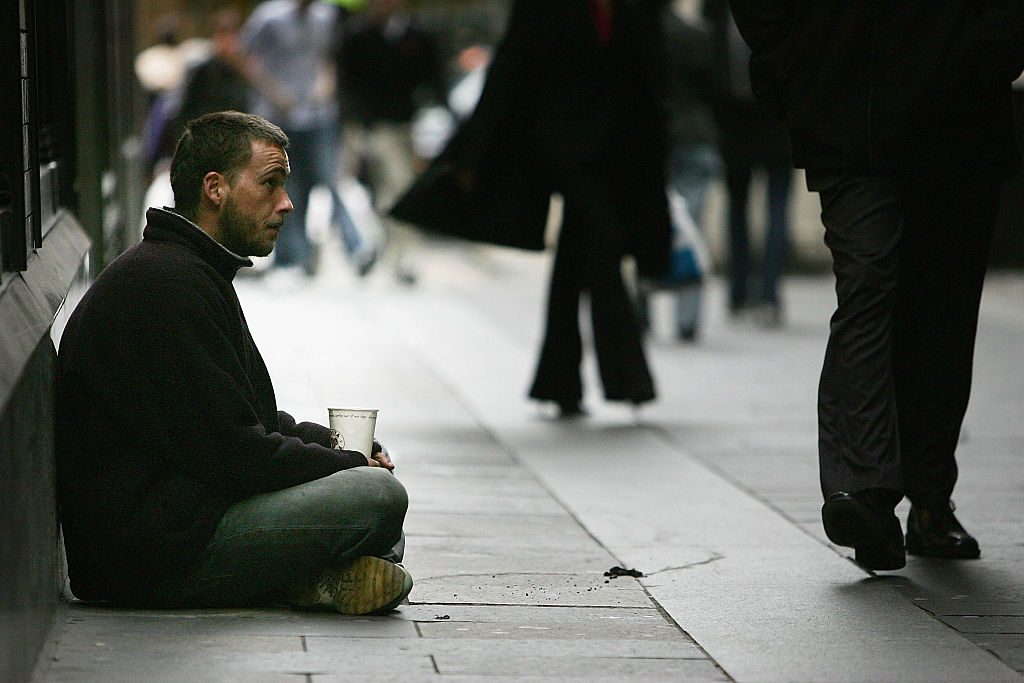
The year is 2019. The UK is in poor shape and dark clouds hang on the horizon. From our politics to our pay packets, the signs of decline are visible everywhere. None more so than in the growing presence of rough sleepers in our towns and cities. In Glasgow, the temperature has dropped to -8°C, and rough sleepers are shivering on every street corner.
A man and his sister prepare to take matters into their own hands. Colin McInnes, who is autistic, and his sister, who is in early recovery from addiction, make their way into the city centre carrying a rucksack with a flask of lentil soup, a sandwich, and some broken bourbon biscuits inside. Colin’s aim is modest: to feed one hungry homeless person.
Little did he know that this small act of compassion would change the course of his entire life and the lives of countless others. As Colin turns to walk home with the empty rucksack, one street-dweller taps him on the shoulder and asks if he will be back. “I will,” he said. “I’ll be here at this time every night.”
Six years later, homelessness is only worsening, and this winter, Glasgow is as cold as ever. Thankfully, though, Colin has been busy. Inside the headquarters of his Homeless Project Scotland (HPS) — the result of the promise made on that cold night — 40 or so people are eating hot meals in a warm café. Sustained entirely by volunteers and public donations and operating without government funding, it provides food, shelter, emergency response and advocacy seven days a week. Every meal, bed and item of clothing here is paid for through public donations, and the quiet support of nearby businesses. At the back of the building, in a glass-fronted office, a man with a 1,000-yard stare chairs a meeting. It’s Colin.
The challenge facing him is acute. Across the UK, the scale of homelessness now runs into the hundreds of thousands. Shelter’s latest analysis shows that at least 382,000 people in England were homeless on a given day in 2025 — including many families stuck in temporary accommodation. Official government statistics show 132,410 households in temporary accommodation in England alone, and Shelter has calculated that there are as many as 100,000 children in temporary accommodation in London alone. To put that another way, one out of every 21 children in London is homeless, equivalent to more than one homeless child per class.
Taken together, these figures underline how pervasive housing insecurity has become, extending far beyond rough sleeping into widespread reliance on emergency and temporary housing. These trends reflect deeper structural pressures: a chronic shortage of genuinely affordable housing, spiralling private rents, insecure tenancies, and a welfare system reformed in ways that leave little margin for error when people hit crisis.
Westminster recently set out a new plan to prevent homelessness and rough sleeping, backed by £3.5 billion in promised investment. Yet critics argue that without a major expansion of social housing and meaningful action on poverty and insecurity, little will change.
Another factor worsening the crisis is dysfunction across the system itself. Research by Shelter has repeatedly shown how stretched resources at local level create avoidable delays to vulnerable people getting the support they need. This failure is often chalked up to the chaotic lives of the homeless as opposed to services arguably unfit for purpose. People with complex needs face specific challenges. Homeless Link’s Unhealthy State of Homelessness research found that 82% of people experiencing homelessness have a mental health diagnosis, but only 9% of accommodation providers state they are capable of supporting people them. They may be judged too risky for mainstream services, while rigid thresholds, poorly integrated services, and turgid referral systems delay timelier intervention. Public misunderstanding compounds the problem, allowing homelessness to be framed as inevitable, insoluble, or the fault of feckless individuals, relieving political pressure for meaningful change.
Homeless Project Scotland is determined to change this. The charity represents a radical communitarian response to these traditional systems, many of which have grown overly cautious to intervene in a climate of scarce resources and institutional arse-covering. Powered by working-class volunteers with little experience of, or interest in, navigating bureaucracy, the project is driven by a palpable sense of moral urgency and a clear message to homeless people: if services won’t help you, we will.
Colin describes that night in Glasgow in 2019 as “something like Armageddon”. And what followed, he tells me, was not a plan but a series of improvised and messy responses to escalating need. He acted swiftly on the impulse to help so many of us feel but resist. Rucksacks became crates. Crates became a battered trailer dragged through the snow under Central Station Bridge. Food was cooked and reheated wherever possible. “We didn’t care about any legalities,” Colin says. “Just caring about humanity. Get it done and feed people.”
Word spread. Soon, Colin’s team was feeding hundreds. Then Covid hit. As other services shut down and staff were furloughed, Homeless Project Scotland kept going. “We were the only place providing food in the city centre,” Colin says. “The whole city just became empty.” Eventually the operation was paused, not because demand fell, but because gathering together in the streets became unsafe.
What followed was even more ambitious. Volunteers cooked in their own homes, met in supermarket car parks and delivered food daily to hotels across the city where the homeless had been lodged during the pandemic. “We took out thousands and thousands of meals,” Colin says.
Made up of volunteers operating off their own backs and running mainly off proceeds from collection buckets passed around local pubs, HPS lacked a formal structure. When it was time to upscale, crowdfunders were launched and more volunteers signed up. In the absence of a professional PR operation, accusations of poor governance found easy purchase — and Colin applied to become a registered charity. “I wanted to be above board,” he says. “I wanted to show everybody where the books were.”
He also needed a premises. First, he persuaded a landlord to let him take over a disused property in a collapsing rat-infested building. After a letter to Network Rail — owner of a vacant retail unit beneath Central Station bridge in the heart of the city centre — an Argyle Street office came next. Then, the current base on Glassford Street on the doorstep of Glasgow’s upmarket Merchant City. “We kept thinking: ‘This is too big,’” Colin says. “And then before you know it, that TARDIS got filled.”
Today the organisation runs what Colin describes as the only fully volunteer-led night shelter in Scotland, alongside a food service producing tens of thousands of meals a month and a volunteer-run national helpline operating around the clock. People call in with all kinds of problems, from loneliness to hypothermia to domestic violence.
Colin is unapologetic about the absence of professional sheen that some apparently mistake for unseriousness. “Bureaucracy can fuck right off,” he says. “You will never fund my charity for a bureaucracy.”
“You will never fund my charity for a bureaucracy.”
What guides the organisation instead is a simpler principle: people before procedure. It’s a principle as risky as it is provocative. Colin traces his distrust of rigid systems back to personal experience rather than ideology. “My approach is shaped entirely by lived experience,” he explains. “I am someone who has suffered at the hands of systems that were meant to protect, support, and care and which clearly failed to do so. That experience gave me a deep understanding of how easily people fall through the cracks and how invisible they can become.”
We take a break. I step out for a cigarette and get talking to a man named Andy. When Andy first contacted Homeless Project Scotland, he wasn’t in Glasgow. He was in Blackpool; after a period of poor decisions, his marriage had broken down and he’d become estranged from his children. Desperate, he phoned the helpline. Instead of receiving advice, a referral, or a soul-destroying automated message, as he might have done if he’d rung any other hotline, Andy got talking to Colin. Colin jumped in a van and drove south through the night. “He came down and picked me up from Blackpool,” Andy says. Within days, he was in the shelter. After three months, he moved into a hotel. Now, he has a furnished flat and is being assessed for a two-bedroom home so his children can visit.
Andy had tried accessing services before and “got nowhere”. If it wasn’t for Colin and the project, he says, “I think I would have committed suicide.” Andy now volunteers seven days a week.
On this brutally cold evening, the shelter is filling quietly. People queue in a seated area, are then greeted by name and guided through a process that is firm without being intimidating. There is no performative authority, no sense of suspicion. The atmosphere is strangely serene.
The dormitories are warm and well-ordered. Each bed is numbered. The system is meticulous rather than bureaucratic. If someone in bed eight takes unwell, staff can immediately access their medical information. There are showers, toilets, laundry facilities and a kitchen area in the shelter. There is a small cinema corner and a few well-stocked bookshelves. Bedding is high quality, supplied by the same company that services the boutique hotel next door. People here are not offered platitudes about “dignity” then fobbed off until Monday morning; rather, they’re treated with care and respect.
In creating such a sanctuary, Colin has come up against many of the computer-says-no types prevalent in officialdom; the kind of people who are so inured to the dysfunction of the sector that they no longer perceive it let alone raise their voices against it. As a result, his antenna for local authority bullshit is extremely well tuned. In a video posted by the project earlier this year, Colin explained that Glasgow City Council had refused him a planning application for a shelter on the grounds that people would queue outside the building for food, a decision he contrasted with the tolerance shown for lines of rowdy revellers outside nearby nightclubs.
The project experiences a fair amount of resistance locally, Colin tells me, much of it framed in the language of health and safety. Risks are identified, concerns are flagged, and safeguards are invoked. In theory, these mechanisms exist to protect the vulnerable. In practice, Colin argues, they are often used to obstruct help at the moment it is most urgently needed. Fire safety was repeatedly cited as a reason not to act, even as people slept outdoors in lethal conditions. At the same time, “shared-air” sleeping spaces were dismissed as undignified, despite the alternative being a doorway in sub-zero temperatures. The contradiction is not lost on him. “The lengths that the SNP-led council and SNP government have gone to in order to defend the position that night shelters are ‘a thing of the past’ are extraordinary,” he says. “This is not about policy, ideology, or box-ticking. This is about life and death. When the choice is a warm, supervised indoor space or sleeping outside in sub-zero temperatures, the moral answer should be obvious.”
To Colin, this all reveals a risk-averse system more comfortable managing hypothetical threats than confronting immediate harm. Worse, he believes that bureaucracy has become a way for institutions to distance themselves from moral responsibility. When procedures are followed but people still freeze, starve or die, process becomes a means of deflection. The absurdities don’t stop there: each time someone is forced to sleep rough, the local authority is in breach of its own statutory duties — yet faces no penalty. In effect, the biggest rule-breaker is left enforcing the rules on everyone else.
By contrast, safety in this shelter is not ignored, it is simply understood differently. “We don’t have time for sitting writing policies,” Colin says. “People are coming in here in an emergency.”
Emergency is not overselling it. The situation in Glasgow is bleak. Official Scottish Government data shows Glasgow accounted for 43% of reports of rough sleeping in Scotland in 2024-25, far higher than other local authority areas. Independent counts by agencies like Simon Community Scotland regularly find around 25-30 people sleeping rough in the city on a given night (the real number is likely higher), illustrating the visibility and persistence of the problem. On a good night, Homeless Project Scotland will still be forced to turn people away because the shelter is at full capacity. The fact it is so oversubscribed demonstrates its direct impact; if it closed, rough sleeping numbers would rise overnight.
This is clearly not a service designed around political correctness. It is a response moving at a pace the homelessness crisis demands. What distinguishes it is not just the services it provides, but how it innovates in the face of administrative gridlock. Despite being run entirely by working-class volunteers, it is a model for what support for homeless people should look like in the 21st century. And while traditional systems have a lot to learn from the project, it’s likely it will inspire more radicalism outside the sector — and continued resentment within it.
While Colin believes his presence is an irritant to leaders both local and national, he has seen interest from politicians looking to capitalise on what is regarded by many as SNP complacency. The shelter has recently drawn visits from both Scottish Labour leader Anas Sarwar and Reform UK councillor Audrey Dempsey, no doubt on charm offensives ahead of Scottish Parliament elections in May. For now, Colin appears wary of political proximity, conscious that attention can just as easily dilute the message as strengthen it, and that keeping power at a safe distance may be essential to the project’s integrity. In truth, Colin, like many great social campaigners, thinks and talks just like a politician. It’s where his loyalty currently lies that ultimately distinguishes him.
I think again about Andy’s story as we walk back upstairs. Had his call been logged, deferred, or redirected to office hours, he might not be here at all. In a system where delay is too often presented as necessary due process, Homeless Project Scotland operates on a simpler moral principle: when someone is in crisis, you go to them. You do not ask them to wait. It’s a principle we could all learn from.