

Dr Oscar Duke talking about Disease X on BBC Morning Live on January 7 (Image: BBC)
A top TV doctor has shared guidance for Brits about the meaning of what even he admits sounds ‘terrifying’ – Disease X. Dr Oscar Duke is a prominent GP who makes regular appearances on the BBC.
His self-confessed approach is to make the world of medical science less complicated. He is known to many viewers, readers and listeners for appearances on BBC Morning Live, in the Telegraph, through his work as an author and as a podcaster on the show Bedside Manners.
And he appeared on BBC Morning Live last week to again follow through with his commitment to ‘tackling complex medical issues’, as his practice’s website says. He was there to talk about a number of things, including New Year resolutions.
But it was his discussion about recent headlines on pandemics that stood out – and in particular what he said about Disease X, something widely discussed in medical circles. His comments come around six years after the Covid-19 pandemic swept the globe, killing millions of people.
Host Gaby Roslin asked him about a recent Mirror report. She said: “I’ve got this headline here: ‘Pandemic 2026 warning: FOUR diseases doctors most worried about after UK outbreaks.’ I’ve seen these headlines popping up. It—I’d imagine a lot of people would be quite concerned. It does sound quite scary when you see something like that. What do you make of it?”
Dr Oscar Duke said in response: “It’s terrifying, isn’t it? When, you know, you see ‘pandemic,’ many of us with experience of that and what that might mean…
“So, yes, we worry about it. And of course, headlines like to catch our attention, it’s a useful way of getting attention.”
As he set out to explain the issue to viewers, he said his aim was to not alarm people. He said: “So, you know, I think the first thing is to be reassured: you know, that we’re not saying that there’s a brand-new pandemic coming, but of course inevitably we will, over time, have these sorts of diseases that come along.
“This article is talking about a total of four different things, many of which we’ve talked about on the show at different times.”
He explained these one by one. He said: “So, flu and super flu: more cases of flu this time of year, always lots of cold and flu anyway.
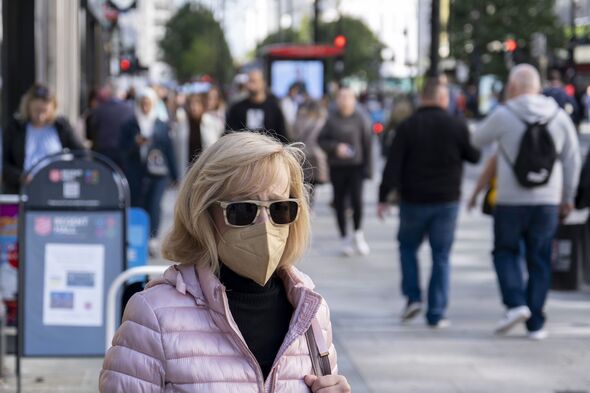
A woman wears a face mask in London. Such sights were very common during the Covid pandemic (Image: Getty)
“You see a lot of this stuff around on social media, don’t you? You know, the all the cases of flu that are going into hospital, it’s really super busy at these times.
“And yes, that is true, so we talk about things like flu jabs to help to prevent that, that’s really important. Um, monkeypox, or what’s now known as M-pox, has also been listed on the conditions here.
“Rubella from a reduction in uptake of MMR vaccines in children – so really important to make sure that your children are vaccinated to prevent them from getting these sorts of infections.”
Once he had discussed the first three of the four diseases referred to in the article, he then turned to the fourth. He said: “And then the most terrifying one of all is Disease X. And people – and this is the sort of future pandemic.
“And I think understanding this is quite important: this is like a placeholder that the World Health Organization [WHO] has created, this term, Disease X.
“It’s not a disease that we know what it is, we don’t – it’s not a particular virus or any particular pathogen. This is just a placeholder for the disease that might cause a future pandemic to help encourage research and development and to protect us in the future from further pandemics.”
What has the WHO said about Disease X?
In a podcast broadcast in 2024, senior WHO figure Ana Maria Henao-Restrepo explained in some depth what the term Disease X is about. Speaking to host Vismita Gupta-Smith, she said at the start of the discussion something that echoes what Dr Duke outlined.
She said: “I think the first thing I want to clarify today is that there is no virus or bacteria circulating right now that is called Disease X and is causing disease. We are preparing for the future. So we are talking about a hypothetical disease and to give a name the scientists call it Disease X to prepare for the hypothetical virus or bacteria that in the future can cause large outbreaks or epidemics or pandemics.
“There are many viruses and bacteria that can infect animals, including humans. For a few we already have vaccines, diagnostics and therapeutics. We know what are the viruses that we need to be alert to, we know what are the bacteria we need to be alert to, but there are many thousands of them. So we need to have a simplified way to refer to them without knowing which one will cause the next pandemic. And we call it Pathogen X.”
She then went on to explain what work countries needed to do to prepare for Disease X.
She said: “From the research perspective, it’s important to keep an eye out to monitor which viruses and bacteria are circulating in the populations in their country. That’s critical.
“The second thing is to characterize the viruses and bacteria, how they transmit, how they infect the people how they cause disease. The third point is contribute to your local, regional and global efforts to develop vaccines, therapeutics and diagnostics.
“And the last point is work together to ensure that researchers have the tools, the financial resources, the support to evaluate those products so that we ensure they are safe and they have the desired effect in reducing infection and disease. And finally, collaboration and coordination is important. Collaboration helps us achieve our goal of getting vaccines, diagnostics and therapeutics to be prepared for the Pathogen X or for the next pandemic, whatever causes it.”