Stay informed with free updates
Simply sign up to the Artificial intelligence myFT Digest — delivered directly to your inbox.
Google is introducing new personalised advertising into its AI shopping tools, as it seeks to make money from the hundreds of millions of people who use its chatbot for free and gain market share from rival OpenAI.
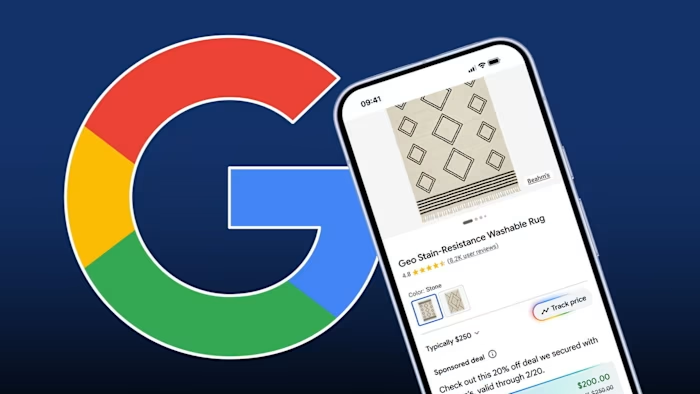
Advertisers will be able to present exclusive offers to shoppers who are preparing to buy an item through Google’s AI mode, which is powered by its Gemini model, the Alphabet-owned tech giant announced on Sunday.
The move marks a push by Google to gain an edge in the race to monetise popular chatbots, as it looks to build on the success of its latest large language model, Gemini 3, which has gained ground against OpenAI’s GPT-5.
It also represents a move away from the tech giant’s traditional ‘sponsored’ ad placements in search results, which generate tens of billions of dollars for the company but has come under threat by the rise of AI chatbots.
“It is a new concept that moves beyond our traditional search ads model,” said Vidhya Srinivasan, vice-president of Google Ads and Commerce.
“It essentially gives retailers the flexibility to deliver value to people shopping in AI mode, whether that’s a lower price, a special bundle or free shipping. In the moment, it matters most . . . to just close the sale,” she added.
 Google’s AI will determine when to display an offer based on users’ shopping behaviour and what they are likely to purchase
Google’s new ads feature will see it move a step forward from its AI rivals by enabling brands to offer highly personalised advertising through its chatbot, such as a discount code.
Last month, OpenAI put on hold internal discussions about advertising products after chief executive Sam Altman declared a “code red” over the need to improve ChatGPT, amid concerns rivals were narrowing its early lead in the race to develop the cutting-edge technology.
Google is leveraging its huge market share in online search to put its AI model in front of billions of users, via the “AI Mode” that it added to search pages last year. Its standalone chatbot Gemini still lags ChatGPT in popularity.
AI groups, including OpenAI, Microsoft and Perplexity, have rushed to launch ecommerce features in their chatbots over the past year as they hunt for new ways to generate revenue from their popular but costly AI products.
OpenAI has been rolling out its checkout feature, first reported by the FT, which sees the AI start-up take a cut of the sales made on ChatGPT.
Microsoft launched its Copilot Checkout on Thursday, which also provides users with recommendations and checkout in its AI chats. The group said shopping through Copilot led to 53 per cent more purchases within 30 minutes of interaction compared to those without.
Google also introduced a “universal commerce protocol”, which it said would enable shopping agents to research products and make purchases without leaving its platform. The protocol was developed with large retailers and marketplaces including Walmart, Target and Shopify.
“We need to work together. I think if we do it well, it’s an extraordinary expansionary moment,” Google chief executive Sundar Pichai said at the National Retail Federation’s annual show in New York.
Google’s new ads feature will make use of the contextual information from peoples’ conversation with the chatbot in AI mode, and trigger offers on relevant products that user have clicked on.
Retailers can set up offers they want to be available, with Google then using AI to determine when it is best to display the deal to a potential customer.
Srinivasan said Google was “initially focusing on discounts for the pilot and will expand to support the creation of offers with other attributes that help shoppers prioritise value over price alone, such as bundles and free shipping”.
Existing Google shopping partners include pet brand Petco and make-up retailer e.l.f. Cosmetics and luggage manufacturer Samsonite.
Additional reporting by Gregory Meyer in New York