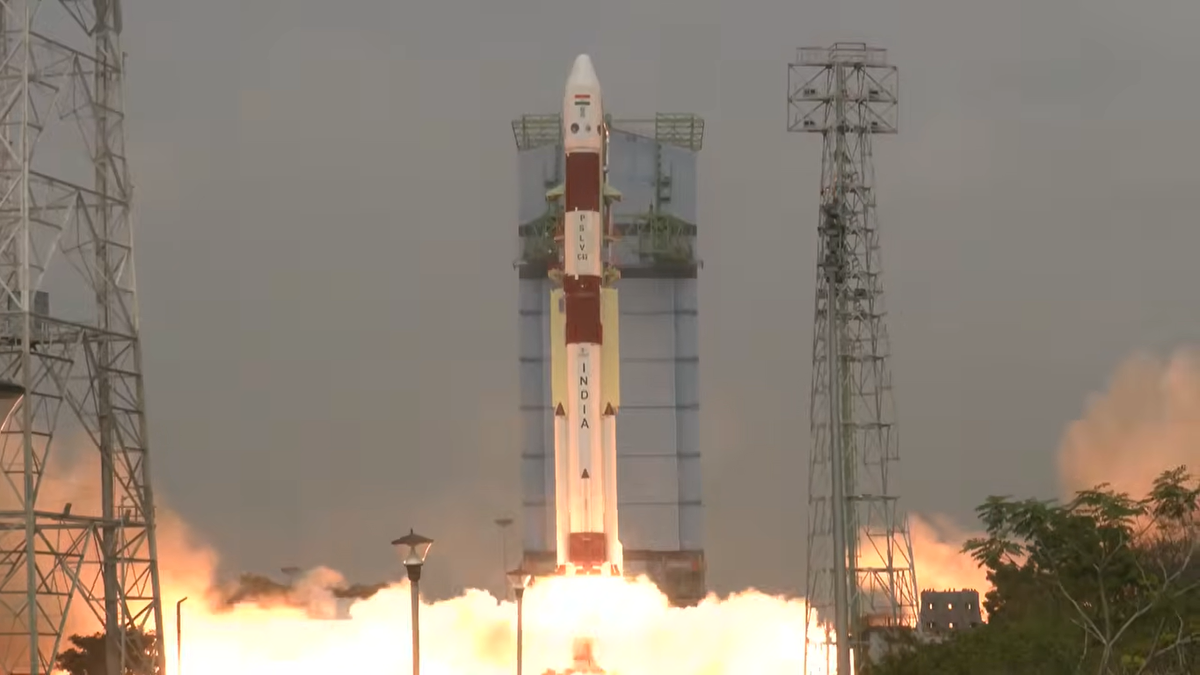

PSLV-C62 is carrying EOS-N1 and 15 co-passenger satellites. Photo: YouTube/ISRO Official
The PSLV-C62/EOS-N1 Mission encountered an anomaly during end of the PS3 stage, following lift-off on Monday (January 12, 2026). A detailed analysis has been initiated, ISRO said.
“Today we attempted the PSLV-C62/EOS-N1 Mission. The PSLV is a four stage vehicle with two solid stages and two liquid stages. The performance of the vehicle upto the end of third stage was as expected, close to the end of the third stage we are seeing little more disturbance in the vehicle roll rates and subsequently there is a deviation observed in the flight path we are analysing the data and we shall come back at the earliest,” ISRO Chairman Dr. V Narayanan said.
What does two PSLV mission failures in a row mean for ISRO? | Analysis
After a 22.5-hour countdown, the PSLV-C62 with the EOS-N1 satellite and 15 co-passenger satellites developed by startups and academia from India and abroad lifted off from the Satish Dhawan Space Centre in Sriharikota at 10.18 a.m.
The EOS-N1 earth observation satellite is said to be built for strategic purposes. “It is a commercial mission of NewSpace India Limited (NSIL). EOS-N1 and 14 co-passenger satellites will be injected into a Sun Synchronous Orbit, and the KID Capsule into a re-entry trajectory,” Indian Space Research Organisation (ISRO) said.
It added that after the injection of EOS-N1 and 14 satellites, the PS4 stage will be restarted to de-boost and enter a re-entry trajectory, followed by KID Capsule separation. “Both PS4 stage and KID capsule will re-enter Earth’s Atmosphere and impact will be in the South Pacific Ocean,” the ISRO said.
Also Read I Why ISRO’s next big challenge is to succeed on an industrial scale
The 15 other co-passengers are: Theos-2 Earth Observation satellite built jointly by Thailand and UK SSTL (UK), CGUSAT by Dhruva Space (India), DSUSAT by Dhruva Space, MOI-1 by Dhruva Space and Takeme2Space (India), LACHIT by Dhruva Space, Thybolt-3 by Dhruva Space and Don Bosco University (India), Munal by Nepal university Antharkshya Pratishtan (Nepal) and MEA, GoI, KID by Orbital Paradigm (Spain) and RIDE! (France), Edusat by AlltoSpace (Brazil), Uaisat by AlltoSpace, Galaxy Explorer by AlltoSpace, Orbital Temple by AlltoSpace, Aldebaran-1 by AlltoSpace, Sanskarsat by Laxman Gyanpith (India) and AyulSat by OrbitAid (India).
Back-to-back PSLV failures for ISRO
On May 18 2025, while ISRO attempted to launch the EOS-09 satellite aboard the PSLV-C61 it could not accomplish the mission due to an observation in the third stage of the rocket.

The launch of the PSLV-C62/EOS-N1 mission is the 105th launch from Sriharikota. It was also the 64th flight of PSLV and the fifth mission of the PSLV-DL variant.
Published – January 12, 2026 10:30 am IST