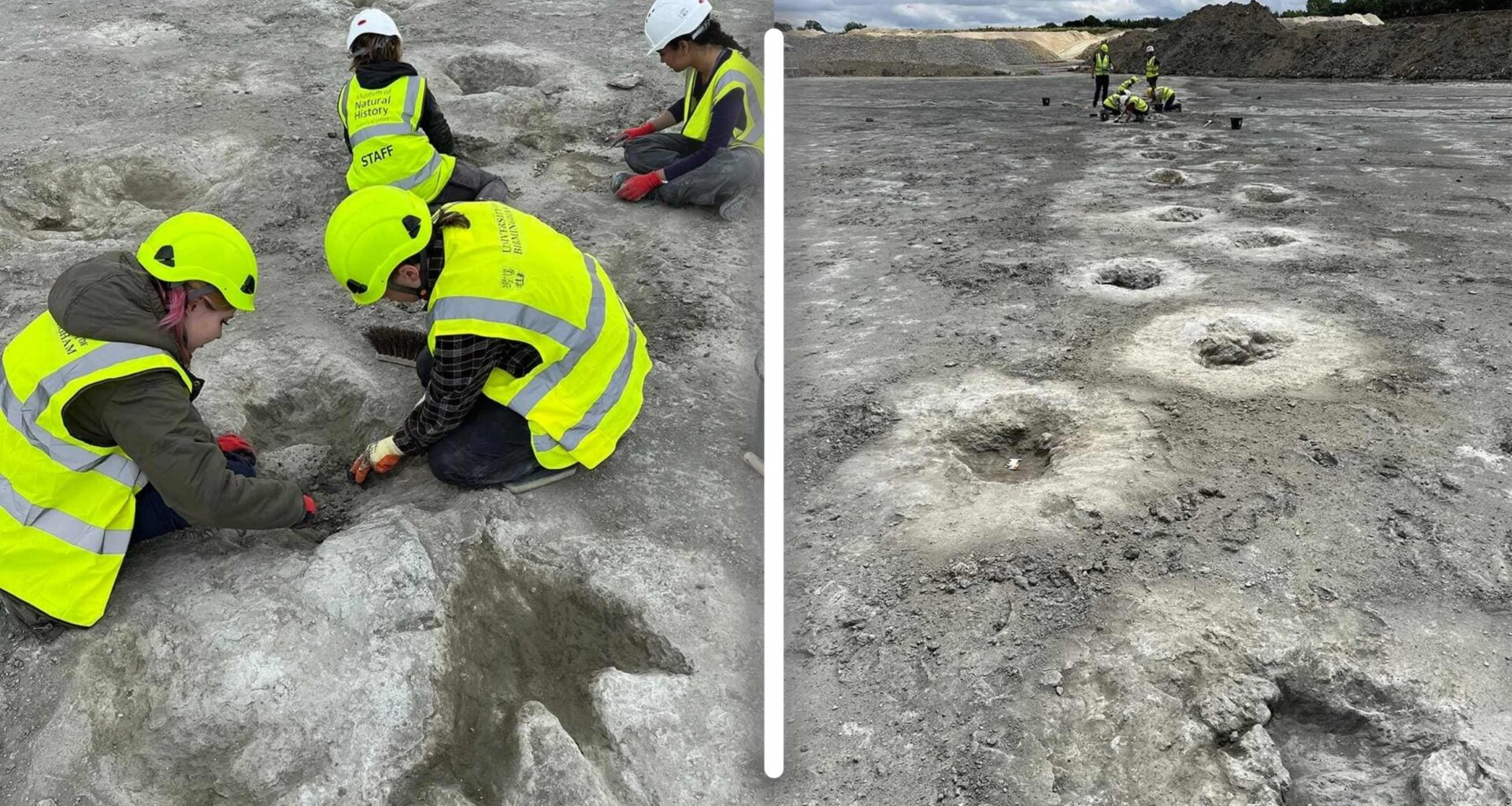
At Dewars Farm Quarry in Oxfordshire, more than 200 well-preserved dinosaur footprints were discovered by accident.
Quarry worker Gary Johnson spotted the impressions while clearing clay, and paleontologists soon arrived to inspect the same surface.

Small ridges in clay first appeared at the site and gave way under scraping tools as quarry work continued.
Field leadership came from Dr. Duncan Murdock at the Oxford University Museum of Natural History (OUMNH).
His research examines how wet sediment deforms under heavy weight, then hardens to keep each step outline intact.
Scientists gathered for careful clearing and measuring across the exposed quarry floor. Researchers worked alongside quarry staff, and a large crew of volunteers exposed prints without breaking fragile edges.
The excavation team documented each footprint, then backfilled sections so the surface stayed readable after machines returned.
Rocks holding the impressions date to the Middle Jurassic, which was a central chapter of the Jurassic Period.
Lagoon mud formed the prints, and later layers buried the depressions before waves smoothed the surface.
Rounded and three-toed tracks link to Cetiosaurus and Megalosaurus, likely left during different walks.
Two distinct footprint styles on the same surface help separate plant-eaters from meat-eaters.
Sauropods, long-necked plant-eaters with pillar-like legs, left rounded hind footprints.
Theropods, meat-eaters that walked mainly on two legs, left narrow impressions ending in sharp claw marks.
What looks like an orderly trail appears as a line of dinosaur footprints made during one walk, with left and right steps repeating.
The direction in which they were traveling is clear because toe tips point forward, and stride length links to body size and pace.
Mud, water, and burial
Throughout eons, mud and sand settled into the dinosaur footprint holes and filled them in, helping the impressions remain clear.
Sediment protected the prints from later pressure. Fine ripples and squeeze rims can survive around a print, since pressure pushes wet mud outward before it dries.
One area includes a place where a three-toed print presses into a larger rounded print.
“To see the evidence of a single dinosaur’s steps preserved so vividly is thrilling,” said Dr. Murdock.
A heavier step can deform an older print, and the compression hints that passage happened close in time.
Reading pace from steps
Stride length across the surface can help estimate dinosaur locomotion. An analysis found dozens of parallel sauropod trackways at Ardley Quarry, and alignment suggested herd travel direction.
Speed estimates aren’t a precise science because mud depth changes step length, and a slipping foot stretches tracks.
Researchers recorded the exposed surface from above using drones that captured the whole area before quarry work resumed.
Drone photos fed photogrammetry, a method that builds 3D models from photos, by matching shared pixels across many images.
Digital models allow later measurements, and the approach avoids repeated scraping of the quarry floor.
Previous Oxfordshire benchmark
The discovery connects to a nearby track surface at Ardley Quarry studied decades earlier.
An Ardley trackway ran over 180 meters (591 feet), showing how far a single animal could walk without turning.
Limited access to the older surface left records incomplete, and the new exposure offers a chance to document more carefully.
Finds like this raise the same question every quarry discovery brings, how to keep evidence safe.
A 2025 assessment reviewed 14 United Kingdom dinosaur track sites and ranked their scientific and public value separately.
Law includes Site of Special Scientific Interest, a United Kingdom label for protected places with rare science, and the quarry could qualify.
Adding context with other fossils
Beyond footprints, the same layer also holds small fossils that describe nearby water, plants, and shoreline.
Researchers found burrows, shells, and plant fragments, showing the surface formed beside living water.
Marine shells and mud cracks can appear together, because tide changes wet the ground and then dry it fast.
The exposed area may extend farther, because quarrying has opened only part of the layer.
Footprints alone cannot prove exact species, and researchers compare shapes with known bones and older track sets.
Further work will test whether different sizes and directions mark separate visits, or one busy period.
Footprint evidence matters because tracks show actions, and the information disappears quickly when conditions change.
Careful storage of digital models and field notes at OUMNH can keep the site useful for research, teaching, and exhibits.
—–
Like what you read? Subscribe to our newsletter for engaging articles, exclusive content, and the latest updates.
Check us out on EarthSnap, a free app brought to you by Eric Ralls and Earth.com.
—–