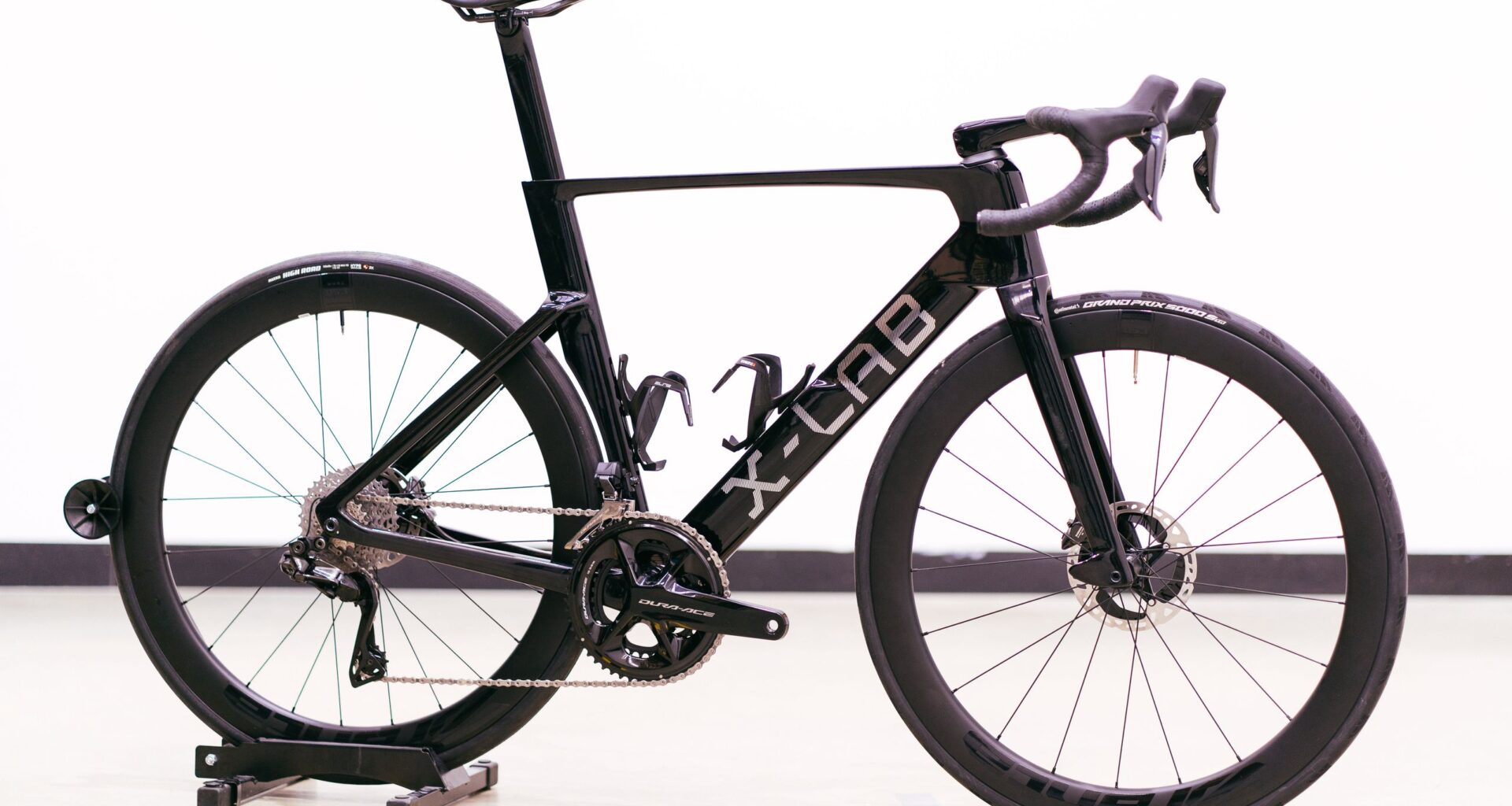
The race bike of choice of the XDS Astana WorldTour team, the X-Lab AD9 represents somewhat of a first, being the first Chinese bike brand to sponsor a WorldTour team, and with that offer a bike designed to compete with the well established players such as Cervélo, Colnago, Specialized and Trek, to name but four.
XDS, the carbon company behind the X-Lab bikes, claims that the bike has been designed in the wind tunnel and ‘rivals top aero bikes on the market’.
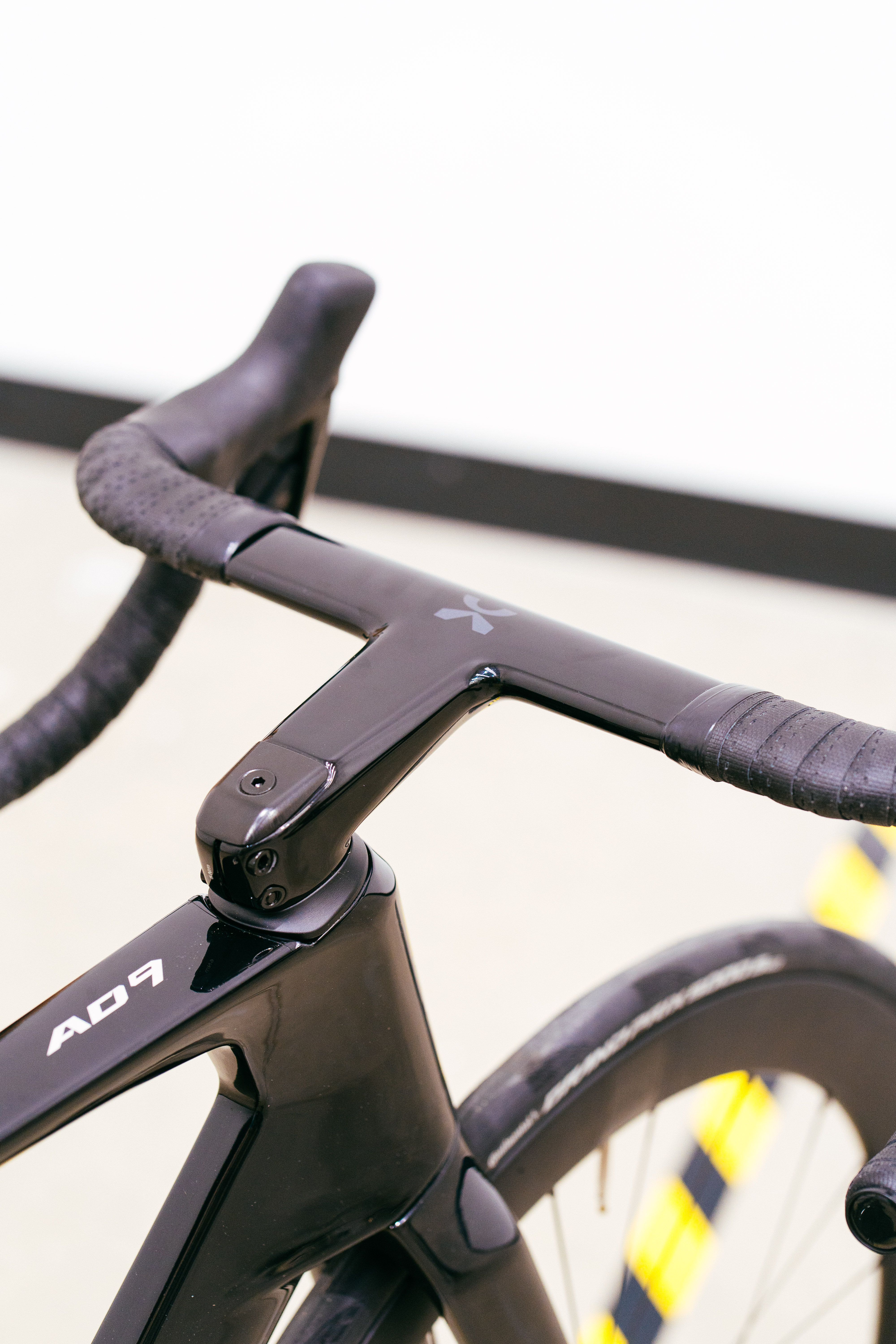
An XDS X-Lab one-piece bar and stem combo is right on trend for any aero bike (Image credit: Future – Will Jones)
There are no integrated bottles like the Wilier Filante SLR ID2 or Trek Madone, or even the integrated cages such as those used on the Colnago Y1Rs or Argon18 Nitrogen Pro. The down tube is fairly wide and flares out around the bottle mounting points, which, on paper, should do a decent job of shrouding the bottles slightly and reducing their impact on the total drag.
And even those deep profile tubes are not quite as deep as the likes of the Ridley Noah Fast 3.0, or the Cervélo S5 with it’s bayonet fork and headtube design.
But as we have seen in our testing, looks is not the be-all and end-all of performance. Some outlandish designs have produced impressively fast frames, but then the addition of a rider onto the bike has altered the results standings.
Image 1 of 2
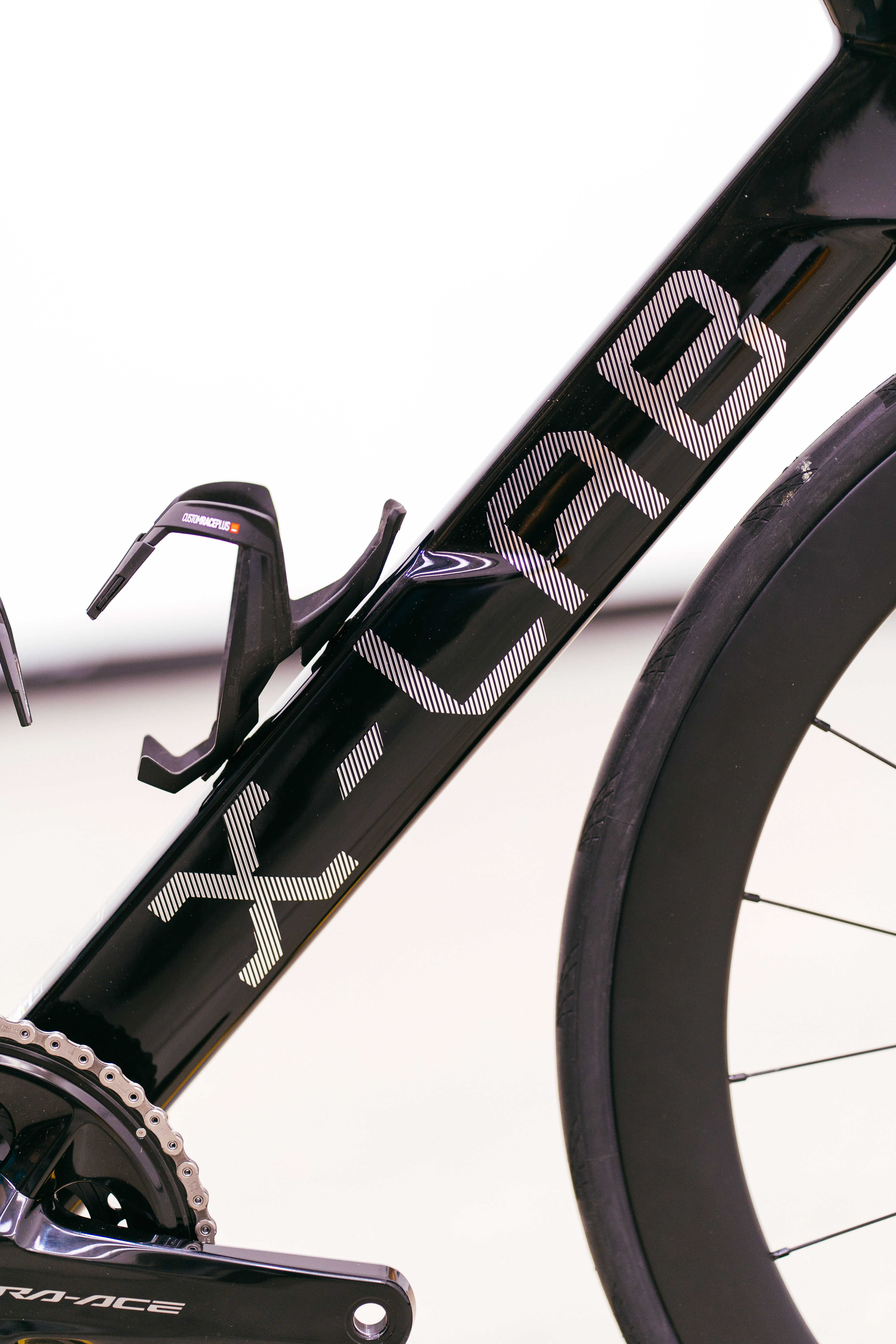 No integrated bottles, but a widening on the downtube to better shroud them is present (Image credit: Future – Will Jones)
 Wide and neatly sculpted seatstays allow for wider tyre usage, while the seattube wraps around the rear wheel(Image credit: Future – Will Jones)
One thing of interest around the AD9 is the apparent lack of data. Looking on the XDS website, details around the bike are fairly scarce. Most of what we have to go on has been seeing the bikes in person at races.
XDS, or X-Labs, doesn’t dive into specific data about how fast this bike is, with no quoted watts saved at X speed and Y YAW angle, so we took it to the wind tunnel to see just where this Chinese competitor stacks up against the highly established competitors it claims to rival. In many ways it’s cleaner this way, with no manufacturer claims to debunk or confirm.
Will it be up there with the likes of the mad looking Factor ONE? How much faster than the Emonda ALR will it be? And will changing the wheels to our benchmark ENVE SES 4.5 set do anything to shift those results?
Let’s find out.
The test protocols
For this test, to ensure maximum accuracy and the ability to compare across tests, we followed the same protocol as used in our two prior wind tunnel aero bike tests. Those include the 2024 test, which covered bikes like the S-Works Tarmac SL8, Trek Madone and Canyon Aeroad, and the 2025 test that covered dedicated aero bikes, such as the Cervélo S5, Colnago Y1Rs and Factor ONE.
That means we took the X-Lab AD9 to the wind tunnel at the Silverstone Sports Engineering Hub, and tested it against our baseline bike; a 2015 Trek Emonda ALR, complete with rim brakes, external cables and round handlebars.
By keeping that baseline bike unchanged between each of our testing days, we’re able to quantify the ‘delta’ – or difference – irrespective of the atmospheric conditions that can affect the results.
And this in turn allows us to compare the delta of the S-Works Tarmac SL8, the Factor ONE, and the X-Lab AD9, despite testing them all on separate days.
To be a tease, we also tested a handful of other bikes on the same day, including the Cinelli Aeroscoop, the Seka Spear, the Enve Melee, a Felt we can’t yet tell you about, and a second bike that we’re not even allowed to disclose the brand name of. Those will be published in the coming weeks.
To add to the confidence and completeness of our results, we test each bike in three different ways.
- Bike-only: This offers repeatability and accuracy. You know the results here are a result of the bike, as there’s nothing else in the wind tunnel, but you lose some of the realism, given bikes can’t actually pedal themselves.
- With-rider: This adds the realism missing above, but with reduced accuracy, because the ability for a real human – me, in this case – to hold an exacting position repeatedly is hard work. We take steps to mitigate, but the variance is still approximately 2-3 watts higher than a bike-only test.
- Bike-only, standardised wheels: This allows an extra test to quantify whether the bike’s stock wheels are where the aero benefits actually lie, how well a frame works with another pair of wheels, and quantify the difference between framesets alone, rather than the complete package as sold by each brand.
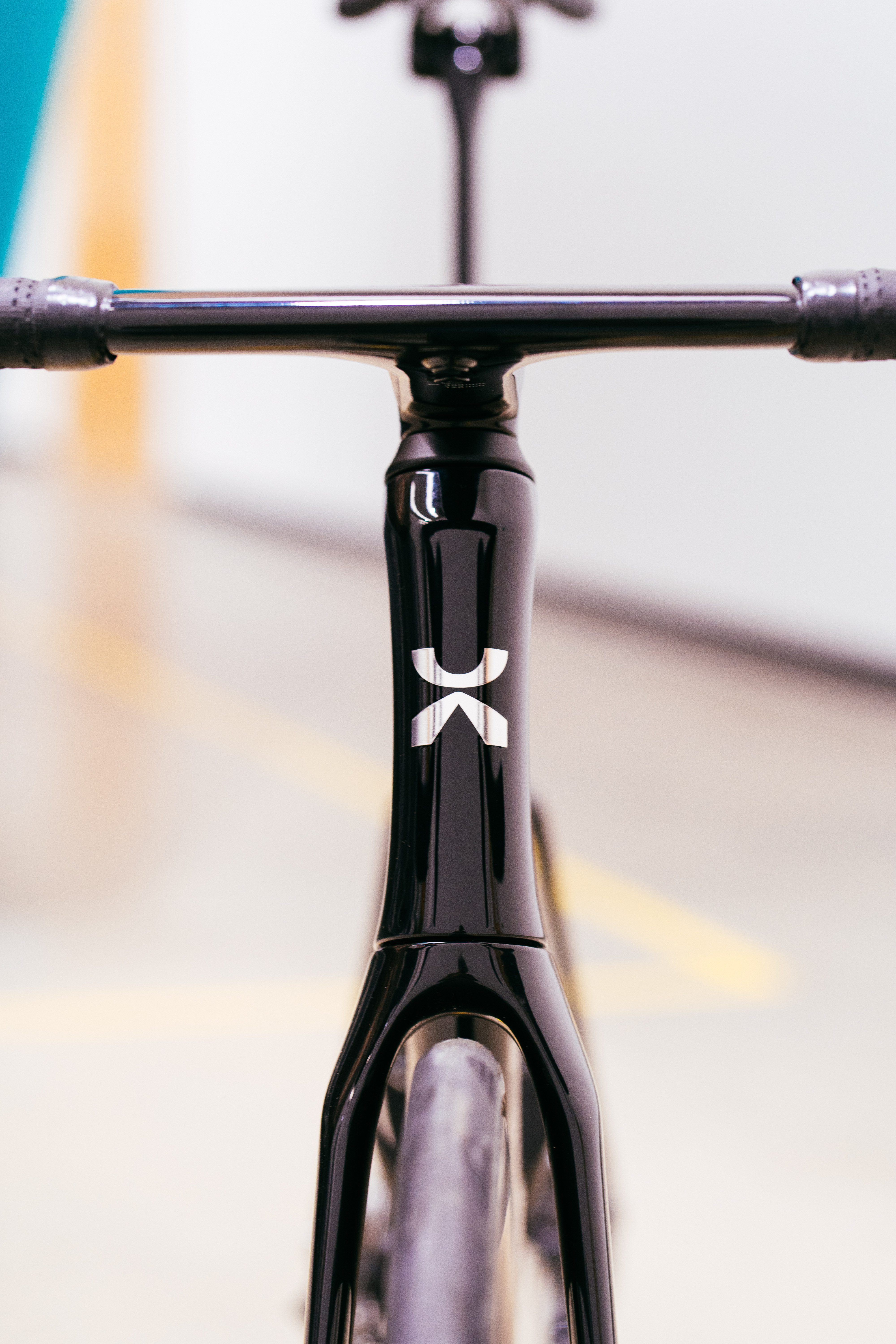
A slightly tapered headtube is another key aero bike design cue (Image credit: Future – Will Jones)
Each setup was tested at seven different ‘yaw angles’ – the angle of the wind, to you and me – which spanned from -15° through to +15° in five-degree increments.
We tested at 40km/h, which is the sort of average speed you’ll see in an amateur road race, road bike time trials, and longer breakaway days in the pro peloton. For bike-only tests, we ensured the wheels were spinning at the same speed, and for rider-on bike tests, we chose the closest optimal gear and ensured pedalling stayed at 90rpm.
For bike-only tests, we measured for 10 seconds per yaw, while the rider-on tests were captured for longer – 30 seconds – to ensure the results weren’t skewed by any accidental movements by the rider.
The wind tunnel, as ever, was tared – like a zero offset on your kitchen scales – before each test.
As per the previous tests, each bike was a 56cm or equivalent, and adjusted to fit as closely as possible to the baseline Trek Emonda ALR, which in turn is fitted to the rider, our Associate Editor, Josh.
With different handlebar widths, different flares of the same width, and then the various geometries of each bike, the position does differ slightly across bikes. The differences here are small enough that we’re not concerned that they affect results unfairly.
Each bike was fitted with a 25mm Continental GP5000 S TR front tyre, to ensure the result wasn’t unfairly skewed by differences in tyre size. For the test with the Enve wheels, we ran a pair of 28mm GP5000 S TR.
Everything else you can think of was standardised too, including what Josh wore, bottles and cages, the computer mounts, and saddles.
With saddles, we were kindly sent a box full of Ergon SR Women Team saddles, which have exactly the same upper – both in shape and material – for both round and carbon railed versions, meaning we could standardise across all levels of bike today and in future.

(Image credit: Will Jones)
A few caveats
We ran multiple repeats of the Trek Emonda ALR to quantify what our repeatability was on the day, which in turn gave us a confidence margin that is applied to the results below.
That margin is as follows:
Swipe to scroll horizontally
Error
Bike
Rider
CdA (in M²)
0.0007
0.0034
Watts (at 40km/h)
0.58
2.80
Our error margin differed slightly on each testing day, which is why the data for some bikes have bigger variances than others when graphed out below.
This and all of our other tests are independent, impartial, and entirely unbiased, and we hire the wind tunnel at the normal commercial rate.
A fair, honest and unbiased protocol is essential to the success of these tests. Even if we could maintain impartiality, you wouldn’t trust the result if it said it was sponsored by XDS, so even though we’ve had multiple requests from various brands (not including XDS, for what it’s worth), we’ve rejected them.
Importantly, the data below is merely the result of our day of testing, not the final word on whether the X-Lab AD9 is a good, bad, fast or slow bike.
We hire a highly respected facility and test as accurately as we can using our set protocol, but we understand that you may see different results under different testing conditions or using different protocols, such as faster test speeds, using mannequins, or testing at different yaw angles.
We also understand that this is just one piece of a much bigger puzzle. There are countless other metrics that make up a bike’s performance, such as stiffness, weight and compliance, and unless you’re a pro cyclist, you should also consider how easy it is to live with, service, and how easy the brand is to do business with, in the case of an issue down the road.
Image 1 of 3
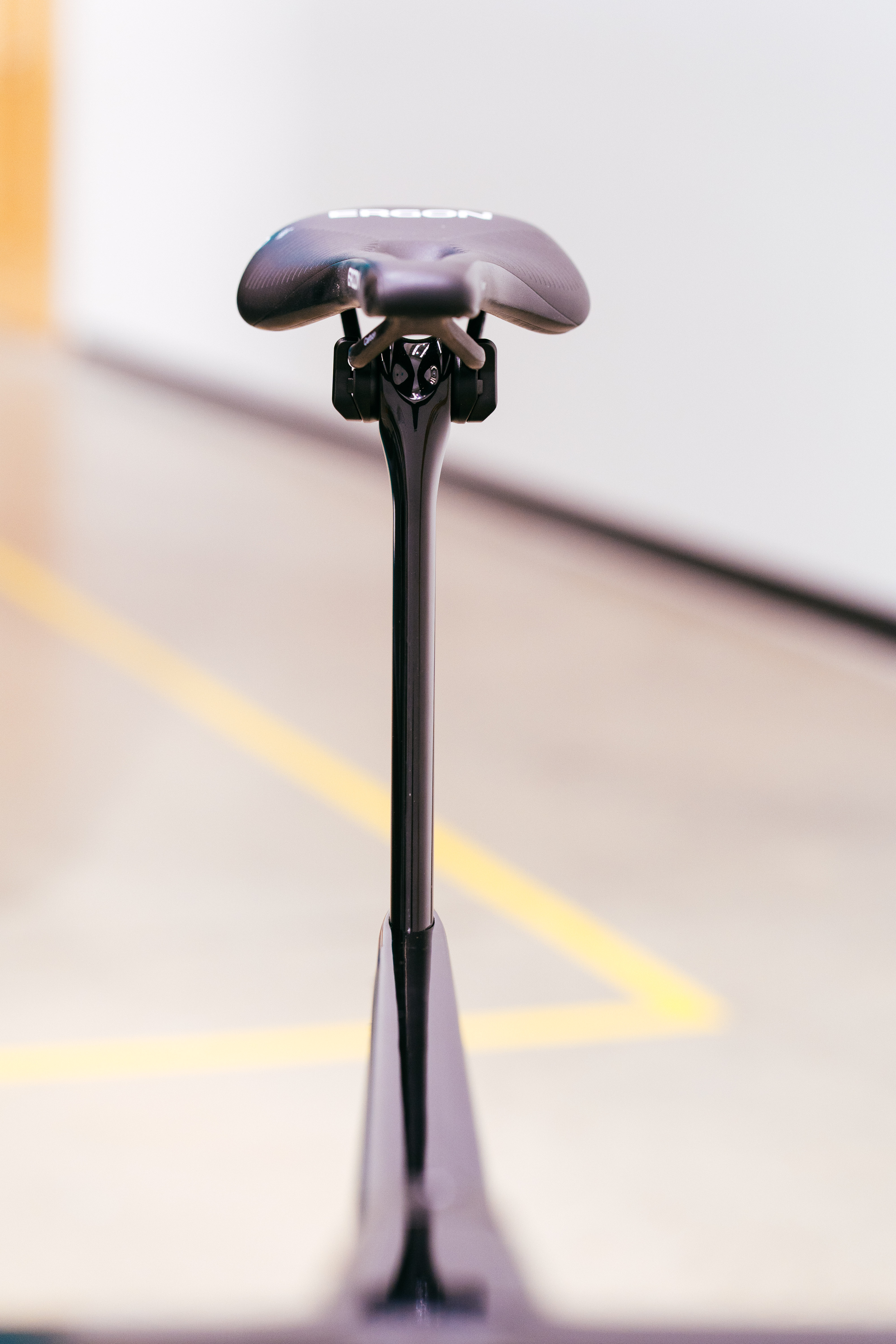 A razor thin seatpost is present, another recent aero bike must-have(Image credit: Future – Will Jones)
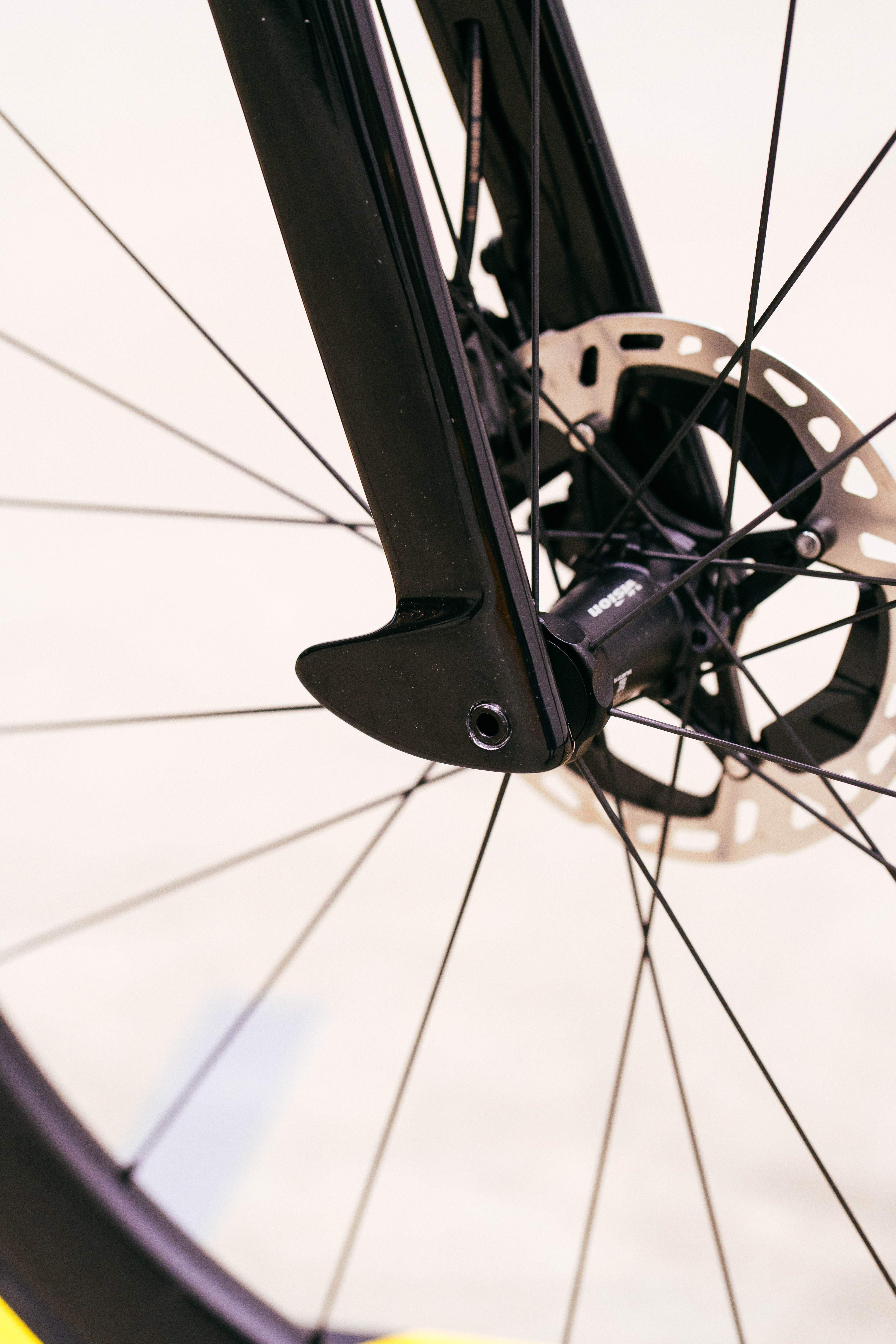 These little winglets on the dropouts aim to reduce turbulent air coming off the back of the base of the fork legs(Image credit: Future – Will Jones)
 A deep bottom bracket junction is paired with neatly sculpted chainstay joints(Image credit: Future – Will Jones)The results
Starting with the raw CdA data for each yaw point. This doesn’t necessarily give us much to go on in terms of comparing to the industry’s competitors, but it’s really interesting to see how a bike handles the wind. Some really struggle when the wind angle grows (to become more of a crosswind) and others actually get faster in crosswinds.
Using the baseline Emonda ALR as our example of a ‘bad’ aerodynamic bike, and the Factor One as the benchmark ‘good’ bike, you can see how the X-Lab AD9 compares. The ‘V’ shape of the Emonda graph basically means that the further the wind comes from the side, the higher the aero drag. This is quite natural given more of the bike is in the line of the wind. The Factor harnesses the wind to ‘sail’, and actually gets faster at 10° and 15°.
The X-Lab AD9 doesn’t have a sail impact such as the Factor does, as when the wind angle increases the AD9 gets slower whereas the Factor gets faster.
However, by adding a rider onto the bike the sail effect becomes far more limited, unless you have a solid disc wheel fitted on the rear. Here impressively, the AD9 follows a similar line to the Factor and actually is faster than it at 15˚ YAW.
We can see that where the Emonda follows a similar curve shape with or without a rider, and the Factor goes from sailing along in the wind to getting slowed down by it, the AD9 has less of an increase in that depth of curve than the Factor.
I do think the Factor ONE suffers somewhat by having a rider onboard due to the design being very much a high speed lower YAW design perfect for bunch sprints and sharing a lot of similarities with track bikes such as the Hope design. Once you add wind from the side and turbulent legs you disrupt that careful balance of aerodynamic frame design.
By being somewhat simpler in the design with fewer gaps and spaces for turbulent air to become muddied, the AD9 performs more consistently with or without a rider. The Factor ONE is still faster, but it’s a far less stark difference when a rider gets on. But how does the AD9 compare to the rest of the bikes we tested?
Looking at the bike only tests, the X-Lab AD9 sits right at the top of the bottom third of bikes, skirting into the mid-table range. The error margin putting it in the region of, at best, the Cervélo S5 (2022 version), and at worst around the Pinarello Dogma F.
In total it represents a 33.94w saving over the Emonda baseline test bike. Still 6.34w behind the Factor ONE, but 9.82w faster than the Look Blade 795 RS.
Of course the bike only isn’t particularly useful in the real world, as a rider will be riding the bike. So let’s look at how it compared in that situation.
With a rider present, the X-Lab AD9 sits firmly in the middle of the table, with the similarly proportioned Van Rysel RCR-F and the Pinarello Dogma F sandwiching it. At least in terms of bikes that we can actually mention at the moment.
That gives it a 20.81w saving over the Emonda, only 6.76w behind the winning Cervélo S5 (2025 model). This would be perceivable in back to back testing, but only just, but for longer races those watts add up.
Looking at the margin for error here, there is around a 3.5w drift either way, which could send the AD9 up the table to competing with the Wilier Filante SLR, or send it down the table too. Not the fastest bike, but certainly one that does compete with, and in some cases best, several of the highly established brands present in the WorldTour, so XDS’s claims that it rivals top aero bikes are not unfounded.
But of course this is just the performance of the bike with its own wheels. To account for that, we also tested with a set of Enve SES 4.5 wheels, so as to see the impact of a standardised wheel on performance. Often, aero bikes will be designed with a set of wheels, and the pairing works well together, but other times wheels are just a spec choice to hit a price point.
This protocol was only added in 2025, so we don’t have data for our 2024 cohort of bikes, but it makes very little difference to the X-Lab AD9, meaning it sits in a similar position behind the Factor, Cervélo, Dare, Colnago, Ridley and others.
When swapping the Enves into play, the bike actually performed fractionally better with a 0.54w saving over the standard wheels supplied. That’s only a small saving though, which is impressive given that the Enve 4.5s were one of the better performing aero wheelsets in our wind tunnel testing.
The X-Lab AD9 is supplied with XDS’s own brand Branta carbon wheels. Seeing that they performed so closely in performance to when the bike was equipped with the Enve wheels suggests they may be rather decent wheels, or at least they work harmoniously with the frame. However, different frames will perform differently with different wheels, so we can’t say for certain how these Branta wheels will compare to wheels such as the Enve on different bikes.
Conclusions
We have yet to ride the X-lab AD9 to really put it through it’s paces in the real world and get a first-hand impression. However, XDS set out with the claim that this bike was comparable in aerodynamic performance to other WorldTour bikes, and based on this testing, that is true.
It’s not as fast as the top players such as the radical Factor ONE, the Grand Tour winning Cervélo S5 or Colnago Y1Rs. However, it sits in the middle of the table surrounded by stalwarts of the WorldTour peloton such as the latest Pinarello Dogma F, and even a bike that we can’t actually mention yet.
It lacks some of the more radical design features like the handlebars or frame geometry of the Factor ONE and Colnago Y1RS, or integrated bottles of the Wilier Filante SLR, but it features many common aero elements used across the WorldTour peloton of aero bikes.
Interestingly, its place in the tables remains consistent, be it with a rider present, or the bike only testing. Additionally, when adding the Enve wheelset on to test it was only half a watt faster, suggesting that the supplied wheels are perhaps of a performance level that you probably need not upgrade them.
This bike certainly didn’t slow the XDS Astana Team at the start of 2025, and although that season had just two WorldTour victories, the team finished 4th in the UCI Team rankings.
The X-Lab AD9 proves that Chinese bike manufacturers can certainly compete with the well established European and American brands, while coming in at a relative fraction of the cost of most of them. Will we see more Chinese brands enter the WorldTour, and will the next bike of desire on the café ride be X-Lab rather than Pinarello in a few years time? Only time will tell.