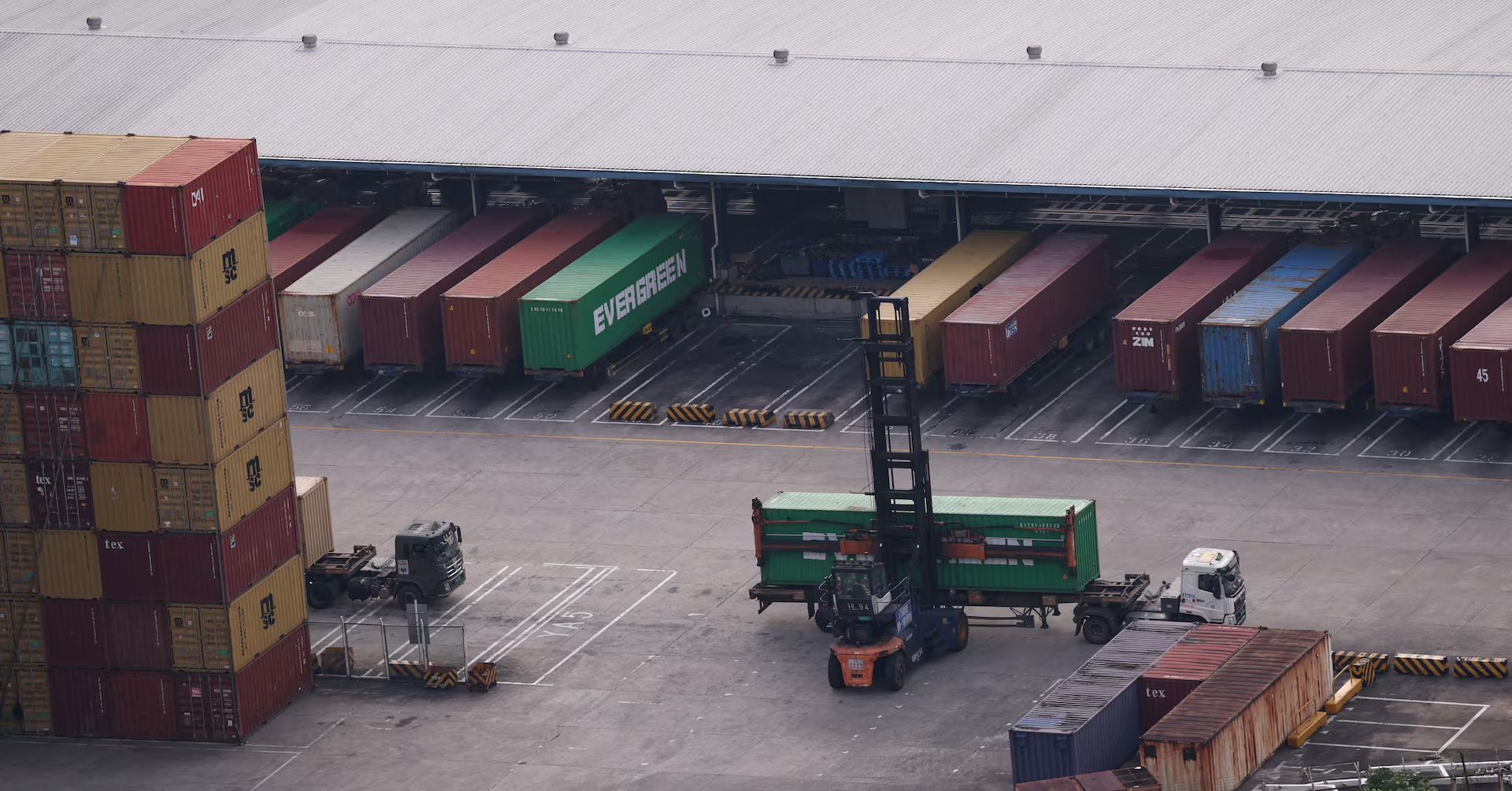
- China posts record $1.189 trillion trade surplus in 2025
- China’s December dollar exports up 6.6% Y/Y, imports up 5.7%; beat forecasts
- Strong exports come despite Trump’s tariffs as China scales up new markets
- China’s ability to weather risks has been ‘significantly enhanced’, says official
BEIJING, Jan 14 (Reuters) – China on Wednesday reported a strong export run in 2025 with a record surplus of nearly $1.2 trillion, as producers braced for three more years of a Trump administration set on slowing the production powerhouse by shifting U.S. orders to other markets.
Beijing’s resilience to renewed tariff tensions since President Donald Trump returned to the White House last January has emboldened Chinese firms to shift their focus to Southeast Asia, Africa and Latin America to offset U.S. duties.
Sign up here.
With Beijing looking to exports to counteract a prolonged property slump and sluggish domestic demand, the record-shattering surplus risks further unsettling economies concerned about China’s trade practices and overcapacity, as well as their overreliance on key Chinese products.
The manufacturing powerhouse’s full-year trade surplus came in at $1.189 trillion – a figure on par with the GDP of a top-20 economy globally like Saudi Arabia – customs data showed on Wednesday, having broken the trillion-dollar ceiling for the first time in November.
“The momentum for global trade growth looks to be insufficient, and the external environment for China’s foreign trade development remains severe and complex,” Wang Jun, a vice minister at China’s customs administration, said at a press briefing on Wednesday.
However, “with more diversified trading partners, (China’s) ability to withstand risks has been significantly enhanced,” Wang said, adding that “the fundamentals for China’s foreign trade remains solid.”
Outbound shipments from the world’s second-biggest economy grew 6.6% in value terms year-on-year in December, compared with a 5.9% increase in November. Economists polled by Reuters had expected a 3.0% increase.
Imports were up 5.7%, after a 1.9% bump the month earlier and also beat a forecast for a 0.9% uptick.
“Strong export growth helps to mitigate the weak domestic demand,” said Zhiwei Zhang, chief economist at Pinpoint Asset Management.
“Combined with the booming stock market and stable U.S.-China relations, the government is likely to keep the macro policy stance unchanged at least in Q1.”
EXPORTS UP AS CHINA SET TO GAIN MORE GLOBAL SHAREChina’s yuan , held steady following the upbeat data even as equity investors welcomed the forecast-beating numbers. The benchmark Shanghai Composite index (.SSEC), opens new tab and blue-chip CSI300 index (.CSI300), opens new tab both rose more than 1% in morning deals.The Asian economic juggernaut’s monthly trade surpluses exceeded $100 billion seven times last year, partially underpinned by a weakened yuan, up from just once in 2024, underscoring that Trump’s actions have barely dented China’s broader trade with the wider world even if he has curbed U.S.-bound shipments.
Exports to the U.S. slumped 20% in dollar terms in 2025, while imports from the world’s top economy were down 14.6%. Chinese factories managed to make inroads in other markets, with exports to Africa jumping 25.8% and those to the ASEAN bloc of Southeast Asian nations up 13.4%. EU-bound shipments grew 8.4%.
Trump on Tuesday said he thinks China can open its markets to American goods, after threatening a day earlier to slap a 25% tariff on countries that trade with Iran, risking reopening old wounds with Beijing, Tehran’s biggest trading partner.
Economists expect China to continue gaining global market share this year, helped by Chinese firms setting up overseas production hubs that provide lower-tariff access to the United States and the European Union, as well as by strong demand for lower-grade chips and other electronics.
A flagship of Beijing’s global industrial ambitions, China’s auto industry saw overall exports jump 19.4% to 5.79 million vehicles last year, with pure EV shipments up 48.8%. China would likely remain the world’s top auto exporter for a third year after first superseding Japan in 2023.
Beijing, however, has shown signs of recognising it must moderate its industrial exports if it is to sustain its success, and the leadership has been increasingly cognizant and vocal about imbalances in China’s economy and the image problem outsized exports are causing.
After November’s trillion-dollar surplus data, Chinese Premier Li Qiang was quoted last week on national television as calling for “proactively expanding imports and promoting the balanced development of imports and exports.”The country also scrapped subsidy-like export tax rebates for its solar industry, a long-standing point of friction with EU states.Lawmakers last month passed revisions to the Foreign Trade Law after two, rather than the usual three readings, in a signal to members of a major trans-Pacific trade pact that China is prepared to shift from industrial subsidies and towards freer, more open trade.
Despite the year-long truce on tariffs that Trump and Chinese President Xi Jinping struck in late October, U.S. duties of 47.5% on Chinese goods are well above the roughly 35% level analysts say enables Chinese firms to export to the U.S. at a profit.
Reporting by Xiuhao Chen and Joe Cash; Additional reporting by Winni Zhou in Shanghai
Editing by Shri Navaratnam
Our Standards: The Thomson Reuters Trust Principles., opens new tab