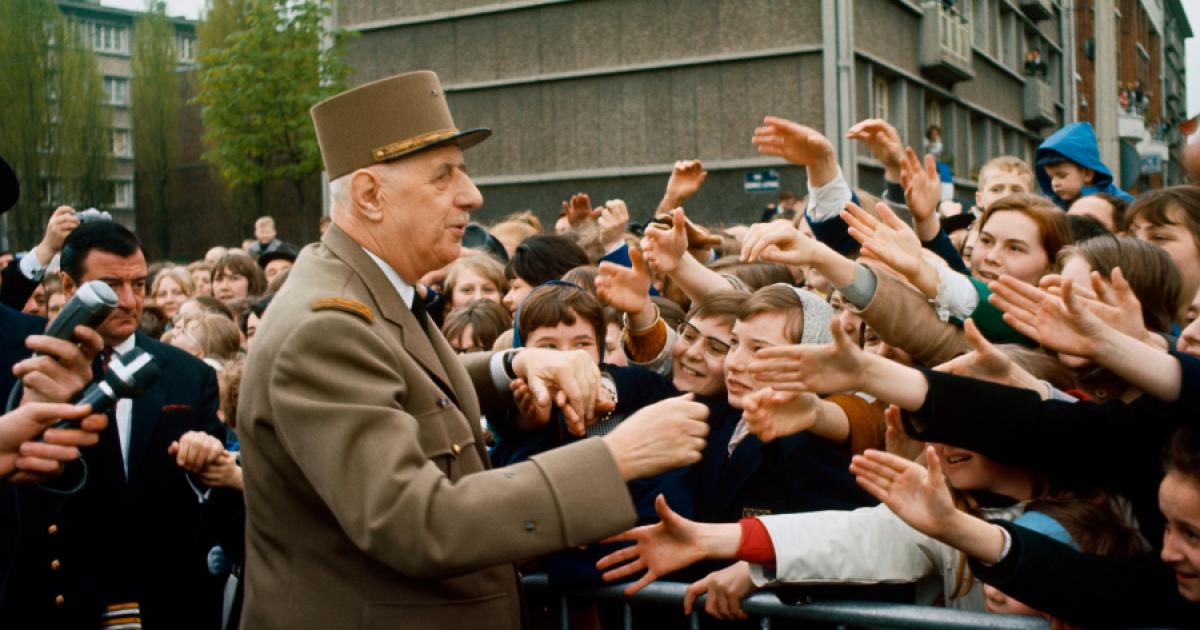
Not out of nostalgia, and certainly not out of political affinity. I simply felt the need to understand his legacy more clearly, and the extent to which it has shaped French political thinking far beyond his own camp.
I listened to historians working on what is often described as social Gaullism, a strand of Gaullist thought that placed social cohesion, participation and state responsibility at the heart of national independence.
What fascinated me was less the mythology surrounding the man and the grandeur of the narrative that still clings to his figure. It was, more importantly, the central place sovereignty occupied in his political thought, as something concrete, fragile, and constantly at stake.
READ MORE: Unionist politicians respond to Budget with 2026 election pitches
This interest did not come out of nowhere. It emerged from a growing unease with the way political debates increasingly circle around symptoms while avoiding structures.
Housing, energy, finance, care, land – we discuss them endlessly, yet often as if they were technical problems to be managed, rather than sites of power where fundamental choices are made. Somewhere along the way, the language of sovereignty disappeared.
De Gaulle offers no ready-made model for today. He was a man of his time, firmly rooted in the political traditions of the right. But his understanding of sovereignty remains strikingly relevant, precisely because it was so practical.
Sovereignty, for him, was not an abstraction. It referred to a capacity, the ability of a people to decide when the essential was at stake.
That capacity was inseparable from the social question. De Gaulle understood that a nation fractured by economic insecurity, dependence and social dislocation could not be sovereign in any meaningful sense.
This is why social Gaullism insisted on participation, on the place of workers within the enterprise, and on the role of the state in arbitrating between capital and labour, because national independence required social cohesion.
Sovereignty, in this sense, was never absolute. De Gaulle was acutely aware of interdependence. Independence did not mean isolation, nor withdrawal from the world.
This is precisely why he supported the idea of a political Europe, not as a dilution of sovereignty, but as a framework in which it could be exercised meaningfully. Sovereignty was relational. It assumed rules, shared commitments, and an international order in which people could assume responsibility for their own destiny.
What he resisted was not co-operation, but subordination. The distinction matters today. There is a difference between a world in which sovereign peoples negotiate with one another, and one in which the sovereignty of the market overrides law and democracy.
This understanding of sovereignty was inseparable from economic and industrial capacity. For De Gaulle, political independence rested on the ability to produce, to equip oneself, and to sustain essential sectors over time. Control over energy, manufacturing, infrastructure and technological know-how shaped the range of political choices available.
Historians of Gaullist economic policy have shown that this was not a secondary concern. Industrial strategy was constitutive of sovereignty itself.
National champions, energy autonomy, technological capacity and long-term planning were not just tools for growth but safeguards of political independence.
“Without economic independence, there can be no independence at all,” De Gaulle famously put it. The point was not as much self-sufficiency as capacity: the ability to act when circumstances changed, rather than find oneself constrained by dependencies decided elsewhere.
Where production, supply chains and energy systems escape collective control, formal political authority remains, but the space for democratic choice narrows. Decisions continue to be made, yet within limits defined elsewhere. This brings us to Scotland. The paradox of contemporary Scottish politics is not that independence lacks support. It is that a party whose raison d’être is independence has struggled to articulate a clear vision of what sovereignty would actually mean in practice. Independence is presented as a status to be attained, more than as a power to be exercised.
The dominant argument remains procedural: Scotland would be better governed, decisions would be taken closer to home, and democratic preferences would be respected.
All of this is true – and insufficient. Competence and normality may reassure, but they rarely mobilise. They do not answer the deeper question many voters are asking, often implicitly: what would independence allow us to do differently?
Energy, housing, land and finance tend to be discussed as policy areas, problems to be managed, constraints to be navigated. They are far less often treated as places where sovereignty might be exercised in a genuinely different way. Limits are acknowledged, sometimes softened, but rarely confronted at their source.
READ MORE: SNP seek to guarantee seats at the expense of a pro-indy majority
The result is that independence can begin to look like a distant, abstract horizon, while the forces shaping everyday life remain immediate and inescapable.
This gap matters. Powerlessness is not usually felt as a constitutional issue, but as a material one.
It is felt when housing becomes unaffordable despite being in full-time employment; when energy bills swing unpredictably in a country rich in natural resources; when investment decisions are taken elsewhere, according to logics people neither see nor influence. These experiences do not automatically turn into support for constitutional change unless independence is clearly linked to the ability to act on them.
A movement can mobilise around constitutional aspiration for a time, but building a durable majority needs something stronger: a shared sense of purpose and a clear idea of what independence is for.
In France, across much of the left, sovereignty has re-entered political language through necessity rather than ideology. Energy shocks have revealed the cost of dependency while also highlighting, by contrast, the protective effect of public control. THE renationalisation of EDF, carried out under Emmanuel Macron, who is far from being a left-winger, was driven by strategic urgency; after Russia started the war in Ukraine, energy independence was recognised as too important to be left fully to the market.
The degradation of public services has similarly laid bare the consequences of outsourcing essential functions, like care homes, to profit-driven actors. Industrial decline, meanwhile, has forced a reckoning with lost capacity and long-term vulnerability.
The concept of demarketisation, now discussed openly within the French left, does not emerge from nostalgia for state control. It reflects a pragmatic recognition that certain sectors must be partially insulated from market logics if democratic choice is to retain substance. It is not a rejection of enterprise or initiative, but a refusal to let the market dictate the terms of collective life. Scotland faces similar pressures, yet the language to connect them to sovereignty remains underdeveloped. The question is not whether the private sector has a role to play (it does) but whether the rules governing essential domains are shaped democratically.
Sovereignty, in this sense, is not about doing everything at home. It is about retaining the ability to decide what must not be left entirely to market forces.
For Scottish independence to reach its next level, nothing less than “a certain idea of Scotland” will do.
An idea that treats sovereignty as capacity rather than symbolism. An idea that takes economic and industrial sovereignty seriously: energy, infrastructure, and the ability to plan for the long term. An idea that recognises that democracy loses substance when it no longer governs the material conditions of everyday life.
Such an idea accepts interdependence, but insists that it be chosen, negotiated and governed rather than imposed by markets, financial actors or structural dependency. It recognises openness, but refuses subordination.
This is the level at which independence becomes meaningful again: not as a destination, but as a power to be exercised. Without this articulation, independence risks remaining an aspiration without momentum. With it, it becomes a political project capable of carrying a majority, because it speaks directly to how people live, work, heat their homes, and imagine their future.
For Scotland to move forward, independence must cease to be merely something to be achieved. It must become something to be done.