Stay informed with free updates
Simply sign up to the Artificial intelligence myFT Digest — delivered directly to your inbox.
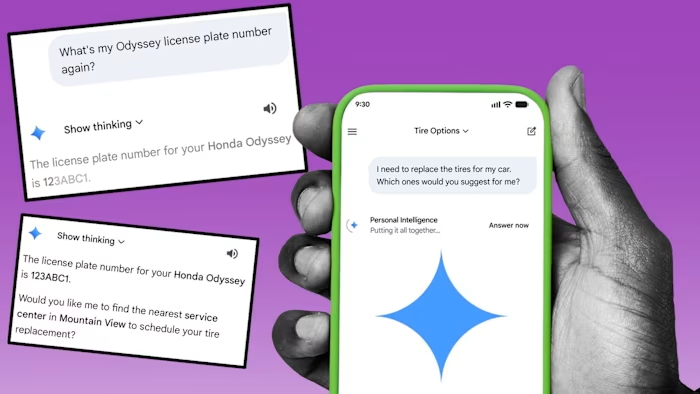
Google’s Gemini chatbot will begin linking information from emails and traditional search history to tailor its responses, as the tech giant seeks to personalise its AI products to better know their user.
The Alphabet-owned group on Wednesday launched a new capability that enables its chatbot to “reason” across different Google apps, such as photos and YouTube viewing history, to provide personalised insights.
The move marks a significant push by Google to leverage its huge span of popular products to gain an advantage over rivals, such as OpenAI, in the race to attract AI users.
“We’ve always wanted to build a personal assistant that’s actually useful in those ‘life happens’ moments, evolving Gemini from a very transactional assistant to one that knows you better and better over time,” Animish Sivaramakrishnan, group product manager of Gemini Personalisation, told the FT.
By having access to this information, as well as its conversation history, Gemini can provide more specific responses rather than a general answer.
For example, when a user is planning a holiday, Gemini will be able to know — based on an understanding of previous trips from a user’s photos or emails — that they may prefer the outdoors, have children or favourite hotels and will use this information to put together a tailored and relevant itinerary.
“We’re now able to grasp context and nuance across your most important apps, so that instead of engineering a prompt, it feels like having a fluid, natural interaction with someone who knows you,” added Sivaramakrishnan.
The personalisation feature will be rolled out to premium subscribers in the US from Wednesday, with a plan to expand it globally as well as to free users in the coming months.
AI groups have stepped up their focus on improving memory over the past year, releasing upgrades that enable their chatbots to store a larger amount of user information to personalise their responses.
The move is viewed as an important step to help top AI firms attract users in a competitive market for chatbots and agents, as well as a means to generate revenues from the cutting-edge technology.
Google’s move could give it an advantage over rivals such as OpenAI and Anthropic which do not have the same access to personal data. Last year, OpenAI and Anthropic enabled users to log in to their Gmail and Google Calendar accounts, as well as to other third-party apps, to provide more context for responses.
Recommended

But a rollout of greater memory capabilities across large language models has raised privacy concerns.
Google said it would prioritise user privacy by disabling the new feature by default and, even when activated, would not personalise every response. Users can select which apps they want to connect to and disconnect at any time.
An ongoing challenge for AI firms over the past year has been increasing chatbots’ ability to retain user data and use it effectively to deliver more personalised and helpful experiences without being creepy.
Google’s move comes just days after it revealed plans to introduce personalised advertising into its AI shopping tools, as it searches for ways to make money from the fast-developing technology.
Advertisers will be able to present exclusive offers to shoppers who are preparing to buy an item through Google’s AI mode in Search, which is powered by its Gemini model.