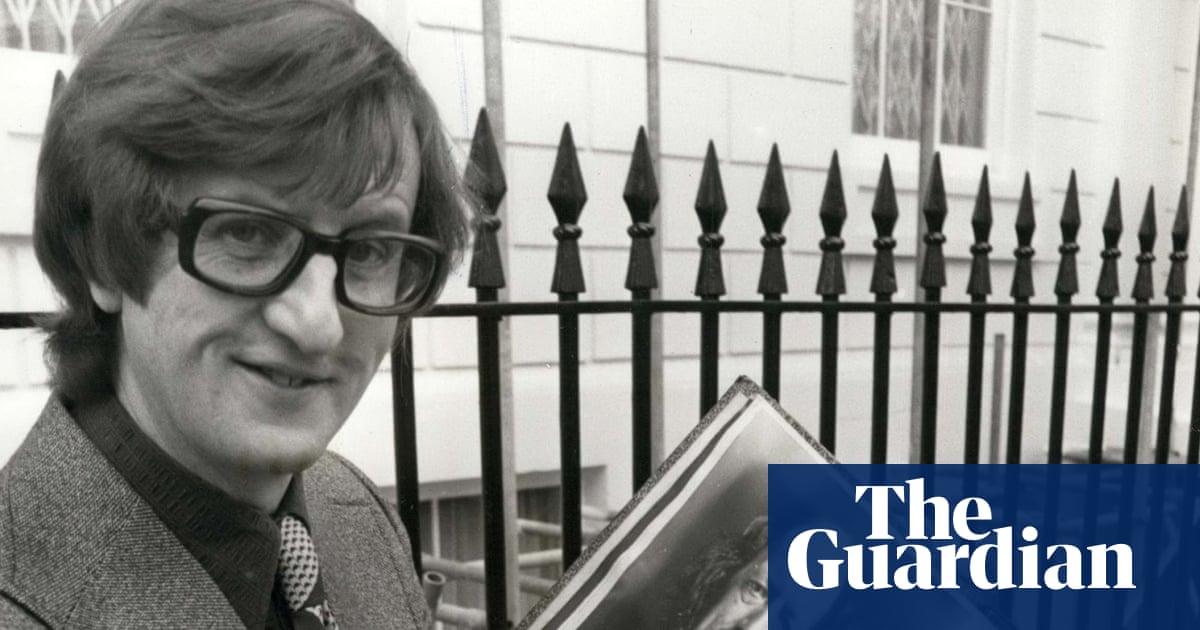
Colin Ford, who has died aged 91, was an enthusiastic promoter of photography in all its forms. As the founding head of the National Museum of Photography, Film and Television, Bradford (1982-93; renamed the National Science and Media Museum in 2017), he aimed to make the science and art of photography and moving images accessible to all.
From 1972 he had been the inaugural keeper of photography and film at the National Portrait Gallery in London, the first such role at a national museum. During his previous seven years as deputy curator of the National Film Archive (now the BFI National Archive), he proposed that the NPG show film portraits of prominent British figures.
The gallery’s director, Roy Strong, replied that they had not even tackled still photography yet, but were determined to do so. (The one photograph in the NPG’s primary collection was a portrait of the Victorian cookbook writer Mrs Beeton.)
David Hockney composing his collage Bradford, Yorkshire, July 18th, 19th, 20th 1985. Photograph: Andrew Tunnard/David Hockney Inc/Collection of National Science and Media Museum
Despite arriving at the NPG without any photographic experience, within weeks Colin gave an interview to Amateur Photographer advocating a dedicated national museum of photography. Soon after, he led a campaign to stop the Royal Academy from auctioning off three volumes of 1840s photographs by the pioneering Scottish duo David Octavius Hill and Robert Adamson, and secured £32,000 from an anonymous donor to purchase them for the NPG.
A subsequent exhibition attracted 23,000 visitors and was accompanied by the book An Early Victorian Album: The Hill/Adamson Collection (1974), co-authored with Strong. Film fell by the wayside, but Colin commissioned portraits of living subjects, including the series The Great British by the American photographer Arnold Newman.
In 1975, an album that the portraitist Julia Margaret Cameron assembled in the 1860s for the astronomer Sir John Herschel was sold at Sotheby’s to a US collector. Colin intervened to get the export licence stopped, the first time that the designation of outstanding cultural significance had been applied to photography.
David Hockney’s collage Bradford, Yorkshire, July 18th, 19th, 20th 1985, showing the new museum. Photograph: Andrew Tunnard/David Hockney Inc/Collection of National Science and Media Museum
A public appeal raised £52,000 for its purchase by the NPG; it later became the first set of photographs to be accessioned by the new national museum. Among the Herschel Album’s astonishingly modern-looking portraits is that of a high-cheekboned man titled Iago – Study from an Italian, a unique print that was Colin’s favourite picture by Cameron.
Dame Margaret Weston, director of the Science Museum, shared Colin’s vision for the new museum, and secured a space in Bradford for the purpose. Audiences flocked to enjoy the first Imax cinema in the UK, displays of photographic technology, exhibitions by internationally renowned artists, and commissions including giant Polaroids by Neal Slavin and collages by the Bradford native David Hockney. By 1988 it had attracted 3.5 million visitors.
Iago, Study from an Italian, Colin Ford’s favourite photograph by Julia Margaret Cameron. Photograph: Alamy
After 10 years in Bradford, Colin was recruited to direct the National Museums and Galleries of Wales. His portfolio initially included 10 institutions, which he eventually consolidated into seven during his five-year tenure, until 1998. In 2025 he donated his library of 2000 photography books to what is now Amgueddfa Cymru – Museum Wales.
The Herschel Album campaign ignited Colin’s passion for Cameron scholarship, which he shared with the public in lectures, exhibitions and books, culminating in a catalogue raisonné in 2003. Co-authored with Julian Cox, with contributions by other scholars, Julia Margaret Cameron: The Complete Photographs is a hefty, 560-page volume.
Colin resisted using the word “complete” in the title and, indeed, dozens of previously unknown Cameron photographs came to light as soon as the book was published. His wish that an updated, digital version of the catalogue be produced was not fulfilled in his lifetime but remains an ambition among younger historians of photography.
Having spearheaded the campaign to save Dimbola, Cameron’s home on the Isle of Wight, from destruction in 1993, Colin served as vice-president of the Julia Margaret Cameron Trust (2005-20). In 2024, his 90th birthday celebration was a theatrical reading of Cameron’s life, performed at the Bodleian Library, Oxford, where Colin’s archive, predominantly relating to Cameron, is now available to researchers.
Born in Battersea, south-west London, Colin was the son of Hélène (nee Jones), an amateur singer, and John Ford, an electrical engineer. He developed a love of music and performance, and his brother, Martyn, became a professional musician.
Colin Ford by Arnold Newman. Photograph: Arnold Newman
After attending Enfield grammar school and graduating in English (1955) from University College, Oxford, where he acted in and directed student productions, he worked for Halas & Batchelor cartoon films (1957-58), and managed the Kidderminster Playhouse (1958-60) and the Western Theatre Ballet (1960-62).
Then he spent two years as a visiting lecturer in English and drama at California State University at Long Beach and UCLA (1962-64), before returning to Britain and joining the film archive in 1965. He remained passionate about classical music, opera and theatre all his life, and his flair for performance served him well as a lecturer, broadcaster and arts campaigner.
In 1979, Colin wrote the catalogue for the first André Kertész exhibition in Britain. It was held at the Serpentine Gallery in Kensington Gardens, then led by its founding director, Sue Grayson, who had Hungarian parents and became Colin’s second wife in 1984.
He considered Kertész one of the greatest photographers of all time, and went on to organise further Hungarian exhibitions, including Eyewitness: Hungarian Photography in the Twentieth Century at the Royal Academy (2011). Two years later he received the Hungarian Order of Merit.
In the 1980s and 90s, Colin was a regular presenter on the BBC Radio 4 arts programme Kaleidoscope and frequently appeared on that network and Radio 3 as an arts commentator and interviewer. He was appointed CBE in 1993 and made an honorary fellow of the Royal Photographic Society in 1999.
In 1961 he married Margaret Cordwell, and they had two children, Richard and Clare. The marriage ended in divorce.
Sue Grayson Ford survives him, along with a son, Tom, the children of his first marriage, Richard and Clare, his grandchildren, Esmé and Inigo, and Martyn.
Colin John Ford, museum director and photographic historian, born 13 May 1934; died 21 December 2025