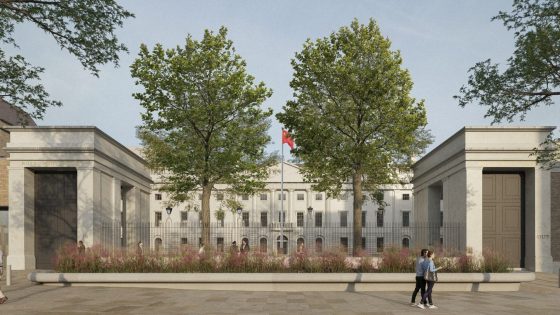
After three delays to the final decision and several calls for a redesign of what would be the largest embassy in Europe, the government is now expected to approve the scheme next week.
But a political and media backlash has erupted over concerns that the building could be used as a spy headquarters, including what is claimed to be a secret underground chamber sitting alongside sensitive communication cables.
The scheme, for the former Royal Mint site opposite Tower Bridge in Tower Hamlets, includes a network of 208 underground rooms. The Telegraph reported on Monday (13 January) that one of these rooms sits next to fibre optic cables carrying the UK’s financial and internet data.
The newspaper said it had obtained unredacted plans showing the room within the subterranean complex, which, it wrote, ‘Beijing [had] sought to keep from public scrutiny’.
This revelation caused six Labour MPs to call on the prime minster to reject the proposal ahead of a decision next week (20 January), in which the government is expected to approve the project. Keir Starmer is set to make a diplomatic trip to China following the government’s decision, though officials insist there has been no political input during the planning process.
A senior official from the White House has also weighed in on the situation, raising fears that the new embassy could be used to ‘exploit the critical infrastructure of our closest allies’.
Meanwhile, shadow home office minister, Alicia Kearns, called the lack of security concern ‘disappointing’ during a parliamentary Q&A, and claimed that the embassy would give China a ‘launch pad for economic warfare against our nation’.
The government had been expected to make a decision on the embassy last month. But this was pushed back to consider particular security implications held by government ministries. It was the third time that a decision on the scheme had been delayed. Housing and communities secretary Steve Reed had been set to make a ruling in October but asked for more time to consider the application.
Before that, Reed’s predecessor, Angela Rayner, had been due to issue a verdict by 9 September, but postponed her decision in order to receive further information from China.
In August, she asked the Chinese embassy to supply further information over blanked-out sections of submitted planning documents, which had been ‘redacted for security reasons’, according to the BBC. These included drawings seen by the AJ for the cultural exchange building and Embassy House elements of the application.
Rayner also reminded China of requests made by then-home secretary Yvette Cooper and then-foreign secretary David Lammy in January for a ‘hard perimeter’ around the embassy to solve concerns over public safety. The two secretaries of state signalled cautious support for the proposals if China amended the scheme.
But China has not signalled that it will amend its plans. Nor have altered plans been submitted to Tower Hamlets. In November, the Guardian reported that MI5 had no security concerns about the project.
Tower Hamlets, the local planning authority, has twice refused the scheme – most recently in December 2024 in a symbolic refusal following Rayner’s call-in. The council said its committee had rejected China’s application ‘due to concerns over the impact on resident and tourist safety, heritage, police resources and highway safety given the congested nature of the area.’
The same committee refused an earlier but identical application in December 2022 against planning officer recommendations.
David Chipperfield Architects has been contacted by the AJ for comment.