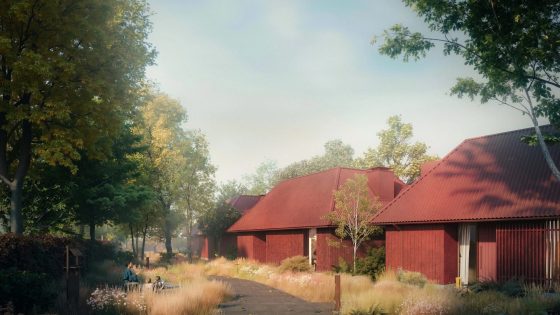
The 2,860m² scheme will sit on a secluded woodland site behind Kent House Road and next to the Alexandra Sports Ground on the border of Sydenham and Penge East.
Earlier proposals included: four semi-detached houses, lodged in 2010 and subsequently refused, then dismissed at appeal; two detached dwellings with parking and a new access driveway, also thrown out at appeal; a rejected 2017 proposal; and a previous application by Dowen Farmer, which was turned down in October 2024 on grounds relating to residential amenity and character.
The Dowen Farmer team, including consultant MJP Planning (see comment below) and landscape architect Studio Bosk, say these proposals all failed ‘for broadly consistent reasons’. These included the ‘long vehicular access penetrating deep into the site’, the loss of landscape structure, and a perception that the schemes were ‘cramped and intrusive’ backland developments.
They describe the approved plans as ‘landscape-led’, using ‘a soft touch approach’ to create a ‘quiet enclave behind the suburban frontage, where the daily experience is shaped by the existing woodland, filtered views, and a strong sense of retreat’.
The layout follows the radial edge of the sports ground and features a boardwalk, which provides the main route through the site.
The practice says the four timber-clad homes have been designed with ‘bold, elegant corrugated roof forms’.
A future timescale has yet to be set out.
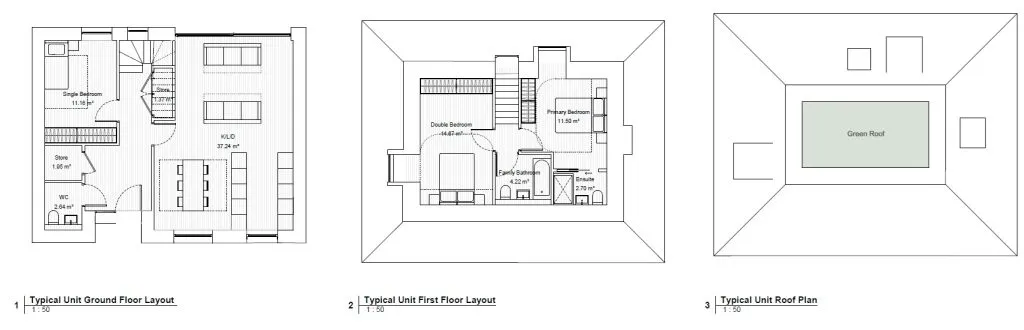
Kent House Road backland plot approval – typical floor plan
Project data
Project name Kent House Road
Lead architect Dowen Farmer Architects
Location London Borough of Bromley
Function Residential
Client Harvard & Taylor Developments
Planning consultant MJP Planning
Landscape architect Studio Bosk
Transport consultant Markides Associates
Arboricultural consultant Hayden’s Arboricultural Consultants
Gross Site Area m² 2,860m²
Completion date To be decided
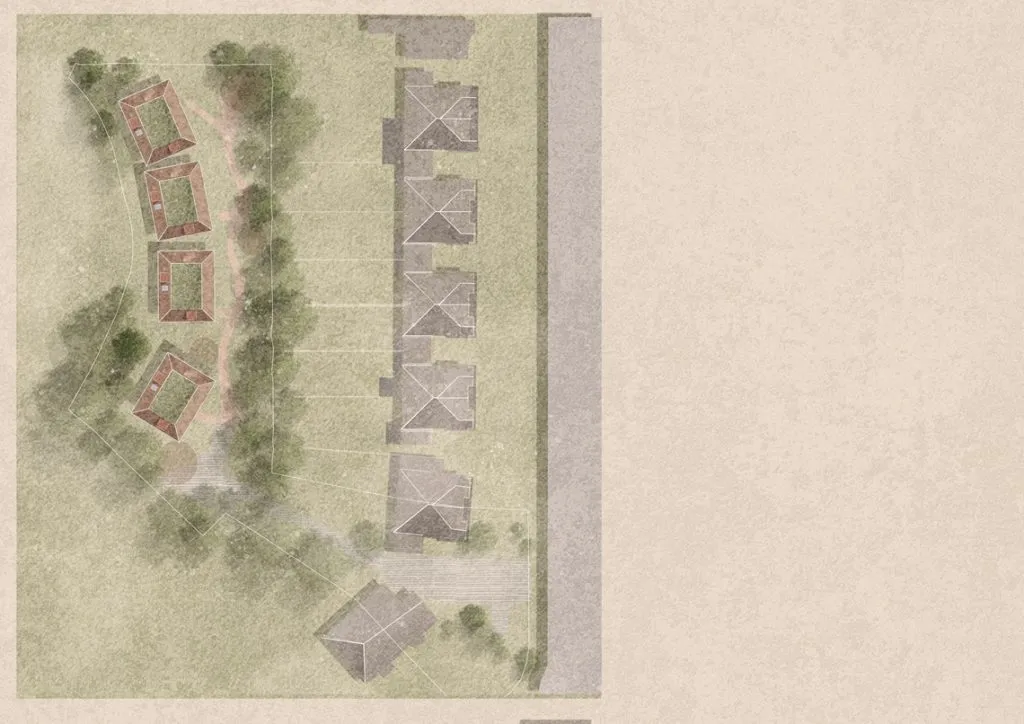
Dowen Farmer’s consented proposals for Kent House Road, Bromley – site plan
How did you convince the local authority to approve the scheme?
Max Plotnek, founder, MJP Planning
To overcome the previous refusal, we made the following moves: we rethought access as an amenity issue, not a highways issue. Historically, highways impacts are rarely the reason for refusal. The problem was how access behaved spatially and experientially, particularly in relation to numbers 104 and 106 Kent House Road. In the consented scheme, day-to-day parking, servicing and refuse collection are pulled forward to the site frontage, rather than being dragged deep into the backland.
The application also gives something back to the host dwelling. A recurring criticism of earlier schemes was that development came at the direct expense of number 106, leaving it with an uncharacteristically short and poor-quality garden. In the approved layout, the retained garden to number 106 is materially increased, restoring a relationship that officers considered more consistent with the prevailing suburban grain of Kent House Road. This was critical. It reframed the proposal from an aggressive severance to a replanned site with a clear hierarchy, where the host dwelling remains legible and respected within the wider plot.
There was also an acceptance that backland solutions must look different. One of the more interesting aspects of the officer’s reasoning is the acknowledgement that a backland scheme on a site of this shape cannot and should not mimic the street frontage typology.
‘The approved design adopts a deliberately soft and subservient approach’
Instead of forcing a pastiche of Kent House Road to the rear, the scheme leans into a quieter architectural language, strong landscape structure, and a layout shaped by the site’s constraints.
High-quality architecture was a key part of unlocking the site. The approved design adopts a deliberately soft and subservient approach, allowing the buildings to nestle into the landscape rather than compete with it. While the typology is not synonymous with the prevailing frontage development, it feels comfortable and well-judged in its setting.
Through restrained massing, carefully chosen materials and a close relationship with planting, the architecture enhances the existing landscape framework and reads as a calm, recessive presence, albeit one with a clear and distinctive identity.
Crucially, this design-led approach landed in a policy context where Bromley is facing a severe housing land supply shortfall, with paragraph 11(d) of the NPPF engaged and substantial weight afforded to small windfall sites.