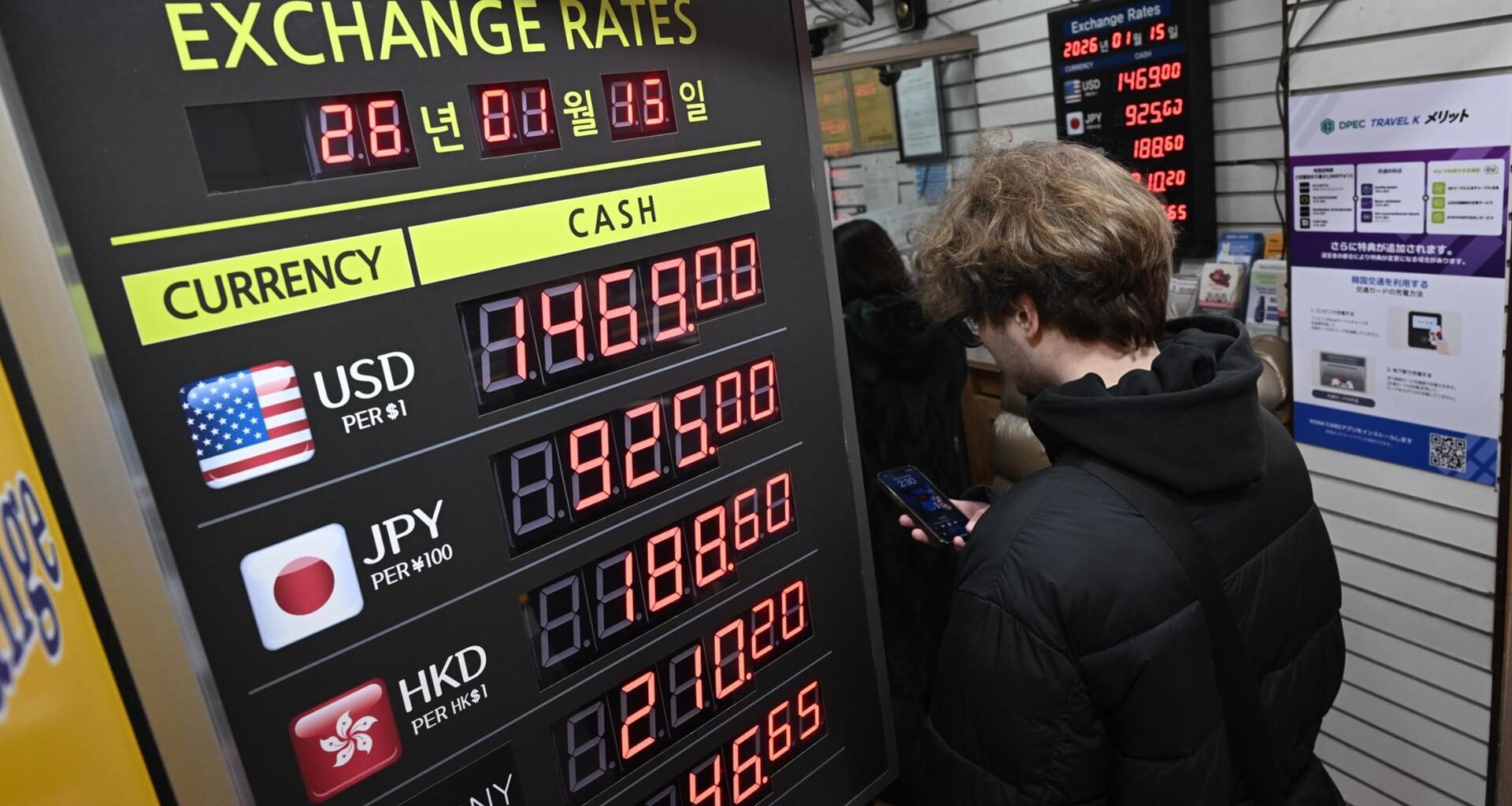
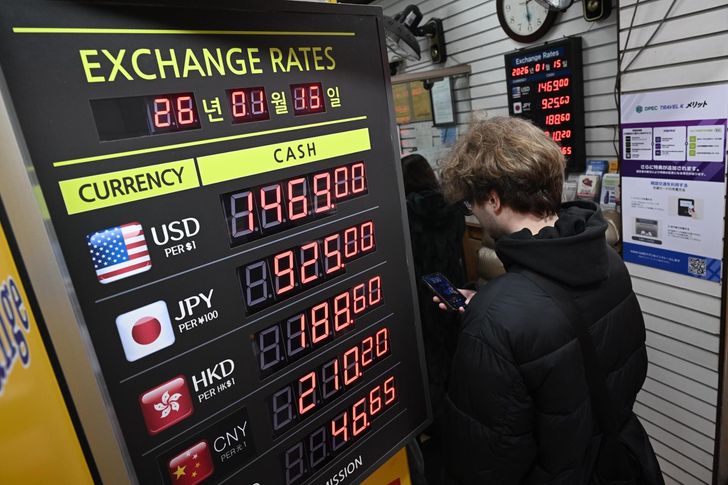
A screen at a currency exchange booth in Seoul’s Myeong-dong shopping district shows the Korean won trading at 1,469 per dollar, Thursday. The local currency strengthened by 7.8 won, closing at 1,469.7 won per dollar in daytime trading. Korea Times photo by Shim Hyun-chul
U.S. Treasury Secretary Scott Bessent’s rare intervention in Korea’s foreign exchange market comes as the two countries recognize the need to jointly address the rapid depreciation of the Korean won, according to the Ministry of Economy and Finance on Thursday.
The rare verbal intervention reflects the importance of the Korean won’s stability for bilateral economic cooperation, including Korea’s planned $20 billion annual investment in the U.S. as agreed to in tariff negotiations last year, Deputy Minister for International Economic Affairs Choi Ji-young said.
His remark came after Bessent addressed the won’s depreciation in a social media post and a readout posted by the U.S. Department of the Treasury.
In a rare intervention by a top U.S. economic policymaker, Bessent noted that the won’s depreciation “was not in line with Korea’s strong economic fundamentals.”
According to the readout, the secretary also “emphasized that excess volatility in the foreign exchange market is undesirable, and reaffirmed that Korea’s strong economic performance, especially in key industries that support America’s economy, make it a critical partner for the United States in Asia.”
Bessent issued the message after his meeting with Minister of Economy and Finance Koo Yun-cheol earlier this week.
“The two top economic policymakers shared concerns over the recent sharp depreciation of the won,” Choi said during a press briefing at Government Complex Sejong.
“Secretary Bessent’s decision to express his views directly on his personal social media account, as well as the U.S. Department of the Treasury’s issuance of a related statement, was made against this background,” Choi said.
With reference to the $20 billion annual investment, Choi said, “The size and timing of U.S.-bound investments can be adjusted in the event of market instability.”
“Going forward, both countries’ financial authorities plan to maintain close communication and cooperation to ensure exchange rate stability as strategic investments are implemented.”
Soon after Bessent’s verbal intervention, the Korean won climbed 12.5 won to reach 1,465 won per dollar. However, it edged back toward the 1,480 level in daytime trading, and closed at 1,469.7 won per dollar at 3:30 p.m., improving 7.8 won from Wednesday’s close.
The local currency had not stabilized even after Korean financial authorities’ aggressive verbal intervention on Dec. 24, 2025.
That measure proved short-lived, prompting the won to strengthen from the 1,480 level to the 1,420 level through Dec. 29, before it fell over the next 10 trading sessions.
“While monetary policies have so far been driven by the Korean government, future measures may require support from the U.S. government,” Shinhan Investment Corp. economist Ha Keon-hyeong said.
NH Investment & Securities analyst Kwon Ah-min voiced a similar view. “The U.S. appears to be cooperating with Korea, as a weak won could affect trade balances with the U.S. and future U.S. investment.”
Meanwhile, Bank of Korea Gov. Rhee Chang-yong said that Bessent was “simply describing the situation as it is” during a press briefing after a monetary policy board meeting at the central bank headquarters in Seoul.