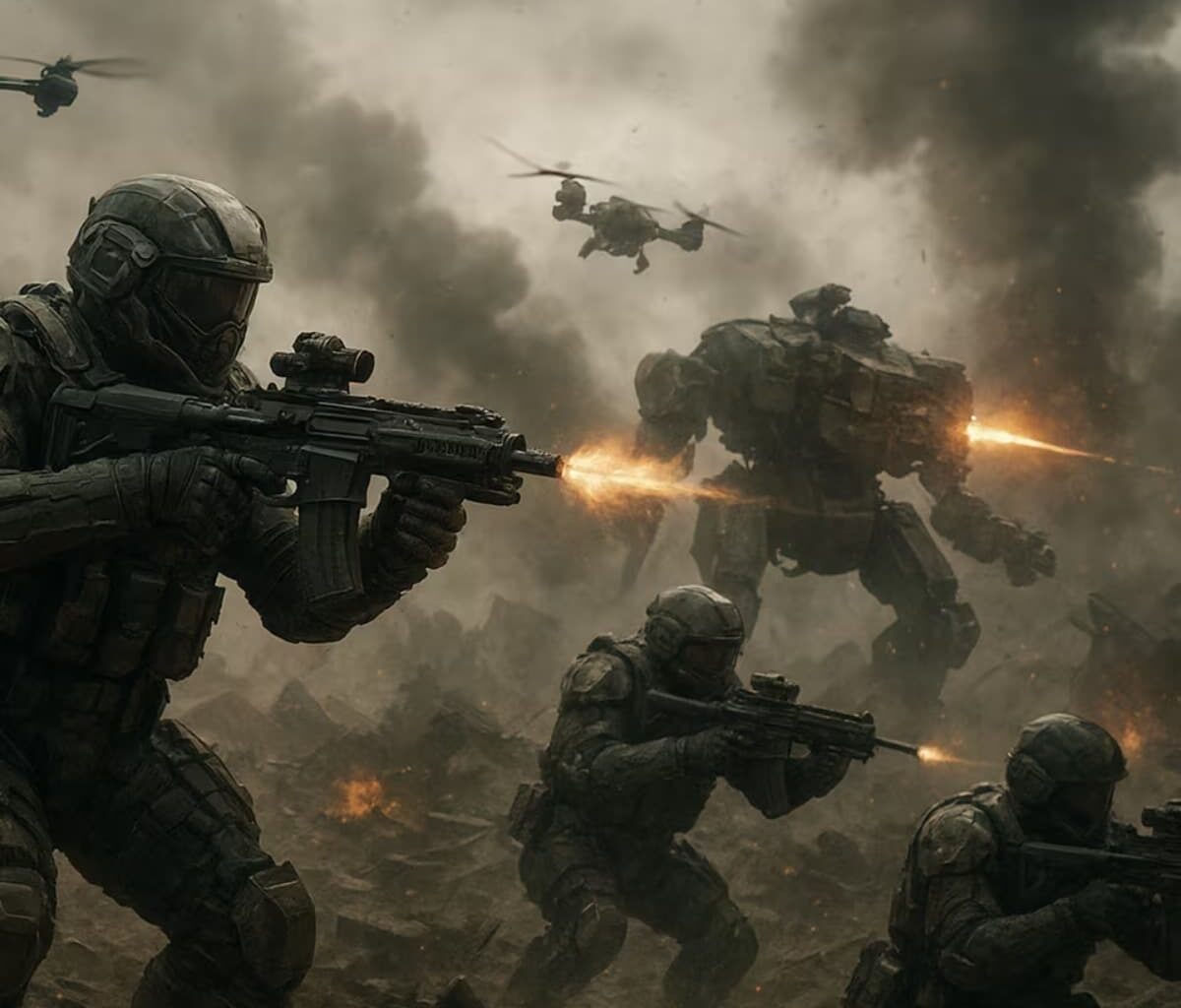
As modern warfare becomes increasingly hybrid, combining cyberattacks and physical conflict, the French military has turned to a bold experiment known as the Red Team to help foresee the battles of tomorrow. So what can we expect from it?
Made up of science-fiction authors and writers working hand in hand with scientists and military experts, the Red Team’s mission is to imagine threats that could one day put France and its national interests at risk. By harnessing creativity and imagination, the group aims to anticipate the technological, economic, social, and environmental forces that might trigger future conflicts in the decades ahead.
To understand what this visionary project has uncovered, we spoke with Xavier Mauméjean—writer, novelist, essayist, and member of the Red Team—whose latest book La semaine des quatre jeudis was recently published by Alma.
How the Red Team works
“The Red Team’s goal is to anticipate the conflicts of the future,” explains Mauméjean. “We were divided into two groups, A and B. Team A created scenarios meant for public release, while screenwriter Xavier Dorison, writer Doa, and I formed Team B, which worked on classified defense studies. Because we weren’t specialists, we could look at things differently—connecting the dots the military provided us to spot potential crises.”
To refine their scenarios, the teams could consult experts in geopolitics, anthropology, and economics, as well as military tacticians for specific strategic insights.
Which scenario seems closest to reality?
“Some of our scenarios were published by Les Équateurs,” says Mauméjean. “Anything involving neuroscience is highly plausible, especially advances in human–machine interfaces and the concept of the augmented soldier. Progress in this field brings undeniable benefits—but also potential risks. Drones are another major concern; they’ve completely reshaped the battlefield. And interestingly, there’s also a move back to analog systems to avoid cyberattacks. What’s often seen as a flaw in the Russian army—their lack of digital modernization—can actually be an advantage.”
The augmented soldier is a component of future conflicts. © The Flares, YouTube
Has the army already made adjustments?
“Yes, it has,” he confirms. “We’ve already seen shifts in the logistics chain, particularly in how certain materials are transported. There’s also greater awareness around citizens becoming trapped in filter bubbles and the potential for manipulation—a known issue, but one that’s now getting more serious attention. We also highlighted the delay between on-the-ground information and the spread of disease during a biological attack. These are points the army is now working to improve.”
When fiction meets military foresight
Some Red Team scenarios, like Face à l’Hydre, may not seem directly tied to defense. In that one, a new instant-acquisition technology blurs the line between expert and non-expert. “One of the conditions for success,” Mauméjean explains, “was to create new ‘wirings.’ In one study, we wanted to simulate an internal cyberattack within the army. We had the concept but not the means. By bringing in an anthropologist and a toxicologist, we found the solution. That’s what makes this kind of creative toolbox so powerful.”
Looking ahead
Has the Red Team’s work come to an end? Not quite. “It’s already evolved,” says Mauméjean. “The follow-up project, Operation Radar, resulted in a book published by Robert Laffont. This time, far more civilian figures were involved, including entrepreneurs. It’s not exactly the same process, but the early Red Team missions paved the way.”