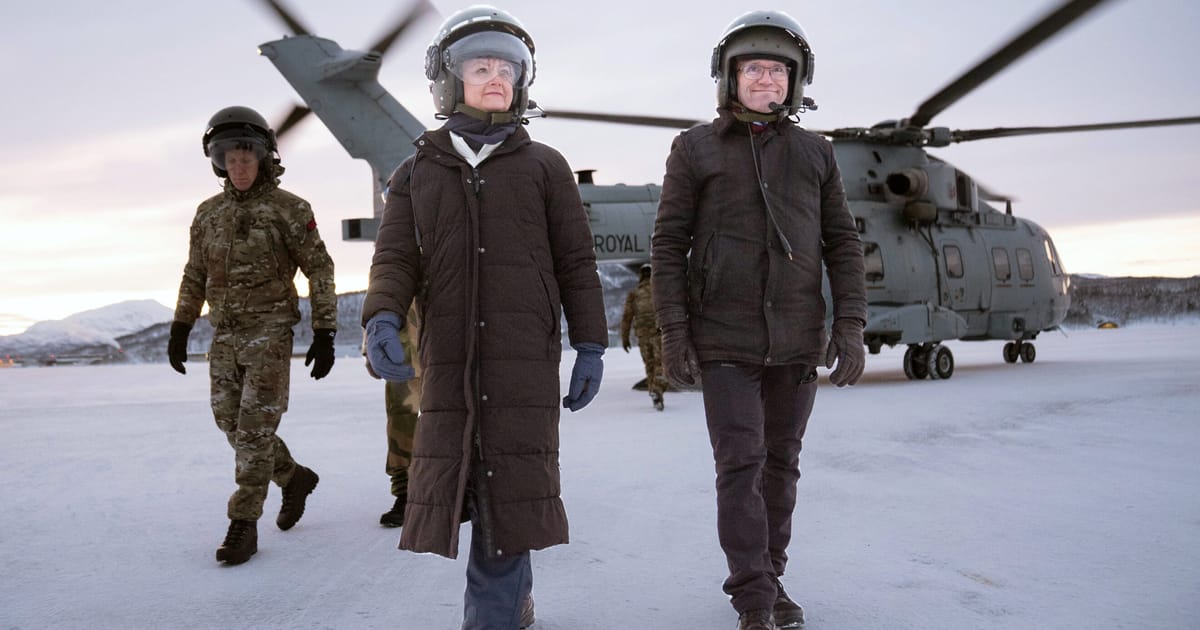
Asked if it could include NATO exercises in Greenland, Cooper said the effort is about countering the forces that have drawn Trump’s attention in the first place. “This is about the whole of the high north. If you look at some of the key areas — for example, the Greenland-Iceland gap, the Iceland-U.K. gap, the shipping channels … are crucial for the transatlantic alliance, security and defense,” she said.
“So that’s why this is about the Arctic as a whole. That includes [Norway] … but it also includes Iceland, Greenland, it includes the work that Canada has been talking about [in] the high north. So it’s a broad approach to Arctic security.”
Norwegian Foreign Minister Espen Barth Eide said Thursday that he welcomed the “Arctic Sentry” proposal and had discussed it with Cooper.
“Actually, it’s an old Norwegian idea — not exactly that name, but to have a co-operation on [the] Arctic in NATO,” Eide told POLITICO. That’s among what he referred to as the “A7” – the seven NATO countries with Arctic territory.
“So we have always thought that it’s useful to have a stronger focus on the Arctic, and what we call the ‘A7’ has been cooperating more and more on this,” Eide added. “We’ve seen that countries that were less interested in the Arctic are now becoming more interested, which is a good thing. And NATO is there for military cooperation on whatever challenge we find.”
He cautioned, however, that Norway’s focus was still more on Russia’s live threat to the European high north than a future threat to Greenland. “According to our own and allied intelligence, there is not so much activity around Greenland as sometimes is being described,” he said. “There’s hardly any military activity from, for instance, Russia and China in Greenland. It’s much more over here and in our north, and we follow that very closely.”