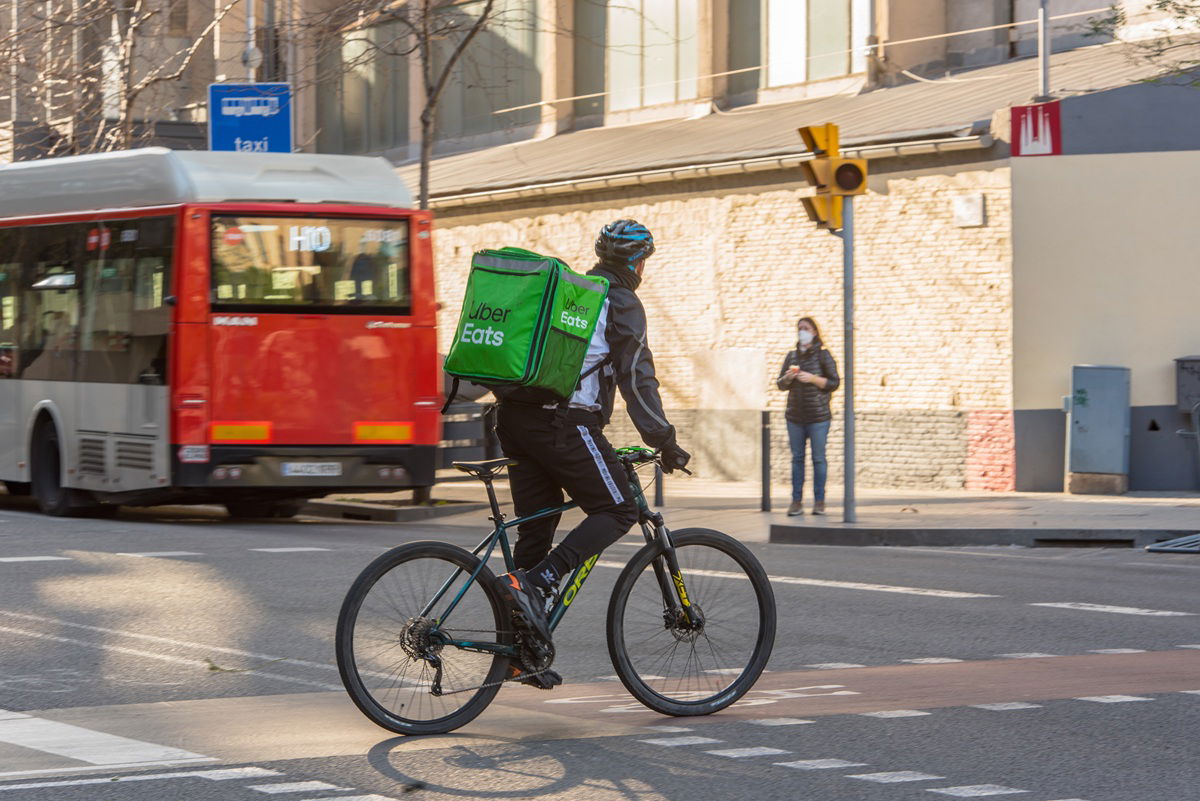
Uber Eats will end freelance deliveries in Spain following pressure from the government over labour laws.
Credit : martin SC photo, Shutterstock
For years, food delivery riders in Spain have lived in a grey zone. Technically self-employed, but working through apps that decided the rules. Flexible on paper, but often anything but in real life. Now, that chapter is coming to an end.
Uber Eats has confirmed it will stop working with self-employed riders in Spain, becoming the last major delivery platform to abandon freelancers after sustained pressure from the Spanish government. The move follows a clear warning from the Ministry of Labour: change the model, or face criminal action.
Uber Eats has chosen to change course – and quickly.
Most Read on Euro Weekly News
The company hasn’t given an exact date, but says the shift will happen “as soon as possible”. When it does, deliveries will only be carried out by riders employed through subcontracted fleets, not freelancers logging in on their own terms.
Why the government finally forced Uber Eats’ hand
Spain’s Rider Law, passed back in 2021, was meant to settle the debate over whether app-based couriers were freelancers or employees. The law introduced a presumption of employment, arguing that riders working under algorithmic control were, in reality, workers – not entrepreneurs.
Some platforms adapted immediately. Others dragged their feet.
Uber Eats initially moved away from freelancers, then brought them back under a hybrid model, allowing riders to choose between self-employment and working for fleet companies. That compromise, however, never convinced labour inspectors.
By mid-December, the Ministry of Labour made its position clear. Officials warned they were considering criminal charges against Uber Eats for allegedly continuing to use false self-employment arrangements, in breach of the Rider Law.
The threat was serious. Under Spanish law, offences against workers’ rights can carry prison sentences and heavy fines for company executives. The message was simple: fix the model before January, or face the consequences.
This week’s announcement suggests Uber Eats decided it wasn’t worth the risk.
What happens now to riders still working as freelancers
For riders currently operating as autónomos, the change is immediate and personal.
Uber Eats has begun emailing self-employed couriers, giving them 60 days to register with one of the platform’s subcontracted fleets if they want to keep delivering. Those who don’t make the switch will be disconnected from the app.
There will be no direct hiring by Uber Eats itself. Anyone who stays must do so through third-party logistics companies.
What remains unclear is how many riders will actually be absorbed. Uber Eats has not disclosed how many freelancers are currently active, how many fleet positions are available, or what conditions riders can expect once they make the move.
That uncertainty has fuelled frustration among riders who say the sector has steadily deteriorated since the Rider Law came into force. Many argue that fleet contracts often mean fewer hours, lower pay and far less flexibility than self-employment ever did.
For some, delivery work used to offer an escape from hospitality or retail. Today, they say, it feels like a job with the worst of both worlds.
Government celebrates – riders remain divided
Spain’s Labour Minister and Deputy Prime Minister Yolanda Díaz was quick to welcome the announcement. She described it as proof that legislation works, insisting that no company, however large, can place itself above the law.
According to Díaz, Uber Eats’ decision could bring more than 50,000 riders into formal employment, generating over €100 million in administrative and social security contributions. She reiterated a point she has made for years: a worker with a phone and a bike was never a start-up founder.
Industry rivals were also pleased. Just Eat, which has always employed riders directly, said the sector was finally converging towards a clear and lawful model – almost five years after the Rider Law was introduced.
Among riders themselves, however, reactions are far more mixed.
Some welcome the prospect of contracts, paid holidays and social security. Others fear that fleet-based work will strip away what little independence remains, replacing it with short shifts and tight margins that make it hard to earn a living.
The end of an era for app-based delivery in Spain
Uber Eats’ move feels less like a sudden decision and more like the final step in a process that has been unfolding for years.
In 2021, the company stepped away from freelancers. In 2022, it brought them back under its hybrid model. Since then, it has steadily expanded its network of fleet-employed riders, hiring more than 7,000 couriers through partner companies in 2025 alone.
With Glovo announcing it would fully comply with the Rider Law from July 2025, Uber Eats had become the last major platform still relying on self-employed riders.
Now, that distinction is gone.
Spain’s delivery sector is entering a new phase – one shaped by regulation rather than flexibility, and legal certainty rather than experimentation. Whether that shift will actually improve life for riders on the ground is still an open question.
What is certain is this: the age of large-scale freelance food delivery in Spain is officially over.