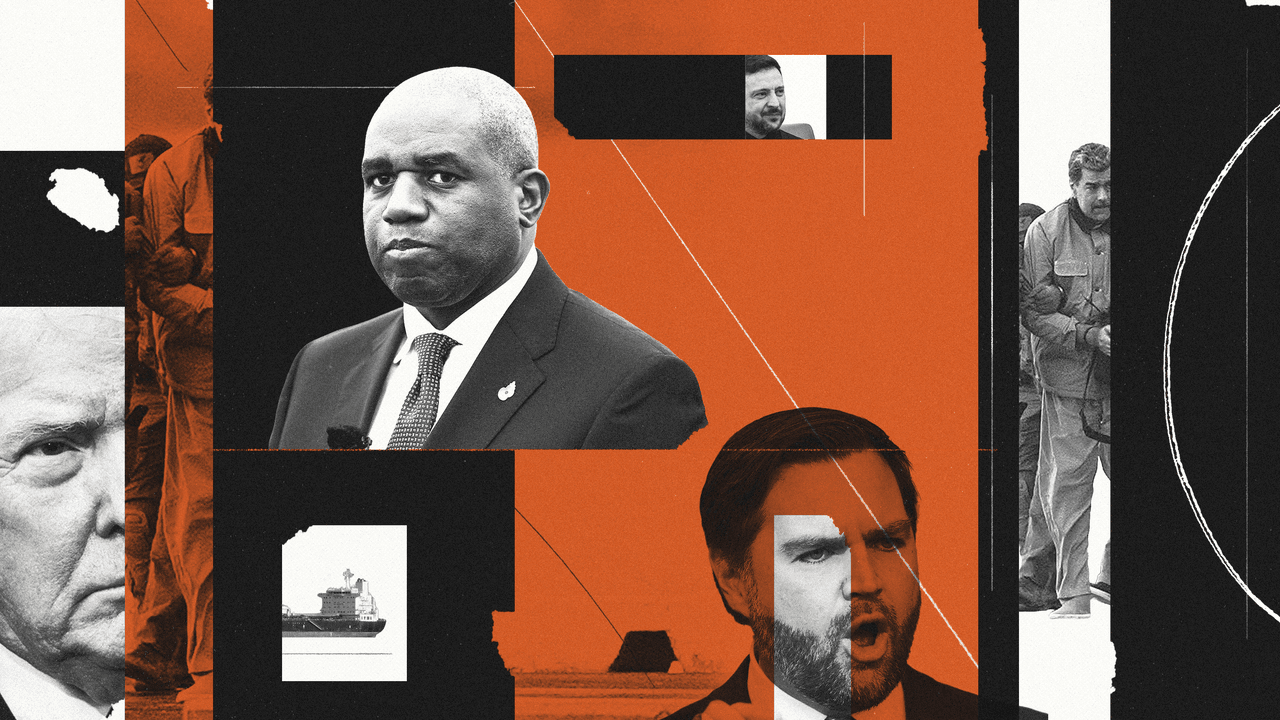
Last weekend, I asked two British foreign-policy officials what had been the most troubling moment, so far, of President Donald Trump’s world-destabilizing start to 2026. Both said (despite the British government’s refusal to acknowledge this out loud) that it was the United States’ seizure of the Venezuelan President, Nicolás Maduro, from Caracas, in the early hours of January 3rd. Trump “surprised us on the downside,” one said. “Just not having had an inkling that Venezuela was coming,” the other observed.
The suddenness—and the likely illegality—of the U.S. operation was disquieting because the British government has spent the past year contorting itself in order to stay in Trump’s good books, while professing belief in things like the U.N. Charter and what used to be called the rules-based order. In public, Keir Starmer, the Prime Minister, has said only that he “sheds no tears” for Maduro, and that he also believes in international law. He will stand up to bullies, just not the one in the Oval Office. What would be the point, anyway? “With this Administration, you would essentially be burning your bridges. You would be destroying your access,” one of the officials I talked to said. “You might even start to knock away at some of the foundations, in terms of the military coöperation, the intelligence coöperation.” The other official just sounded wearier. “All of this is really, really hard,” he told me.
Until now, getting along with Trump has been counted as a rare policy success for Starmer, during his beleaguered eighteen months in office. Starting in 2024, both Labour Party officials and British diplomats courted the Trump campaign, adopting a posture of studied deference. “Whatever has been said about Donald Trump, white, Black, and brown working-class Americans voted for him in high numbers. And that’s something to be reckoned with by my liberal Democrat friends,” David Lammy, the United Kingdom’s Foreign Secretary, said, when I interviewed him for a piece in the magazine, this time last year. (Last September, Lammy became the Deputy Prime Minister; his role in the Foreign Ministry was taken by Yvette Cooper, the former Home Secretary.) In the fall, Trump enjoyed a second state visit to the U.K., during which he and Melania Trump dined with King Charles and watched a parachute display from the steps of Chequers, the Prime Minister’s Buckinghamshire country retreat. In return for its obeisance, Britain has escaped most of the Trump Administration’s wrath toward Europe, and the European Union, in particular. The country has dodged most of the tariffs imposed on the rest of the continent and signed a notional thirty-one-billion-pound “tech prosperity deal,” to encourage A.I. investment at home and in the U.S. We try not to talk about civilizational erasure.
The prize has been to keep Trump onside when it comes to Ukraine. The day after Maduro was indicted in New York and Stephen Miller, the White House deputy chief of staff, told CNN that Greenland should “obviously” be part of the U.S., Starmer was in Paris, with Emmanuel Macron and Volodymyr Zelensky, agreeing to deploy British and French troops to Ukraine, in the event of a ceasefire. Steve Witkoff, the U.S. special envoy, and Jared Kushner, the President’s son-in-law, were there to endorse the idea, speaking of “durable security guarantees” and “real backstops,” backed up by the U.S., to stop Russian aggression. Diplomatically, at least, it all feels a long way from Zelensky’s dressing-down in the White House, eleven months ago. “That’s an enormous achievement,” one of the British officials said. The day after the meeting in Paris, British forces supported the U.S. military when it intercepted the Bella 1, a Russian-flagged oil tanker, in the North Atlantic, and Starmer and Trump caught up on the phone. “The Prime Minister has spoken to Trump several times,” the other official said. “And they have, you know, proper conversations about things. So I feel like we are still in a position to influence and we still have a partner that wants to help.”
It is impossible to overstate how much of Britain’s foreign—and security—policy is predicated on containing Vladimir Putin. In 2025, the U.K. signed a hundred-year partnership agreement with Ukraine. “It looks absolutely mad,” Richard Whitman, a professor of international relations at the University of Kent, told me. “Who would sign a treaty of that duration?” If British soldiers are eventually sent to Ukraine, it would mark a major departure for the defense of the continent. For the first time since the Second World War, the U.S. would be reduced to the role of peace guarantor, rather than being physically responsible for policing Europe’s borders. “This is a new version of the British Army of the Rhine,” one of the officials said, referring to the force, composed of thousands of British soldiers, that was stationed in Germany from the nineteen-forties to the eighties. “It’s a new European security architecture that is coming out of this, with Ukraine integrated into the West, and into NATO, in all but name.”