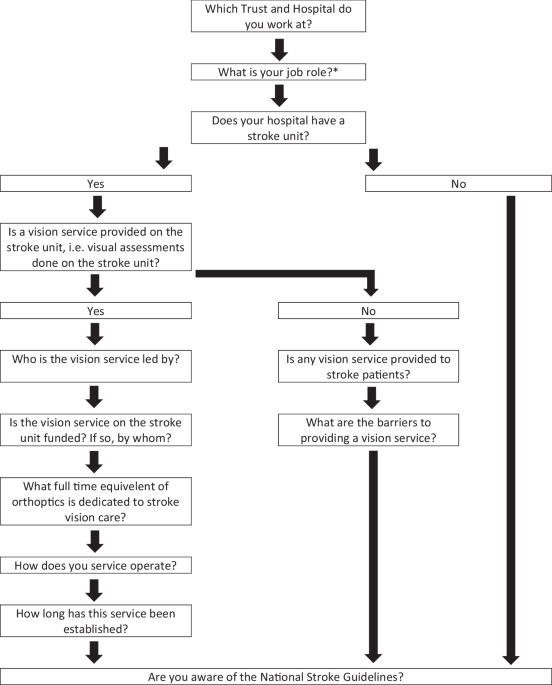
This third survey assessing the provision of vision services in stroke care has again shown an increase in the number of departments reporting a vision service on stroke units (66.1%). In 2017, it was reported that 45.5% of departments had a provision of a vision service on the stroke unit with more providing appointments in outpatients. This was an increase from the first survey in 2007 where a high proportion (45%) offered no formal provision of a stroke vision service [6, 7]. Increases in vision service provision likely reflects the inclusion of orthoptists as core members of the MDT in the 2016 National Clinical Guidelines [5]. There was further increase of knowledge of the guidelines amongst respondents, with 93.6% reporting their awareness, up from 85.7% in 2017 and 62% in 2007 [6, 7].
Despite the increase in number of departments reporting a vision service on the stroke unit, there were very few (11.8%) providing blanket orthoptic screening as recommended in the 2023 updated NICE guidelines for stroke rehabilitation [9]. There remains some departments where there is no orthoptic provision for stroke (2.6%), and thus they fail to meet the 2016 and 2023 National Stroke Guideline recommendations [5]. The SSNAP post-acute organisational audit in 2021 reported 29% of post-acute inpatient stroke teams did not have access to orthoptists [13]. There was a high reliance (84.2%) on MDT screening, of which 46.2% reported use of a standardised screening tool (i.e. completed the same way by all users, covering all required domains of the stroke vision screening core outcome set) as recommended in the 2023 National Clinical Guidelines [4]. A core outcome set has been established for vision screening in clinical practice for stroke; the core elements include testing visual acuity, eye alignment, eye movements, visual fields, visual inattention and functional vision [14]. This reliance is supported by the SSNAP national organisational audit with a reduction in access to orthoptists within 5-days from 85% in 2019 to 78% in 2021 [15]. These differences in service provision across stroke units represents a health inequality for stroke survivors, with MDT screening unlikely to detect all visual impairment types especially in cases where not all elements of visual function are being assessed through use of non-standardised screening tools or where there is an over-reliance on symptom reporting [9, 16,17,18,19,20]. This highlights that not all available tools are suitable for vision screening, for example, the National Institute of Health Stroke Scale only assesses for visual field loss and horizontal gaze defects and therefore does not assess all visual function facets [21]. The 2023 NICE guidelines for stroke rehabilitation and 2025 ESO guideline on visual impairment in stroke recommends, in the absence of a specialist visual assessment which would provide improved detection, a validated vision screening tool be used [3]. A validated screening tool will have been assessed in terms of reliability (ability to achieve consistent findings in visual impairment detection), validity (ability that visual impairment can be accurately detected) and sensitivity (probability that visual impairment will be detected if present). Increasingly, multiple guidelines are recommending a specialist visual assessment to identify visual impairment following stroke, which for the UK are orthoptists [3, 9]. In the absence of these services at present, the recommendations now stipulate either a standardised (i.e. completed the same way by all users, covering all required domains of the stroke vision screening core outcome set) or validated (i.e. psychometrically evaluated) screening tools for use by the wider stroke MDT [14]. In addition, the reliance on vision screening by the stroke team followed by referral to orthoptic services creates a time delay for treatment, as reported previously with use of a referral pathway with a first vision assessment (median 19 days) versus pathway using a blanket orthoptic assessment (median 4 days) [2, 22].
The level of orthoptic staffing reported by departments (mean 0.43FTE, median 0.25FTE) falls well below the staffing levels recommended by BIOS and the 2023 National Clinical Guidelines for Stroke [4, 23]. A higher level of staffing does not correlate with larger stroke units. In 2017, the Northern Ireland workforce review identified that an additional 3.4FTE of orthoptic time was required instead of the 2.4FTE already provided to achieve regional equity [24]. An action plan to extend the roll out of orthoptic assessment for all stroke survivors was also set within this report for 2019 to 2029 [24].
This survey indicated a reduction in the number of funded services down to 27.6% from 32.9% in 2017. Funding was reported from a variety of sources across stroke and ophthalmology. The models for paying NHS providers varies across countries and department specialities, including block contracts (payment to deliver a specific service), national tariffs (payment according to activity) and capitation (lump-sum based on number of patients in a target population) [25]. Orthoptists most commonly sit within ophthalmology departments and stroke commonly not factored into the funding model, therefore this work in performed on top of contracted services resulting in ad hoc delivery of care as reported in survey responses. Funding, along with lack of workforce capacity, were common barriers to providing stroke vision services. The latter may be as a direct result of lack of funding or loss of positions. Lack of orthoptic capacity from University-level training of orthoptists was not found to be an issue. Training numbers remain robust and are increasing. The economic evidence section of the NICE guidelines for stroke rehabilitation highlighted that, overall, staff time costs associated with a routine orthoptic assessment on the stroke unit would be lower compared to MDT vision screening followed by orthoptic referral [9]. Cost savings therefore could be made through provision of orthoptic assessments on acute stroke units. Orthoptists are typically on the same salary scale as occupational therapists who most frequently provide the MDT vision screening. Stroke survivors with visual impairment would be identified and receive treatment quicker when seen by orthoptists negating referral requirements (and associated costs) to ophthalmology. This would also facilitate a more efficient use of the MDT skill mix [9]. In addition, there is the potential for downstream savings associated with prevention of falls and driving accidents associated with visual impairment [9]. Early identification and treatment of visual impairment can also improve the experience of stroke survivors, improve engagement with MDT rehabilitation, and reduce impact on quality of life; equally important for stroke survivors with pre-existing visual impairment [8, 26, 27].
Studies in Canada and Norway highlight that other countries are attempting to implement early vision assessments within stroke units [28, 29]. The Norwegian study identified barriers to implementation of these services, including lack of ownership of vision assessments, lack of interdisciplinary collaboration and time constraints [28]. Other countries are using alternative methods of vision assessment in the absence of orthoptists, such as tele-consultations with ophthalmologists with a focus on retinal artery occlusion (ocular stroke) rather than visual impairment associated with cerebral stroke [30]. These studies highlight that vision assessment across different countries remains a challenge. However, in the UK and Ireland there is an orthoptic workforce which can be utilised with both clinical and cost effectiveness within stroke care.
A limitation of this study is that not all orthoptic departments responded to the survey. It is possible that departments with better services were more likely to respond, potentially overestimating the provision of services. Alternatively, weaker services may have been more likely to respond in order to highlight their need for support, potentially underestimating the provision of services. Only one response was received from the Republic of Ireland, it is only since 2023 that the UK and Ireland have had guideline which has applied across the five nations [4]. This survey also only collected the perspective of the orthoptic profession although this was essential to gather information on the provision of orthoptic services on stroke units. Incorporating multidisciplinary viewpoints (e.g., stroke team, commissioners) could broaden insight. This study was conducted in the UK and Ireland and therefore is not generalisable to countries who do not have routine access to orthoptists. However, the question could be asked about which professions are providing vision screening post-stroke and specialist eye services in other countries given the occurrence of visual impairment post-stroke is known to be similar to the UK [29].