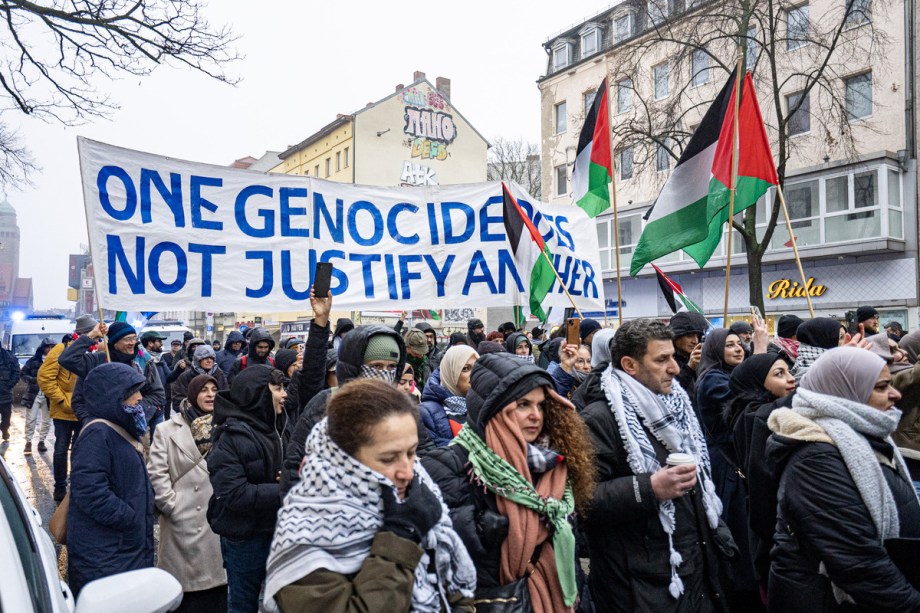
The internationally recognised Lemkin Institute for the Prevention of Genocide has issued severe criticism of Germany. In a statement dated 13th January 2026, it “condemns the persistent efforts by several high-profile German civil society organizations to deny the ongoing genocide in Gaza and to disseminate disinformation and denialist narratives among German political decision-makers.” At the same time, the Institute accuses major German media corporations of having become “the Israeli government’s most loyal mouthpiece”. German policymakers are likewise criticised for turning away from the “international legal order” – an order “that was created in large part due to the horrors it produced”. This refers to Nazi crimes, including the Holocaust against European Jews, the genocide of the Sinti and Roma, and the war of annihilation against the Soviet Union.
Systematic denial of the Gaza genocide
The Institute denounces the fact that, in Germany, the reality continues to be denied that Israel has been responsible for a genocide in the Gaza Strip lasting at least two years since 7th October 2023. This criticism is directed not only at governing parties and senior political figures, but also at Germany’s leading media outlets: “Germany’s largest media outlets have abandoned their journalistic responsibilities, threatening critical voices and effectively becoming the Israeli government’s most loyal mouthpiece.”
According to the report, this systematic denial of genocide is driven primarily by political pressure from above as well as by Israeli lobbying and disinformation efforts. The latter are attributed in particular to the Middle East Peace Forum (NAFFO), the Europe Israel Press Association (EIPA), the German-Israeli Society (DIG), and the European Leadership Network (ELNET), including its Forum of Strategic Dialogue (FSD).
“In this symbiosis, organizations deliver the pseudo-arguments that German politicians rely on to legitimize an otherwise untenable political stance. In return, these organizations are rewarded with public funding or privileged access to Parliament. By financing, platforming, and politically endorsing actors that discredit UN bodies, ignore well-established legal standards, and engage in genocide denial, Germany has turned its back on an international legal order that was created in large part due to the horrors it produced.“
Call for a political reversal
The report points out that both Israel and Germany are currently before the International Court of Justice (ICJ) – Israel accused of genocide, Germany of possible complicity. The latter, in particular, continues to be almost entirely ignored in Germany’s public discourse. Against this backdrop, the Lemkin Institute issues an urgent appeal to German state authorities “to immediately halt all active financing, dissemination, and legitimation of genocide denialist propaganda masked as critical expertise.”
It continues: “We further urge the German government to withdraw public funding and end privileged parliamentary access for organizations and initiatives engaged in genocide denial and the systematic discrediting of international legal institutions. We remind Germany and all its political bodies of their obligations under the Genocide Convention, including the duty to prevent and punish genocide and any forms of complicity. Above all, we call on the German state to end its complicity in the genocide against Palestinians, including through arms exports to and uncritical diplomatic support for the state committing genocide.“
The Lemkin Institute is an internationally active NGO based in the United States. It is named after Raphael Lemkin, a Polish-Jewish jurist and Holocaust survivor who coined the term “genocide.” The Institute’s mission is “to connect the global grassroots with the tools of genocide prevention.” As early as April 2024, the Institute stated that the current Israeli genocide is not confined to the Gaza Strip alone, but affects all of Palestine, including the West Bank.
The views expressed in this article belong to the author and do not necessarily reflect the editorial policy of Middle East Monitor.