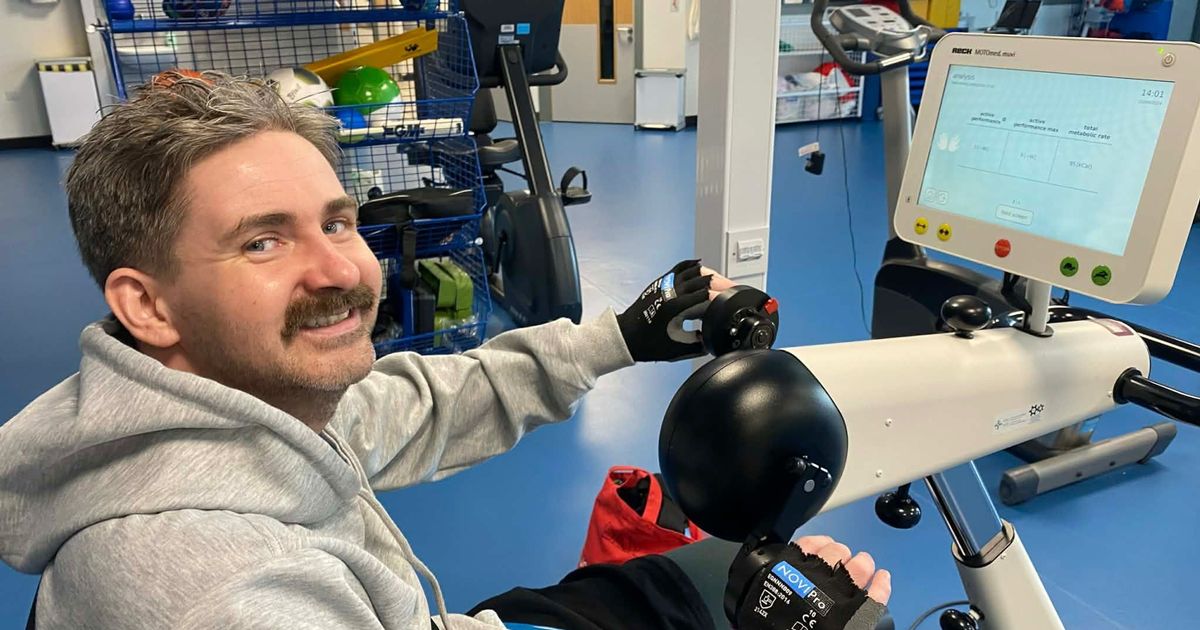
Dan Richards has gone to huge effort and expense to try and get his life back on track, but has now found a way forward in a different country that he hopes will be a complete game changer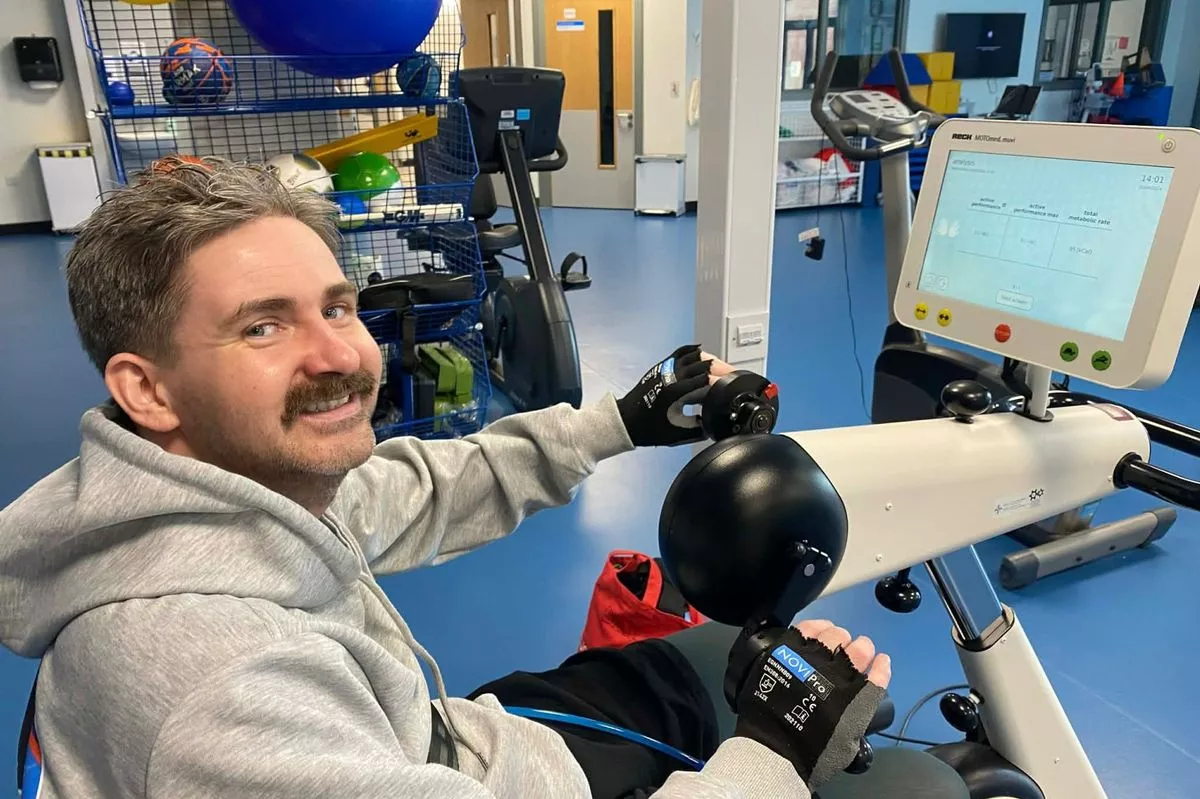
Mr Richards pictured during his physiotheraphy(Image: Anna Thomas)
A Swansea man recovering from a freak accident whilst going on a cold water dip which left him paralysed has described how he decided to take matters into his own hands to enhance his chances of recovery, travelling to Germany and using AI technology in the hopes of being able to walk again.
It has now been just over two years since the life of Dan Richards was completely changed as he knew it. The keen surfer, then aged 35, joined his partner Anna Thomas, her mum Jayne Trew and friend Sharon Nicholson on a trip to Langland Bay on New Year’s Eve to bid farewell to 2023.
As he dived into the water, the wave rotated his body, causing the back of his head to hit the sand, breaking his neck. The former gas engineer heard a loud noise, saw a bright light, then opened his eyes underwater and saw his arms and legs, but had no control over them. Never miss a Swansea story by signing up to our newsletter here.
He was helped to shore by the three ladies and was then airlifted from the beach to Bristol Southmead Hospital. He underwent life-saving treatment for his injuries, including a C5 burst fracture which he said was removed and replaced with a cage, and fractures to C4 and C6 of the spinal cord. He was then moved closer to home at Morriston Hospital.
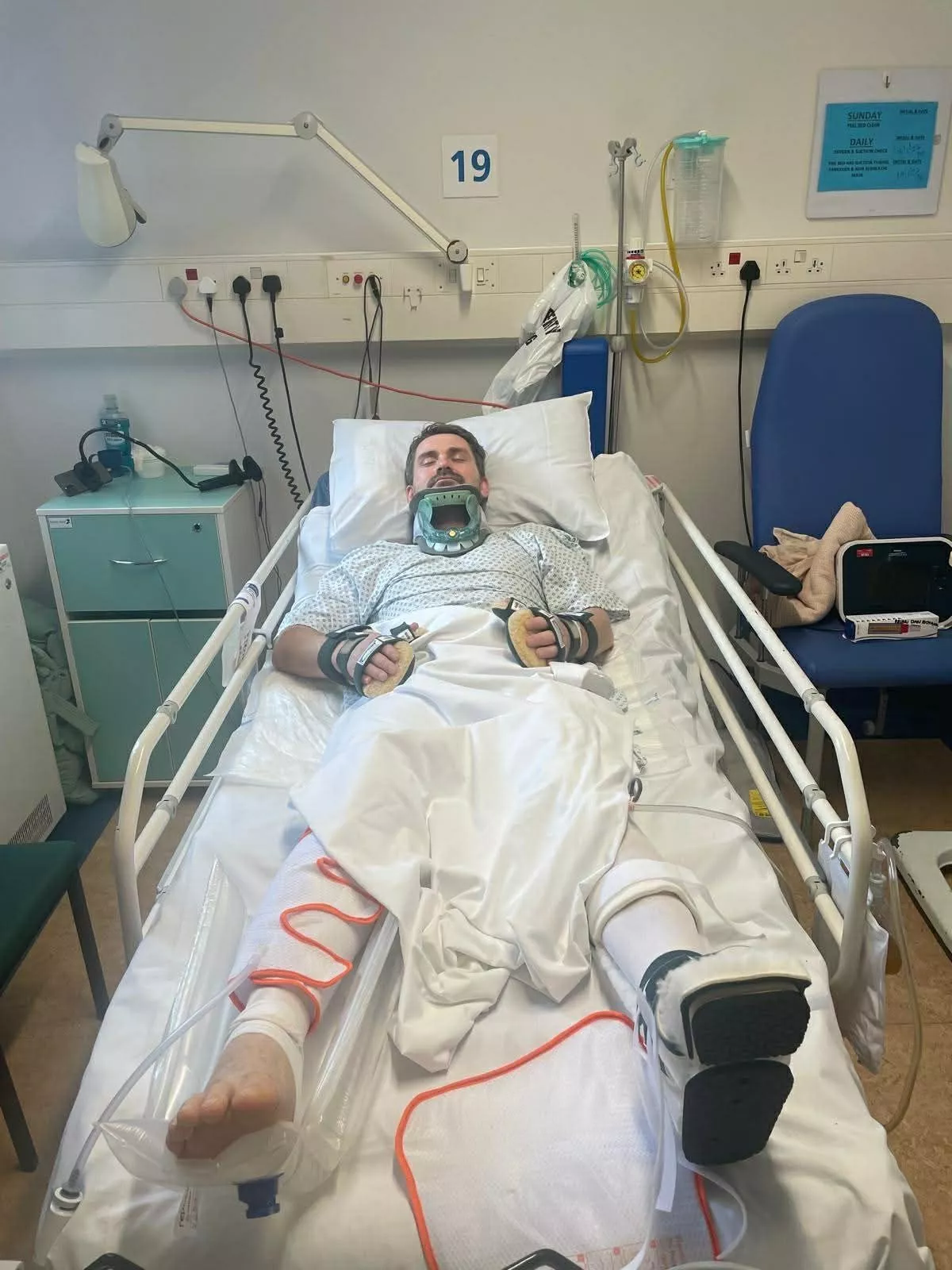
Dan Richards pictured in hospital after the accident on New Year’s Eve 2023(Image: Anna Thomas)
Mr Richards was then transferred to long-term rehabilitation facility Llandough Hospital in Cardiff, to be treated at a specialist spinal unit, but found himself having a poor spell of health, experiencing illnesses, including coronavirus and pneumonia, ending up back in intensive care for a period of time, delaying the start of his rehabilitation.
At the hospital, doctors told Mr Richards his injury was severe, and that it would be “a lot of hard work ahead to regain anything.” Undergoing physiotherapy five days a week for an hour at a time, he began making what he described as “semi-good progress” over the course of three months, but he wanted to increase his recovery prospects.
“I quickly realised I wasn’t getting enough input at that point,” he said.
“I had regained quite a bit of strength, and I needed more, but due to constraints with everybody in the hospital, I could only have one hour a day.
“At that point, we had set up a GoFundMe, the link had been shared, and we raised money for me to go to a private physio. After eight months, we started having talks with the hospital about me discharging early, which they were a bit dubious about, but when it got to nine months, I told them I would be leaving.
“At the end of nine months, I left, came home, got everything in place, and then I went to Morrello, a rehabilitation facility in Newport, where I was able to go there four days a week, for four to five hours a day. It meant I was doing more there in a day than I was in a week in hospital. It is a huge difference and that’s all thanks to people helping and donating.”
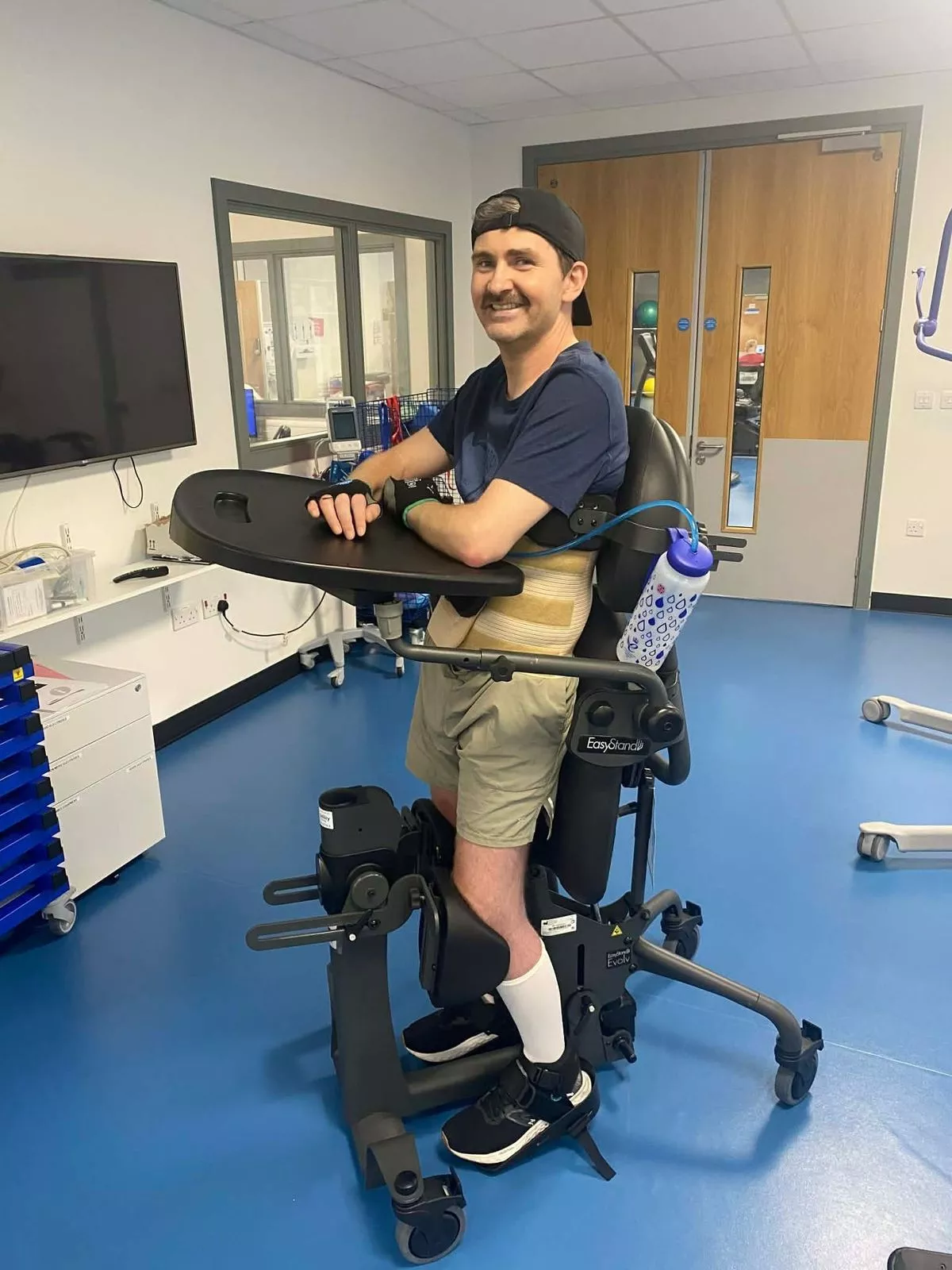
Mr Richards has been on the long road to recovery(Image: Anna Thomas)
Whilst at Morello, Mr Richards got to use an exoskeleton for the first time, which is a wearable robotic device designed to assist patients with walking and movement. This was combined with NeuroSkin trousers, which are an AI-powered smart garment with embedded electrodes that people with mobility issues regain walking ability by delivering personalised electrical stimulation to muscles, mimicking natural movement.
“It was the first time those two technologies had been put together, powered by AI, and I started to see progression from that,” the now 37-year-old said.
“Unfortunately, with technology and equipment so advanced, it comes at a high price tag, and all of the funds we raised, we started to burn through very quickly.
“I started in Morello in October (2024) and by January (2025), we had gone through around £30,000.”
Despite the huge cost, Mr Richards had seen great progression whilst using the technology, regaining the use of one of his hands, practical use of both arms, and an improvement on his core and trunk stability.
“I also started to move the toes on my right foot, and I could move my foot a little bit,” he said.
“They said they could feel flickers in my right leg and in my glutes, which was huge, as I was told all of that was gone.
“The money had started to dwindle, and unfortunately my health took a bit of a turn at that point, I came down with a pressure sore which got quite bad, and stopped me going to physio. On top of that, I was going to a charity called Sandville in Bridgend, and they had a physio there and PT volunteers, which were fantastic, and I was going to hydrotherapy there and using their gym, which helped immensely. They were fantastic there and deserve a lot of praise.
“I also had to stop going there. At that point, I started doing some research into what I could do, and I made a discovery.”
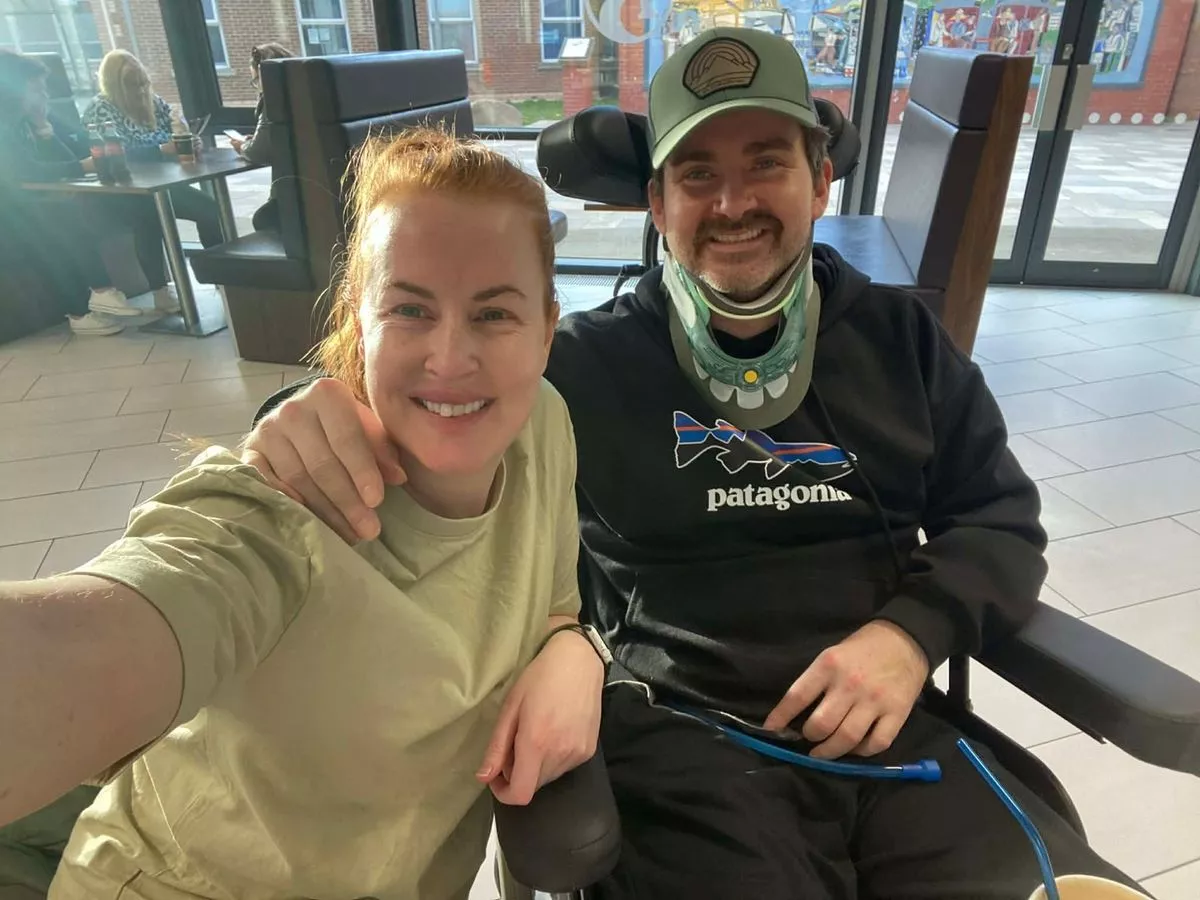
Mr Richards has had the support of his partner, Anna Thomas, every step of the way(Image: Anna Thomas)
Mr Richards discovered that a stem cell treatment was being carried out in Germany, combined with a different type of exoskeleton. He spoke to his physios at Morello about it, and they did not discourage him from doing it.
He said: “I thought, nothing ventured, nothing gained, and so I contacted the German company, set up a meeting via Zoom, went through all the details, and once I was fit enough in June last year, me and my partner drove out to Germany and had a trial in their exoskeleton, which is called a HAL suit, which is an exoskeleton picked up by brain waves.
“It picked up signals from my brain sent to my legs, and the impulse is picked up on the skin, and the exoskeleton translates that signal into movement in the correct muscle group, and then sends the signal back to the brain to say the movement has been completed, which is called a feedback loop.
“By the fourth session, I was starting to get some movement, and that was very, very promising, and I was told that the suit would be able to help me long-term.
“From there, I went to another clinic in another part of Germany, for the second part of treatment, which was stem cell. They removed cells from my body, incubated them, and turned a few hundred cells into a few thousand, with the aim that I would go back out, undergo an injection into my spinal chord every Friday, rest at the weekend, and then go Monday to Thursday using the HAL suit, so they could try and repair my body’s motor function and neuro pathways hopefully with the stem cell.
“We had to start fundraising again to get back out to Germany, as this amazing treatment came at a very high price, and so I took out loans and fundraised, until I went back out there, to Bochum, in October and stayed there until Christmas.
“I did the first stage of the treatment, which took around ten weeks, and I’ve got to go back out again for a further six weeks to finish.”
Discussing the moment he first discovered the technology was available, Mr Richards described it as “a bittersweet moment.”
He said: “From being told, this is what I was left with, and there was nothing available and that I would have to accept life in a wheelchair, to coming across this technology, it was amazing. This could really make a big difference to me and a lot of people like me.
“You get that immediate high, but then reality sets in that it’s in another country, and that it’s going to be a very long process, and then you get hit with the costs. To use the suit, with stem cell combined, is around £45,000, and you are forced to weigh up, how much will this cost, what will it do, but we decided anything I could regain was worth it, and left no stone unturned.
“It’s a shame. This technology is not available in the UK, but in Germany, it is provided as part of their healthcare. Myself and my partner have tried to put this out there on social media that there are avenues out there and that you don’t just have to take what you are told by the doctors.”
Over the course of the ten-week treatment, Mr Richards regained more functional movement in his arms, considerably more function in his core, autonomic functions “to a high degree”, and the signals and movements in his legs increased considerably over the course of time he was there.
“I had a lot more control in the suit and could do a lot more,” he said.
“Day to day, I use both my hands now – I can make myself a cup of tea now, I can eat, I can do a lot of normal functions with my hands, like picking things up, putting things down, using my phone, all those sort of things. I am able to propel in a manual wheelchair instead of electric, my blood pressure has improved dramatically, so I can use a standing frame at home now, there’s been many other changes – strength, muscle tone, but those are the main ones.
“When I first started to get my fingers moving and my arm moving, it was tiny movements, we’re talking a couple of millimetres, and I could feel it but couldn’t even see it, but it a surreal moment. Surreal, but I knew it was going to happen. At no point did I think I wasn’t going to get anything back and that it wasn’t going to work.”
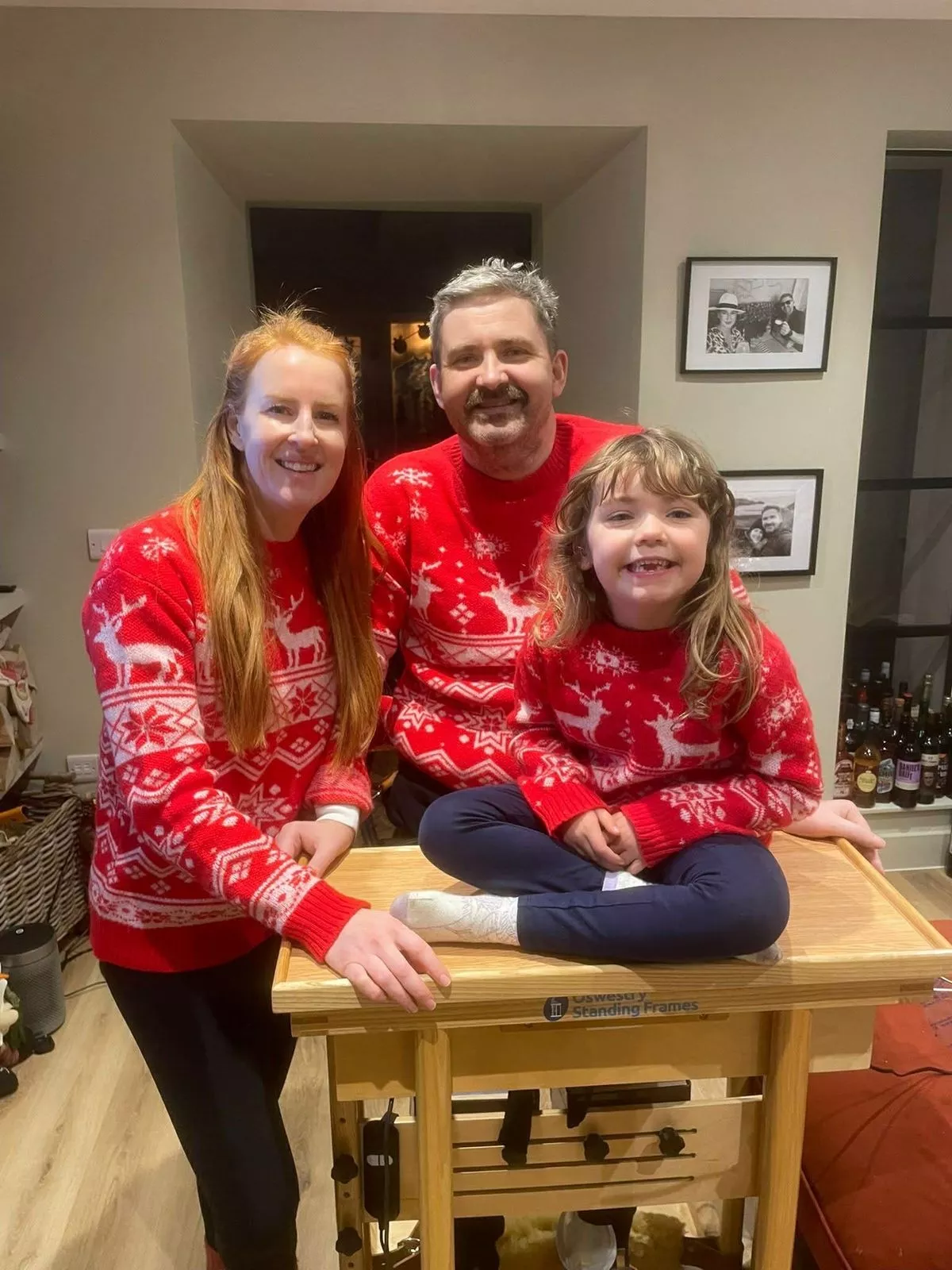
Mr Richards pictured with his partner Anna Thomas and daughter Hailey(Image: Family of Dan Richards)
The Waun Wen, Swansea resident shared exactly what had kept him so determined during the course of his recovery.
“Family,” he said.
“My partner, my family, my daughter, I have got to recover the best I can for them. I am determined to never give up. We’ve had a lot of setbacks, and quite a lot of things have gone wrong along the way.
“At the moment, my latest challenge is that I can’t get back out to Germany to complete the treatment because I need to get a long-stay medical Visa which has slowed down me getting back out there. We’ve applied to the Germany embassy and hope to be there at the end of February.
“I’m hoping by the end of this programme that I will have a bit more movement in my legs, but I’m hoping to do another cycle with the suit only, without the stem cell, in future. There’s been people in situations like mine who have been able to walk again unaided after it. That’s the goal.
“Christmas was very busy as we didn’t get back until the 16th, but I had a moment to reflect on the things I can do with my hands and upper body, compared to the summer, is very different. I’m very proud of how far I’ve come and what we’ve been able to achieve, but there’s a lot more to come and a lot more to do.
“My ambition is just to get back out to Germany and continue the treatment as soon as possible.”
You can help Mr Richards raise money to cover the cost of his treatment in Germany by donating via his GoFundMe page by clicking here.
Get Swansea news updates on your phone by joining our WhatsApp community here. We occasionally treat members to special offers, promotions and ads from us and our partners. See our Privacy Notice.