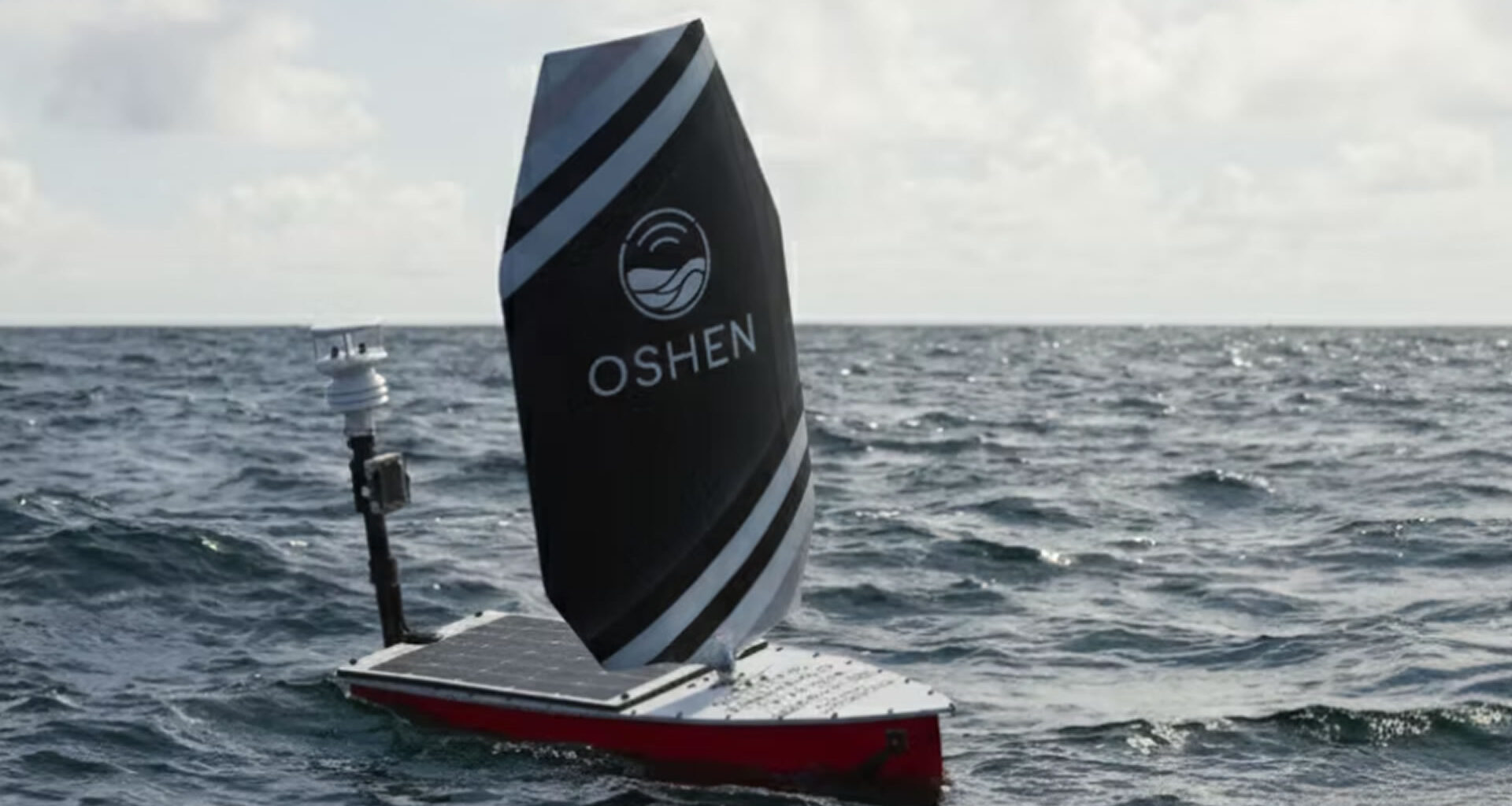
UK-based oceangoing drone manufacturer Oshen has made history by collecting live data from inside a Category 5 Hurricane at sea for the first time. This feat has now managed to catapult the company’s profile and attract new potential governmental and defence industry customers.
The company was founded by Anahita Laverack, who initially attempted to build small autonomous sailing robots to cross the Atlantic. Unfortunately, this failed, but it helped her realise that the real problem wasn’t engineering, it was a lack of real-world ocean data.
Done for the Microtransat Challenge, most other entrants failed because their robots were too small, not designed for brutal ocean conditions, or the technology wasn’t tough enough to survive.
This led her to found Oshen, which now focuses on building small, cheap, long-lasting oceangoing robots that can survive extreme weather conditions and collect data.
Oshen’s small and expendable drones for science
“I realized half the reason that all of these attempts were failing is, number one, obviously it’s hard to make micro-robots survive on the ocean,” Laverack explained to TechCrunch. “But number two, they don’t have enough data on the ocean to know what the weather is or even know what the ocean conditions are like,” she added.
To this end, she realized that such robots actually need to know what they are sailing into. As such, they generally lack real-time ocean condition data, accurate weather data at sea, and feedback loops to adapt mid-mission.
In other words, such robots weren’t just fragile, they were also effectively blind. When attempting to solve this, she discovered that no one had solved ocean-scale data collection properly.
She also found that governments, researchers, and defence groups wanted that data, and some were even willing to pay her directly to try collecting it. This led to the development of C-Stars, Oshen’s preeminent autonomous small sailing robots.
These robots are able to operate in swarms and can survive at sea for up to 100 days at a time. They are relatively cheap but smart enough to collect useful environmental data in real-time.
After research and development and validating the technology in real-world adverse weather conditions at sea, the Oshen founders were approached by the National Oceanic and Atmospheric Administration (NOAA) to attempt to collect hurricane data.
Hurricane data is highly prized
And so, in 2025, NOAA commissioned Oshen to deploy a test fleet of C-Stars into the path of Hurricane Humberto. Oshen deployed five of its drones, three of which were able to survive the ordeal and retrieve valuable data.
Oshen’s drones could become highly prized as they can now help improve weather prediction models, naval awareness, and help scientists better understand certain aspects of climate science.
It could also prove valuable for remote sensing without risking manned crews and offer persistent surveillance without satellites. Being cheap and expendable, Oshen’s tech has now landed UK government contracts and has potential interest for defense companies too.
The company is now looking to raise venture capital to scale up its operations in Plymouth, England.