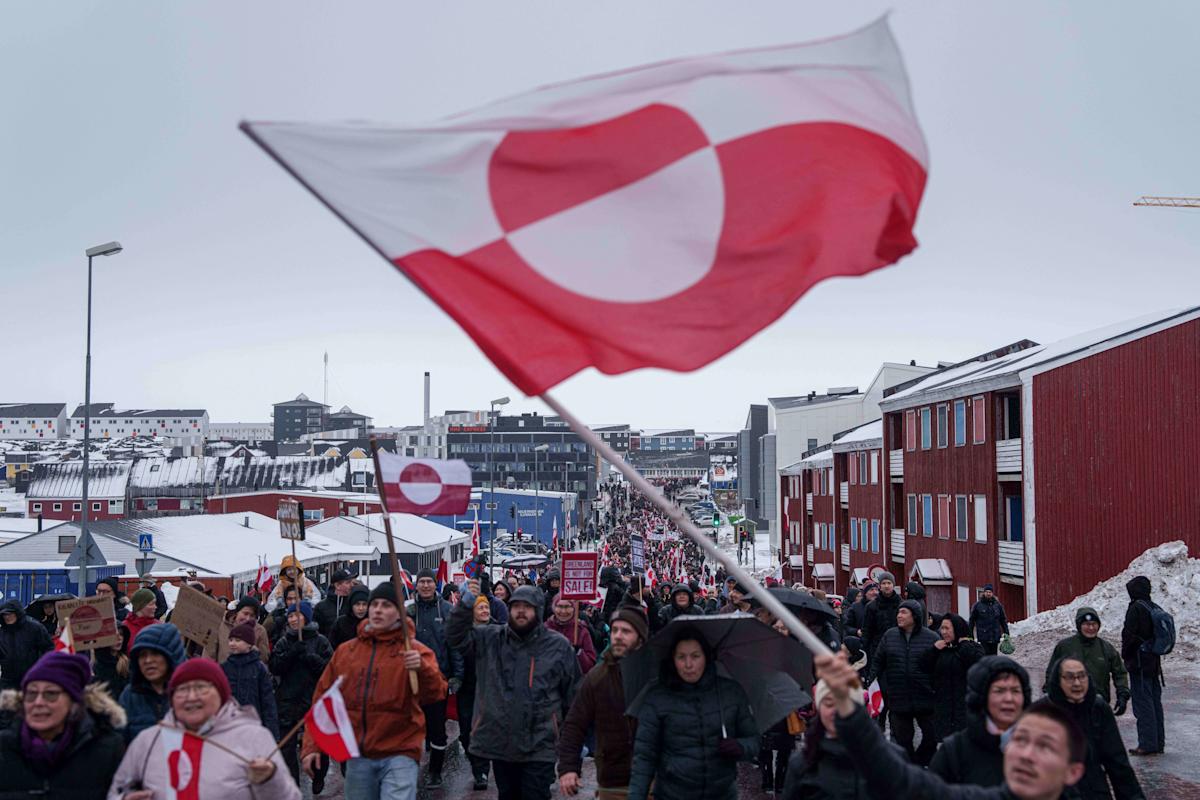
The FTSE 100 (^FTSE) and European stocks fell at the opening bell on Tuesday, as traders digest the latest developments in president Donald Trump’s bid to control Greenland.
Trump wrote on social media that the UK’s move to hand over the Chagos Islands to Mauritius was an “act of great stupidity” and that it had made the US’s acquisition of Greenland imperative.
“There is no doubt that China and Russia have noticed this act of total weakness. These are International Powers who only recognize STRENGTH, which is why the United States of America, under my leadership, is now, after only one year, respected like never before,” he wrote.
Britain’s Chagos agreement, signed in May last year, was conditional on retaining control of a strategic UK-US military base on Diego Garcia. The Trump administration had previously given public support for the deal.
Meanwhile EU leaders continue to try to reason with Trump, who published a text message he received from french president Emmanuel Macron and floated a 200% tariff on champagne.
“I do not understand what you are doing on Greenland,” Macron wrote. He also proposing a G7 meeting – after the World Economic Forum in Davos – with Danish, Ukrainian and Russian representatives attending on the margins.
Macron has reportedly declined a position on Trump’s Board of Peace.
Trump has also threatened to impose new tariffs 10% tariffs on a set list of European nations, beginning on 1 February and applying to “any and all goods sent to” the US.
The levies on Denmark, Norway, Sweden, France, Germany, the UK, the Netherlands and Finland would be raised to 25% on 1 June if no agreement is in place.
Gold, an asset investors tend to flock to as a haven in times of risk, rose to new all-time highs, with futures prices (GC=F) up 3% as markets opened in Europe.
-
The FTSE 100 fell 0.8% after the opening bell. Luxury retailer Burberry (BRBY.L) was the top faller in the index in early trade, down more than 2.8%. Luxury stocks are sensitive to tariff policy.
-
The DAX (^GDAXI) in Germany dipped 0.8% ahead of the latest ZEW economic survey reading.
-
The CAC 40 (^FCHI) in Paris declined 0.7%.
-
The pan-European STOXX 600 (^STOXX) sold off 0.7%.
-
The pound rose 0.4% against the dollar (GBPUSD=X) to just below the $1.35 mark.
LIVE 16 updates
- Bank of England’s Bailey says policymakers must stay ‘alert’ amid Greenland tensions
Pedro Goncalves writes:
Bank of England governor Andrew Bailey warned that officials “have to remain very alert” to rising geopolitical tensions, stating that growing uncertainty around global politics and trade poses a significant risk to financial stability.
Appearing before parliament’s Treasury Committee, Bailey was questioned about the potential economic fallout from escalating geopolitical disputes, including US president Donald Trump’s recent threats to annex Greenland and impose new tariffs on European countries. Bailey avoided commenting on Greenland directly, instead pointing to the BoE’s latest financial stability assessment.
The BoE’s December financial stability report concluded that risks to the financial system had increased over the past year, despite markets remaining relatively calm. Bailey told MPs that geopolitical developments were a key factor behind that assessment.
“I do think that geopolitical tensions and particularly trade issues, are an important part of that,” he said. “Now, that does not mean to say that I want say that any particular issue is trigger. But the level of geopolitical uncertainty, and the level of geopolitical issues, is obviously a big consideration because they can have financial stability consequences.”
- Dollar index dips almost 1%
The dollar index, which tracks the greenback’s value against a basket of six major foreign currencies (Euro, Yen, Pound, Canadian Dollar, Swedish Krona, Swiss Franc) is plumeting this afternoon:
- Oil prices slip
Vicky McKeever writes:
Oil prices slipped on Tuesday morning, as Trump’s tariff threat over Greenland reignited trade war fears.
Brent crude (BZ=F) futures declined nearly 1% to $63.51 per barrel at the time of writing, while West Texas Intermediate futures (CL=F) fell 0.8% to $58.87 a barrel.
Trump’s threat to implement new tariffs, and a potential retaliation from the Europe, has renewed concerns about the economic impact of a trade war.
- GSK deal sends stock lower
AJ Bell investment director Russ Mould, said:
- Stocks to watch at the opening bell: Netflix
Pedro Goncalves writes:
Shares in Netflix (NFLX) were little changed in pre-market trading on Tuesday as investors awaited the streaming group’s fourth-quarter results, due later in the day.
Revenue is expected to have risen 16.82% in the October to December period to $11.97bn (£8.90bn), slightly slower than the 17.2% growth recorded in the previous quarter, according to data compiled by LSEG. Analysts forecast revenue growth of about 13% for Netflix in 2026.
Although the company stopped disclosing subscriber numbers a year ago, Visible Alpha estimates net additions of about 10 million, taking total users to more than 327 million by the end of the year.
Tuesday’s earnings call will be Netflix’s first since it announced a deal on 5 December to buy Warner Bros.
“The earnings will be overshadowed by what Netflix says about the deal … what’s next and the questions around it,” said Paolo Pescatore, an analyst at PP Foresight.
Netflix is seeking to accelerate revenue growth through the acquisition of Warner Bros (WBD), a move that would make it the world’s largest streaming platform with about 428 million subscribers. Its $82.7bn pursuit of Warner Bros’ streaming and studio assets would give Netflix access to a sought-after content library that includes Friends, Game of Thrones and Harry Potter.
The company is facing competition from Paramount Skydance (PSKY), which has offered $108.4bn for all of Warner Bros Discovery, including cable television assets that Netflix does not want.
- First-time buyers in London need twice the UK average deposit
Pedro Goncalves writes:
First-time buyers in London need a 10% deposit of around £44,800 to buy a typical home – more than double the UK average of £23,000 and over three times the amount required in parts of northern England or Scotland, according to Nationwide.
Buyers in the North East would typically need £13,100, while a 10% deposit in Scotland would be about £13,900 and in Yorkshire & the Humber £15,400.
At current saving rates of 10% of average net pay, around £320 a month, it would take nearly six years for a typical UK buyer to accumulate a 10% deposit of £23,000. In London, the same target would take about nine years, compared with four years in the North.
“Even based on saving 10% of average net pay, it would take a prospective buyer nearly six years to accumulate this,” said Andrew Harvey, Nationwide’s senior economist. “However, the level of deposit required also varies considerably by region, reflecting differences in average house prices.”
- DFS stock jumps as it lifts profit outlook
Sofa chain DFS Furniture (DFS.L) has lifted its profit outlook after reporting sales growth and launching its important winter promotions.
The furniture business, which is listed in London, said it was “utilising data” to help drive more orders across its brands.
It revealed a 2.3% increase in orders over the six months to December 28, compared with the same period last year, with both the DFS and Sofology brands seeing growth.
Gross sales, which are calculated once orders have been delivered to customers, are expected to be up by nearly 9% across the year.
The winter sale trading period started how the business expected it to, DFS told investors.
Promotions and accompanying national marketing activities, including TV adverts, are a key driving force for DFS’s yearly sales as it offers discounts on sofas and furniture.
Underlying pre-tax profits for the first half are expected to be around £30m to £31m, up to £14m more than the same period last year.
DFS cautioned that the macroeconomic and consumer outlook remains hard to predict after a period of weakness with consumers widely reported to be tightening budgets and holding off on big purchases.
- Rate cut still unlikely in February: PwC
Jake Finney, senior economist at PwC UK, said:
- Unemployment could peak in Autumn
Debapratim De, director of economic research at Deloitte, said:
- Job growth stagnation: AI or something else?
Jarek Sklodowski, head of UK Trading at Financial Markets Online, said:
- UK unemployment remains near five-year high and wage growth slows
Vicky McKeever writes:
UK unemployment remains at nearly a five-year high, while wage growth has continued to slow, according to the latest data from the Office for National Statistics (ONS).
The rate of UK unemployment was stood at 5.1% in September to November, which was unchanged from the previous three months.
Annual growth in average earnings, excluding bonuses, was 4.5% in September to November, which was down from 4.6% for the previous three months.
The estimated number of payrolled employees in the UK fell by 155,000 in the year to November and declined by 33,000 on the month.
An early estimate for payrolled employees in December showed a 184,000 fall on the year and a 43,000 decline month-on-month.
Meanwhile, early estimates for the number of job vacancies in the UK suggested a small increase of 10,000 for October to December.
- Here’s the US stock futures chart
- US stock futures lower after holiday break
From our US team:
US stock futures slid Tuesday morning, signaling a rocky return to trading as President Trump escalated trade tensions with Europe over Greenland, reviving tariff fears just as Wall Street heads into earnings season.
Dow Jones Industrial Average futures (YM=F) fell 1.1%, pointing to a drop of around 550 points at Tuesday’s open. S&P 500 futures (ES=F) slipped 1.2%, while Nasdaq 100 futures (NQ=F) sank just over 1.4%.
The moves followed Trump’s weekend announcement that the US will impose sweeping tariffs on imports from eight NATO countries unless they agree to negotiations over the “complete and total purchase of Greenland.” In response, Europe has discussed up to $108bn in retaliatory tariffs, with a potential fallout of some $8 trillion.
In a Truth Social post on Saturday, Trump said US tariffs against the EU would begin at 10% on Feb. 1 and climb to 25% by June 1. European officials quickly condemned the threat as “unacceptable.” Adding to the intrigue this week, Trump will speak at the World Economic Forum in Davos, Switzerland, on Wednesday.
- Good morning!
Hi from London. Another day — another geopolitical drama.
On the slate:
-
The World Economic Forum in session from Davos (all week)
-
UK jobs data (already published — more to come on the blog)
-
Germany’s ZEW economic sentiment indicator
In terms of earnings and company updates, expect some noise from:
UK: Watkin Jones (WJG.L), Kromek (KMK.L), Rio Tinto (RIO.L), Cranswick (CWK.L) Interactive Brokers (IBKR), DFS Furniture (DFS.L)
US: Netflix (NFLX), US Bancorp (1USB.MI), DR Horton (DHI), 3M (MMM), United Airlines (UAL)
Let’s get to it.
-